
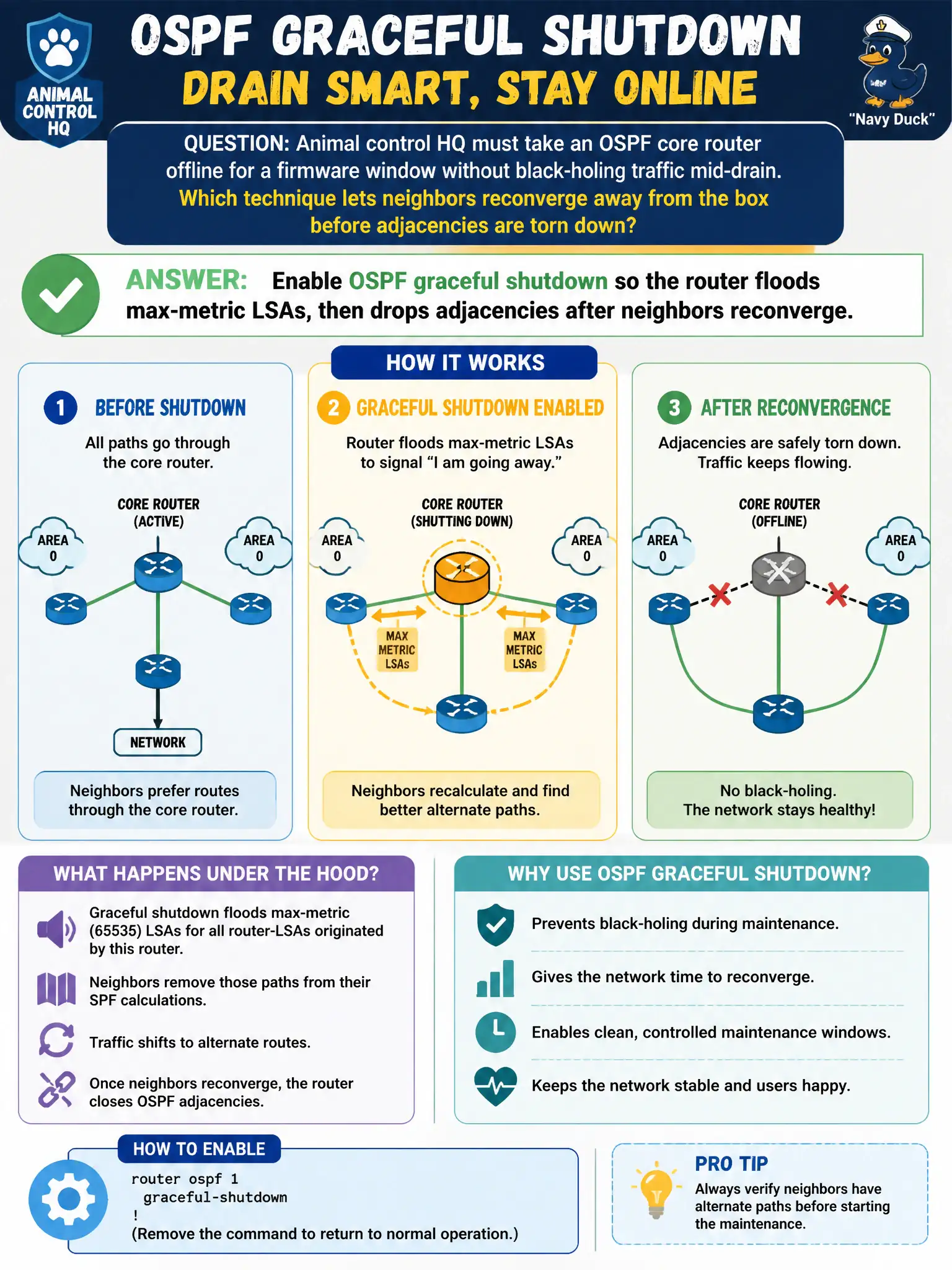
Animal control HQ must take an OSPF core router offline for a firmware window without black-holing traffic mid-drain. Which technique lets neighbors reconverge away from the box before adjacencies are torn down?
Select an answer to reveal the explanation.
Short Explanation
Picture the HQ router as a busy highway off-ramp you’re closing tonight. Graceful shutdown first posts ‘detour’ signs (max-metric LSAs) so cars leave the ramp, then it closes the gate. A hard process clear just yanks the ramp with traffic still on it.
Full Explanation
OSPF graceful shutdown floods router LSAs with maximum metrics so neighbors recompute paths away from the device before adjacency teardown. Animal control HQ taking a core router offline for firmware should enable graceful shutdown so the router advertises max-metric LSAs, then drops adjacencies after neighbors reconverge. That ordered drain avoids transient black holes during planned maintenance on the civic core.
Clearing the OSPF process with a hard reset so neighbors rebuild from an empty LSDB immediately maximizes disruption rather than draining traffic first. Lowering Hello and Dead timers to sub-second values only on the maintenance router changes detection speed, not pre-teardown diversion of traffic. Advertising a default with AD 1 toward the maintenance router attracts traffic to the box being removed—opposite of drain intent.
Exam caveat: allow time for SPF elsewhere after max-metric floods before yanking power; graceful shutdown is the controlled offline pattern, not an instant power pull. Operational check: enable graceful shutdown, watch neighbors install alternate next hops, confirm traffic leaves the maintenance router, then proceed with reload once forwarding has drained.