
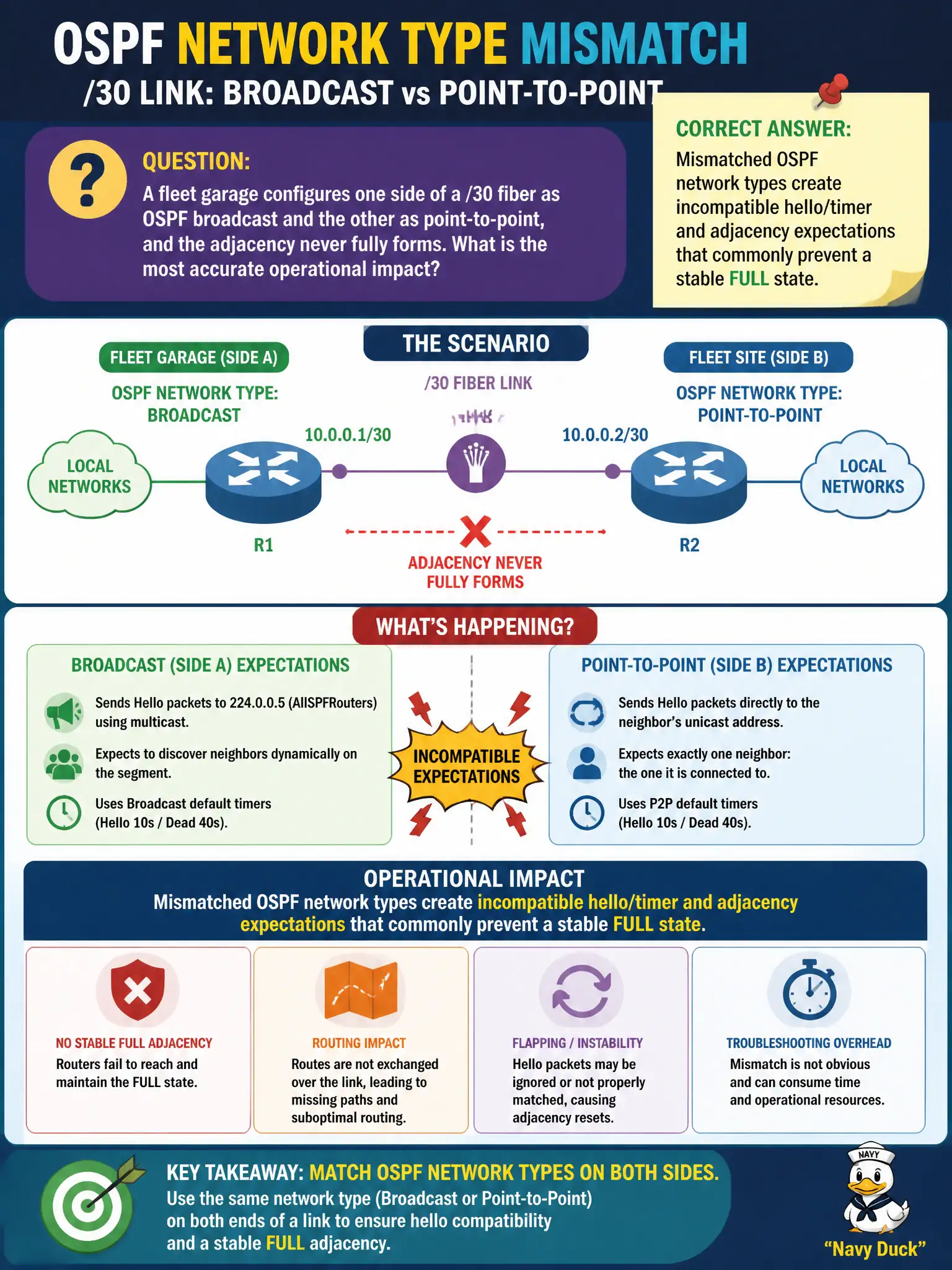
A fleet garage configures one side of a /30 fiber as OSPF broadcast and the other as point-to-point, and the adjacency never fully forms. What is the most accurate operational impact?
Select an answer to reveal the explanation.
Short Explanation
Broadcast expects a DR party; point-to-point expects a simple two-router handshake—and their hello timers don’t even share the same default rhythm. Mix them on a /30 and the adjacency often never settles. Match the network type on both ends.
Full Explanation
OSPF network types dictate hello and dead timers, DR/BDR behavior, and adjacency rules. When a fleet garage configures one side of a /30 fiber as OSPF broadcast and the other as point-to-point, timer and DR-election expectations diverge and commonly prevent a stable FULL state. Mismatched OSPF network types create incompatible hello and adjacency expectations that operators must correct by aligning types—usually point-to-point on pure /30 fiber links that have no multi-access neighbors.
Network-type mismatch is not ignored with only Router ID collisions able to stop adjacency. The mismatch does not automatically convert both sides to EIGRP named mode. Claiming that timers diverge but adjacency always reaches FULL anyway understates how often mismatched broadcast versus point-to-point configurations fail to form or remain FULL in production.
Exam caveat: matching hello and dead values alone may not fix broadcast versus point-to-point if DR expectations still disagree; set both sides to the same network type deliberately and consistently. Operational check: show ip ospf interface on both ends, align network type, clear the adjacency, confirm FULL, and document the standard network type for civic /30 fiber handoffs.