
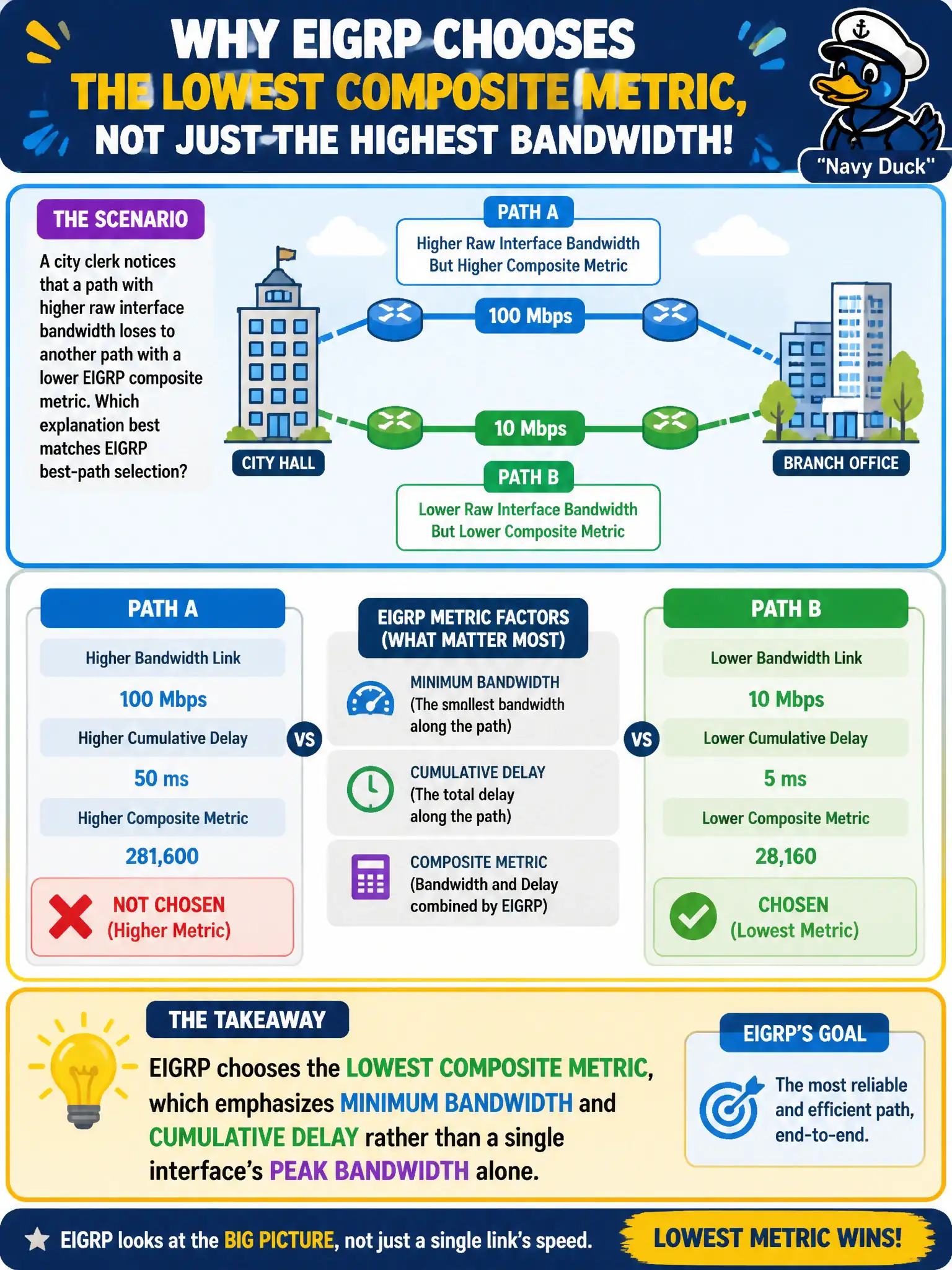
A city clerk notices that a path with higher raw interface bandwidth loses to another path with a lower EIGRP composite metric. Which explanation best matches EIGRP best-path selection?
Select an answer to reveal the explanation.
Short Explanation
EIGRP doesn’t crown the link with the flashiest sticker speed—it scores the whole hike using the worst bandwidth hop and the delay pile-up. A “faster” NIC can still lose if the path’s composite score is worse. Look at the calculated metric, not one interface’s brochure number.
Full Explanation
EIGRP best-path selection uses a composite metric that, by default, is heavily influenced by the minimum bandwidth along the path and the cumulative delay. A city clerk noticing that a path with higher raw interface bandwidth loses to another path with a lower composite metric is seeing that behavior: a single high-bandwidth hop does not guarantee the lowest metric if other hops or delay dominate. The successor is the lowest composite metric path among loop-free candidates.
EIGRP does not select solely by hop count with bandwidth and delay ignored. It does not always prefer the path with the largest configured variance regardless of metrics—variance only widens which feasible successors may share load after the successor is chosen. It does not install every loop-free path equally while ignoring composite metric differences; unequal-cost sharing is controlled and still metric-based.
Exam caveat: K-values must match between neighbors; classic wide metrics change scaling but not the conceptual role of bandwidth and delay. Operational check: show ip eigrp topology for the prefix, compare computed metrics and reported distances, identify which link’s delay or bottleneck bandwidth drives the winner, and avoid equating “faster NIC” with “best EIGRP path.”