
A housing authority dual-homes a staff VLAN behind two first-hop routers and must keep DHCP, time sync, and gateway failover coordinated during maintenance. Which integration best supports clean failover?
Select an answer to reveal the explanation.
Short Explanation
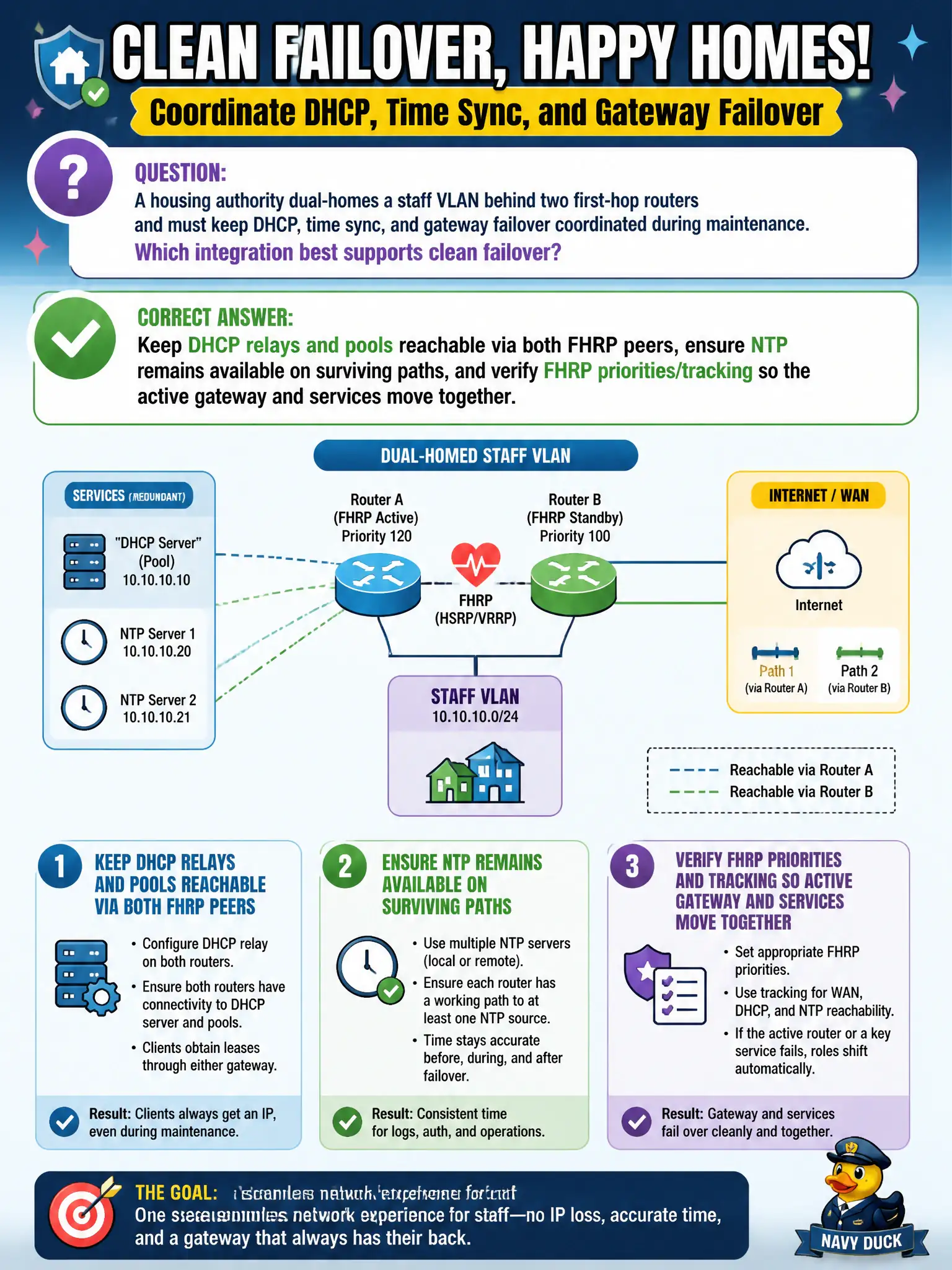
Failover is a three-legged stool: gateway (FHRP), addresses (DHCP), and clocks (NTP). If one leg is glued to the router you are about to shut down, tenants fall over. Design so relays, time sources, and HSRP/VRRP tracking move with the surviving path.
Full Explanation
Housing-authority staff VLANs dual-homed behind two first-hop routers need DHCP, NTP, and gateway failover to move together during maintenance. Keeping DHCP relays and pools reachable via both FHRP peers, ensuring NTP remains available on surviving paths, and verifying FHRP priorities/tracking so the active gateway and services move together is the integrated approach. Service reachability must survive with the VIP, not die with the former active chassis.
Pinning DHCP and NTP exclusively to the lower-priority FHRP router so they never move creates a dependency on the standby path. Disabling FHRP and hoping hosts discover gateways via gratuitous ARP storms alone is fragile. Placing the only DHCP server on a switchport that dies when the active gateway fails couples addressing to the failure domain.
Exam caveat: tracking should reflect uplink or critical service reachability, not only interface up/down on a single SVI. Operational check: fail the active gateway in a window, confirm VIP movement, DHCP renew/new lease success, and NTP reachability from a staff client, then restore and document timers. Housing operations should treat DHCP/NTP as first-class dependents of FHRP design reviews.