
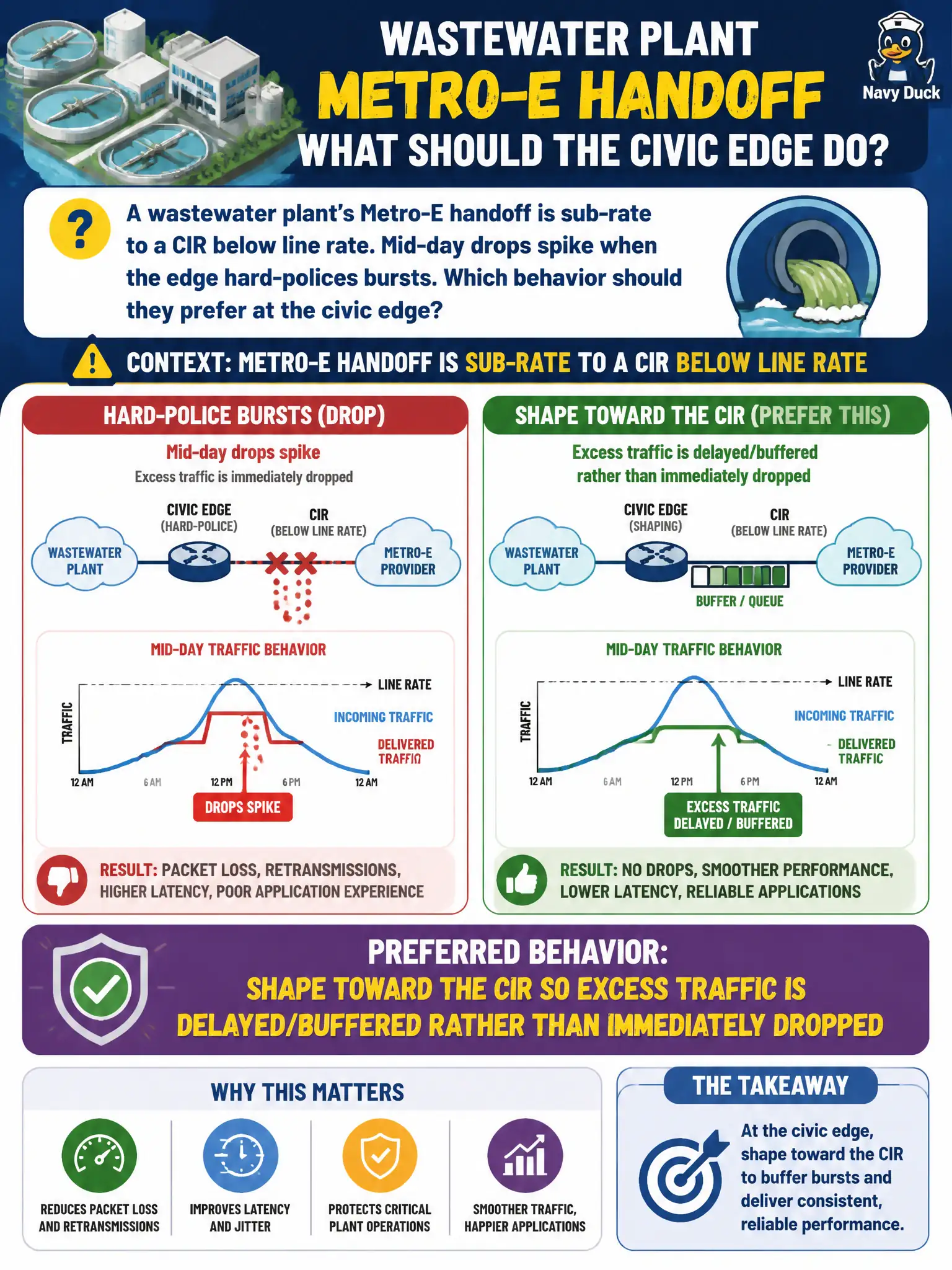
A wastewater plant’s Metro-E handoff is sub-rate to a CIR below line rate. Mid-day drops spike when the edge hard-polices bursts. Which behavior should they prefer at the civic edge?
Select an answer to reveal the explanation.
Short Explanation
Policing is a bouncer who cuts the line; shaping is a velvet rope that makes people wait their turn. On a sub-rate Metro-E circuit, shaping to CIR usually beats slamming drops at noon. Buffer and pace instead of discarding mid-burst.
Full Explanation
When a wastewater Metro-E handoff is sub-rate to a CIR below line rate, hard policing of bursts creates mid-day drops. Prefer shaping toward the CIR so excess traffic is delayed and buffered rather than immediately discarded. Shaping aligns civic egress with the purchased rate while giving TCP and scheduler behavior a chance to absorb bursts more gracefully than a hard dropper.
Policing aggressively to zero with no burst tokens maximizes drops and prevents useful queuing. Disabling all QoS and relying on TCP alone to discover the sub-rate limit still allows the Ethernet interface to run at line rate into a carrier that will police harshly. Policing only voice LLQ while leaving bulk unmarked and unshaped fails to pace the aggregate toward CIR and can still trigger carrier drops that hurt all classes.
Exam caveat: shaping adds latency/jitter under load; voice still needs LLQ inside the shaped hierarchy—shaping replaces reckless policing of the aggregate, not class-aware queuing. Operational check: apply a shaper at CIR on the handoff, generate a controlled burst, compare drop versus delay behavior against the prior policer, and confirm voice stays within delay budgets. Wastewater operators should baseline drop and latency graphs before and after enabling the shaper so the CIR change is evidenced in the change ticket.