
A police records bureau needs one authenticated IP phone plus an attached PC on desk drops, but open conference rooms must allow several devices after the first success. Which 802.1X host-mode pairing fits those layouts?
Select an answer to reveal the explanation.
Short Explanation
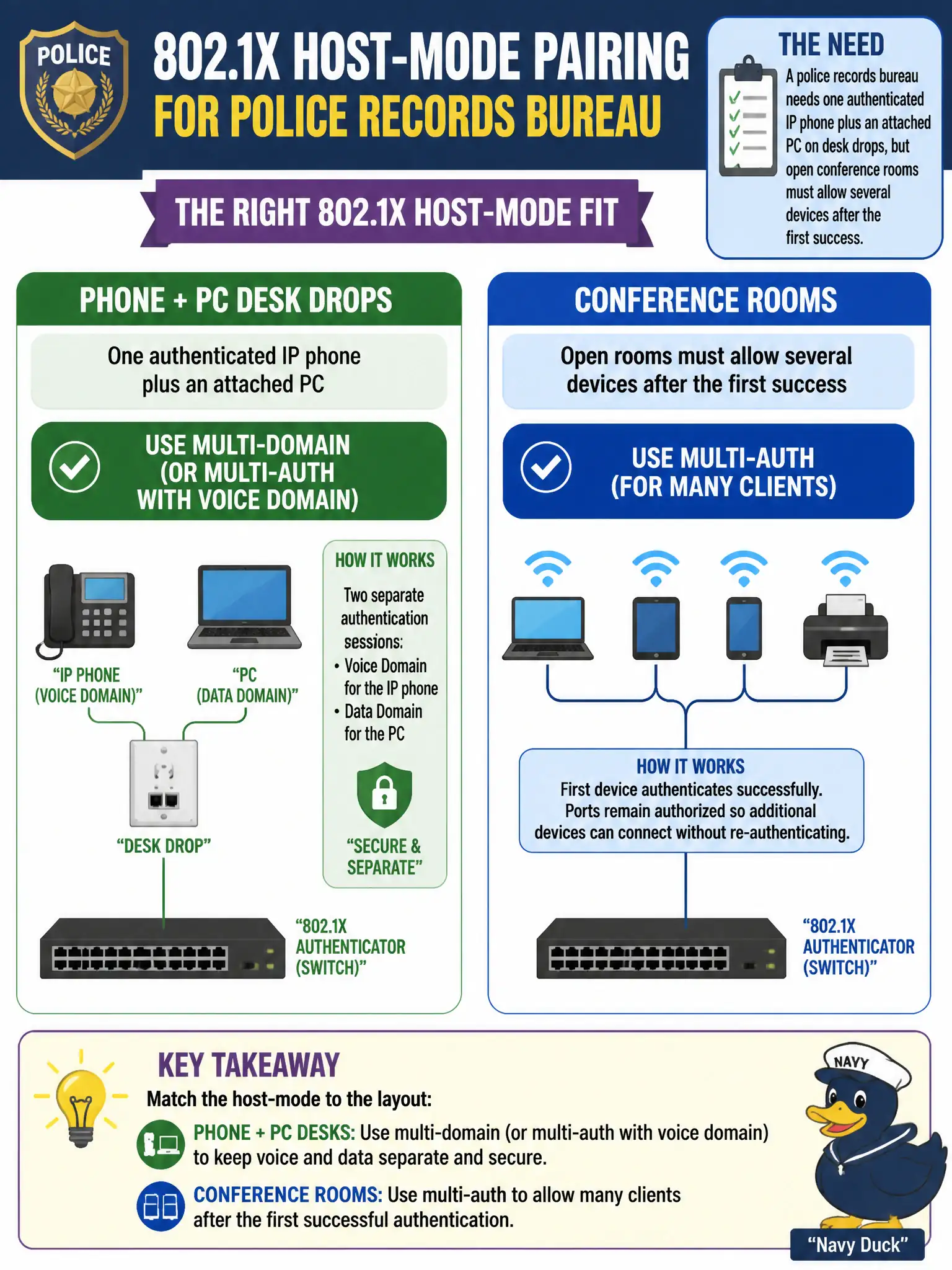
Desk phones with a PC behind them need a mode that understands voice and data domains—or multi-auth with a voice lane—while a conference table is a parking lot of laptops. Multi-domain/multi-auth for desks and multi-auth for rooms matches how people actually plug in.
Full Explanation
Police records desks commonly daisy-chain an IP phone and a PC on one switchport, while conference rooms host many laptops after the first successful authentication. Multi-domain (or multi-auth with a voice domain) fits the phone-plus-PC layout because it separates voice and data domains on the same physical port. Multi-auth fits open conference rooms because it allows several authenticated MACs after the first success. Pairing those host modes to the two civic layouts matches how 802.1X host-mode is actually designed on Catalyst access switches.
Single-host mode for both desks and conference rooms limits the port to one authenticated MAC, which breaks phone-plus-PC desks and multi-user rooms. Disabling 802.1X on desks and relying only on MAC authentication bypass in every conference room abandons strong EAP-based identity where phones and PCs can authenticate properly. Forcing closed mode citywide so failed authentication still grants full VLAN access contradicts closed-mode intent and weakens NAC rather than solving host-mode design.
Exam caveat: product documentation sometimes uses multi-auth with voice VLAN features as an alternative to classic multi-domain; focus on the requirement (voice+data vs many data clients) rather than a single CLI keyword. Operational check: apply multi-domain/multi-auth as designed on a records desk and a conference port, authenticate phone and PC or multiple clients, and verify authorized VLANs and dACLs match ISE policy before expanding to the bureau floor.