
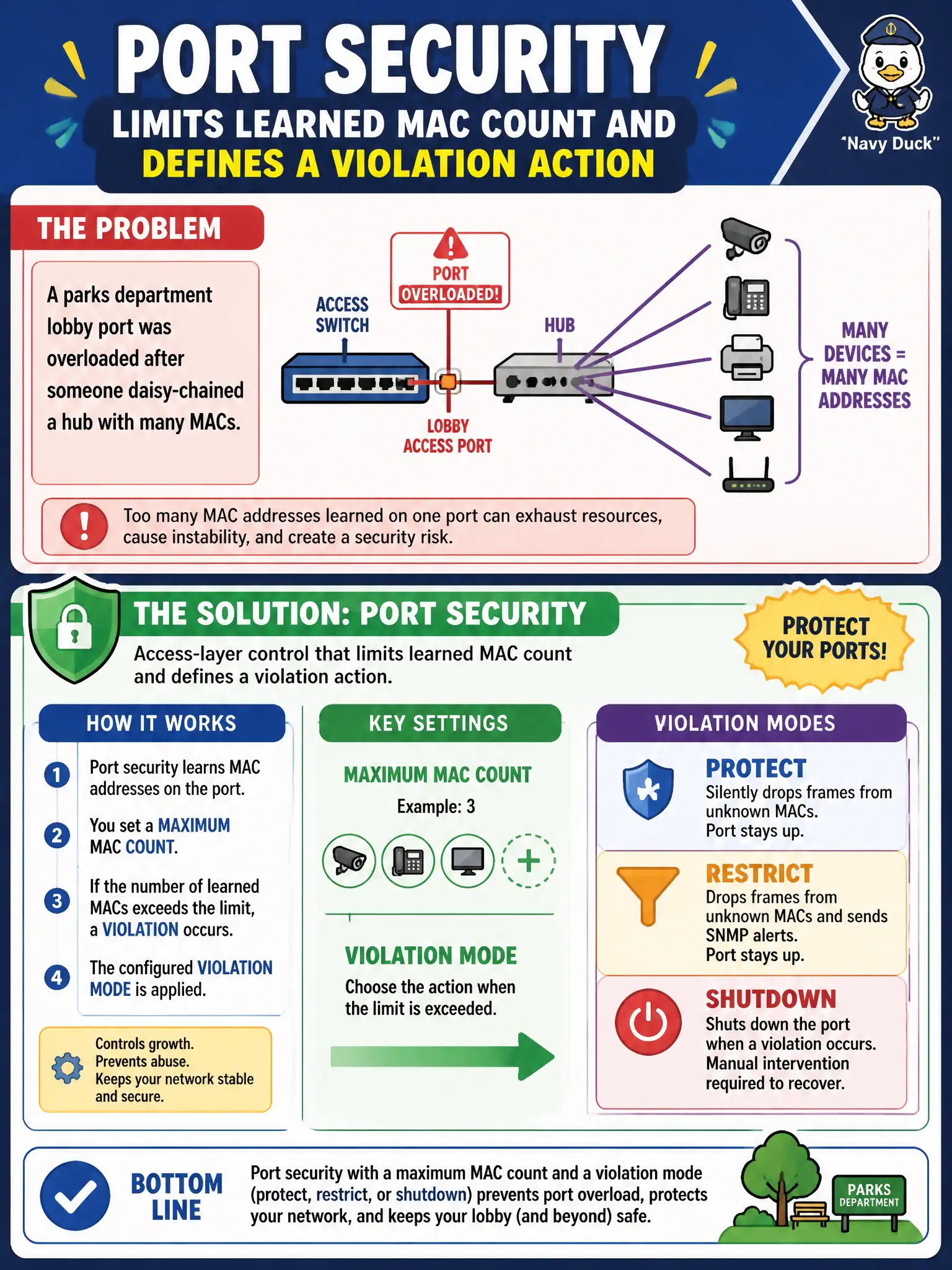
A parks department lobby port was overloaded after someone daisy-chained a hub with many MACs. What access-layer control limits learned MAC count and defines a violation action?
Select an answer to reveal the explanation.
Short Explanation
Port security sets a guest limit on how many MAC addresses a lobby jack may learn. Chain a hub past that limit and the port protects, restricts, or shuts—your choice of violation mode.
Full Explanation
Port security constrains the number of MAC addresses on an access interface and applies a violation mode such as protect, restrict, or shutdown when the maximum is exceeded. After someone daisy-chains a hub with many MACs onto a parks-department lobby port, port security with a maximum MAC count and a defined violation action is the access-layer control that limits learned MAC count.
BGP maximum-prefix on the lobby switch uplink bounds BGP routes, not Ethernet MAC learning on an access jack. OSPF stub configuration on the lobby SVI affects routing area behavior, not MAC limits. IPv6 RA Guard on the uplink toward the core only filters Router Advertisements, not excessive MAC learning from a hub.
Exam caveat: MAC flood/hub on access port → port security max + violation mode.
Operational check: set max MAC count and violation mode on lobby ports, test with multiple MACs, confirm protect/restrict/shutdown behavior, and document recovery steps for parks staff. For civic operations, record the chosen control and the rejected alternatives in the change record so future on-call engineers understand which failure modes were avoided for citizen-facing services. Re-validate after the next platform or policy change.