
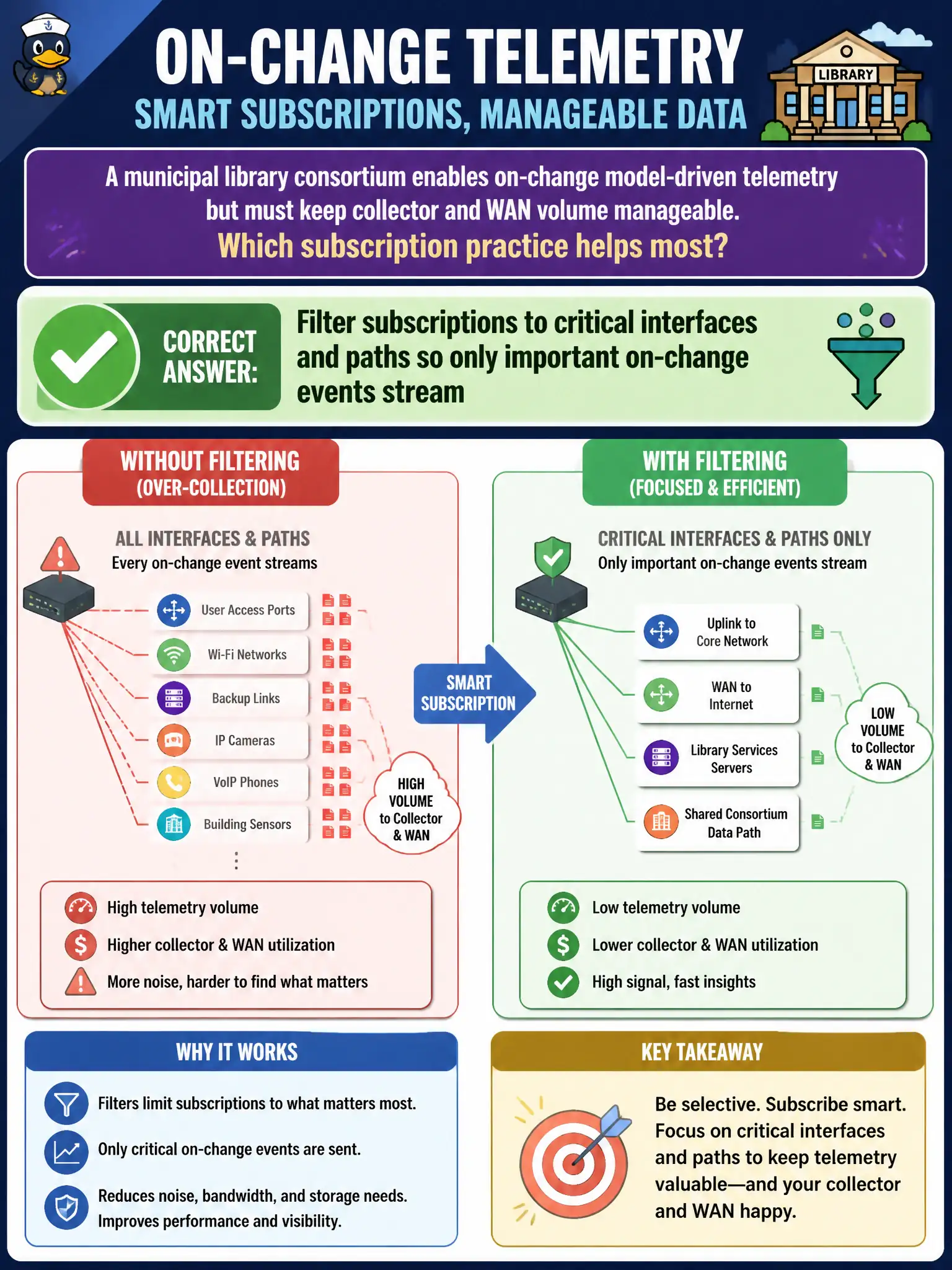
A municipal library consortium enables on-change model-driven telemetry but must keep collector and WAN volume manageable. Which subscription practice helps most?
Select an answer to reveal the explanation.
Short Explanation
On-change for every leaf on every port is a firehose aimed at a drinking fountain. Narrow the subscription to the uplinks and critical interfaces you actually page on. Filtering is how the library keeps the collector standing.
Full Explanation
Library consortia enabling on-change model-driven telemetry must keep collector and WAN volume manageable by filtering subscriptions to critical interfaces and paths so only important on-change events stream. Scope control is the primary volume management practice for on-change designs. Subscribe to what matters for SLOs, not every leaf on every switch.
Subscribing on-change to every interface and every sensor leaf floods collectors and WANs. Claiming filtering is useless because telemetry volume is always fixed is false. Mirroring full packet captures of all access ports into the telemetry collector confuses PCAP with telemetry and explodes volume.
Exam caveat: on-change bursts during mass events (many links down) still need collector headroom and dampening strategies. Operational check: start with uplink and critical server ports, measure event rates, then expand carefully. Alert on collector lag so libraries know when filters must tighten. Record the chosen control and rejected alternatives in the municipal change record so future on-call engineers understand the failure modes avoided for city services. Re-validate after the next maintenance window that telemetry, API results, and device state still match the documented design intent.