
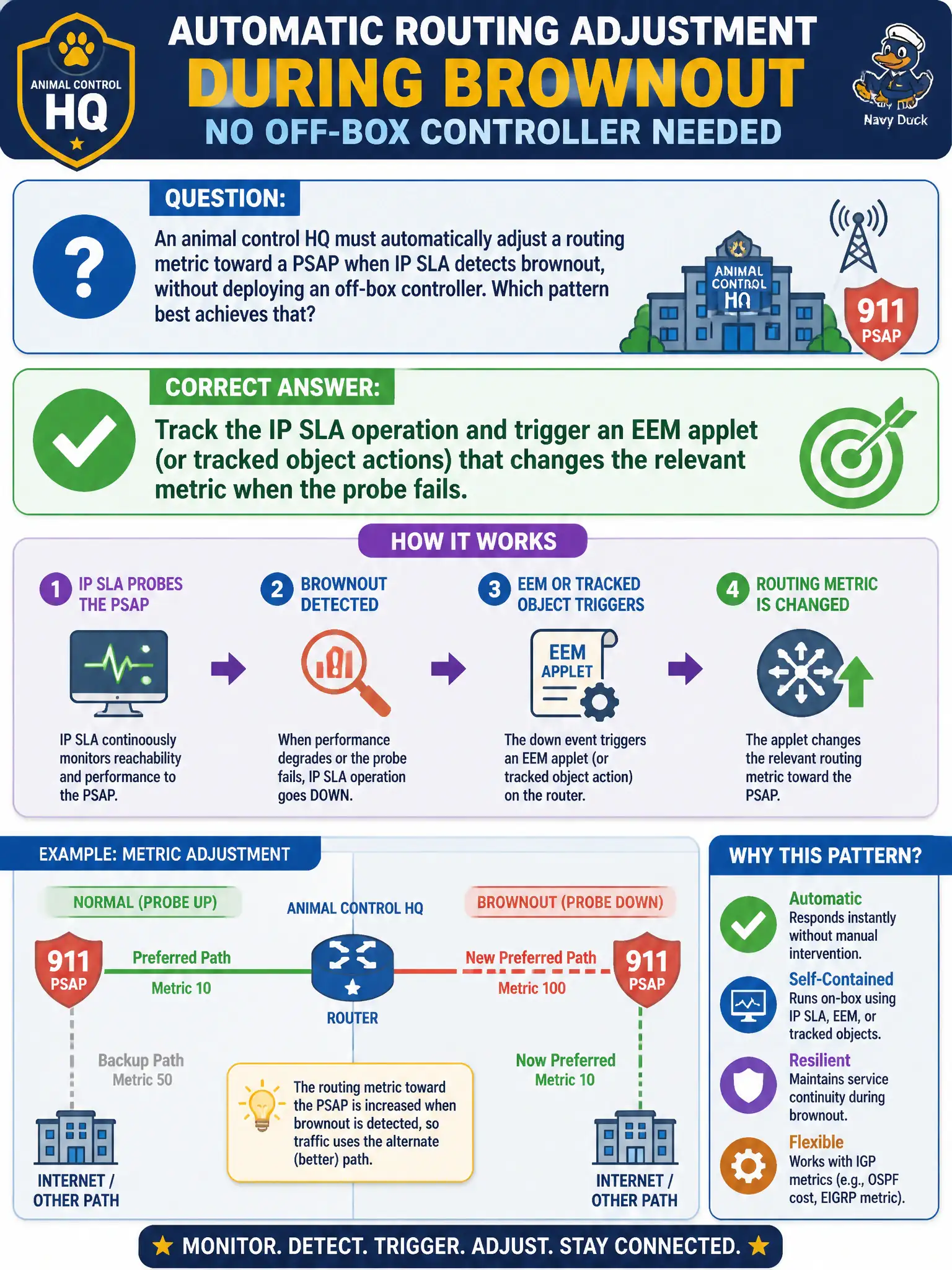
An animal control HQ must automatically adjust a routing metric toward a PSAP when IP SLA detects brownout, without deploying an off-box controller. Which pattern best achieves that?
Select an answer to reveal the explanation.
Short Explanation
IP SLA is the canary toward the PSAP; EEM is the hand that turns the metric dial when the canary coughs. Together they steer traffic away from a brownout without waiting for a human or a distant controller.
Full Explanation
Animal-control HQ needing automatic routing-metric adjustment toward a PSAP when IP SLA detects brownout—without an off-box controller—should track the IP SLA operation and trigger an EEM applet (or tracked-object actions) that changes the relevant metric when the probe fails. Combining SLA evidence with on-box automation yields local, fast reaction to brownout while leaving broader policy to humans or controllers later.
Ignoring IP SLA and relying on monthly manual traceroute reviews is too slow for PSAP path quality. Hard-coding a static default via the brownout path with AD 1 forever locks in the bad path. Disabling all dynamic routing so metrics never need adjustment removes the routing system the automation is meant to steer.
Exam caveat: distinguish hard failure from brownout—latency/jitter SLA operations may be required when ICMP echo to the next hop stays up. Operational check: configure SLA + track + EEM/metric action in lab, induce artificial delay/loss, verify the metric change and recovery, then promote carefully. Alert the NOC when the applet fires so PSAP path changes are visible outside the router. Record the chosen control and the rejected alternatives in the municipal change record so future on-call staff understand which failure modes were avoided for city services.