
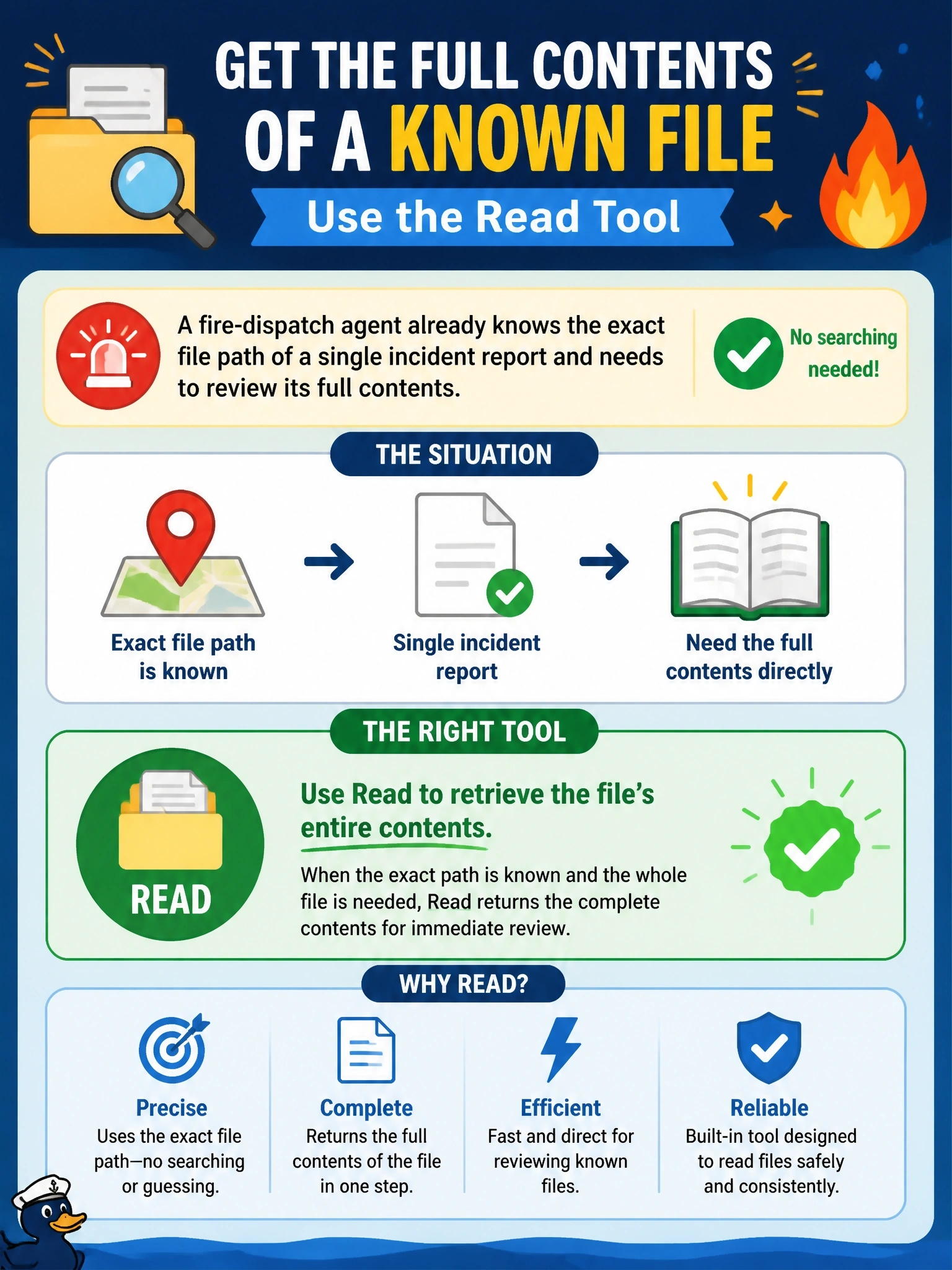
A fire-dispatch agent already knows the exact file path of a single incident report it needs to review in full, with no need to search for it. Which built-in tool is the right fit for retrieving its contents?
Select an answer to reveal the explanation.
Short Explanation
If you already know the book and the shelf, you do not send a librarian on a search—you walk over and pull it. Read is that direct pull when the path is known.
Full Explanation
Tool selection should track what is actually unknown. When a fire-dispatch agent already holds the exact path of an incident report and needs the whole document, nothing remains to be discovered—the task is retrieval, and any tool whose job is search inserts a step answering a question nobody asked.
Read takes a path and returns the file's contents directly. It is the shortest route from a known location to full text, it imposes no pattern-matching or shell layer, and it hands back the document in a form the agent can reason over without parsing command output.
Grep searches file contents for matches, so aiming it at a file whose location is settled spends a traversal rediscovering a known fact and returns fragments rather than the full report; Glob discovers paths by name pattern, which is precisely the step already completed; running a shell command to locate and print the file reimplements Read through a broader, less constrained interface, widening the agent's blast radius for no benefit.
Exam caveat: the deciding factor is what is known—with only a partial name, Glob comes first; with only a phrase to find, Grep does; Read is correct once the path is settled. Operational check: before choosing, state explicitly whether the path, a name pattern, or only the content is known, and pick the tool matching that answer.