
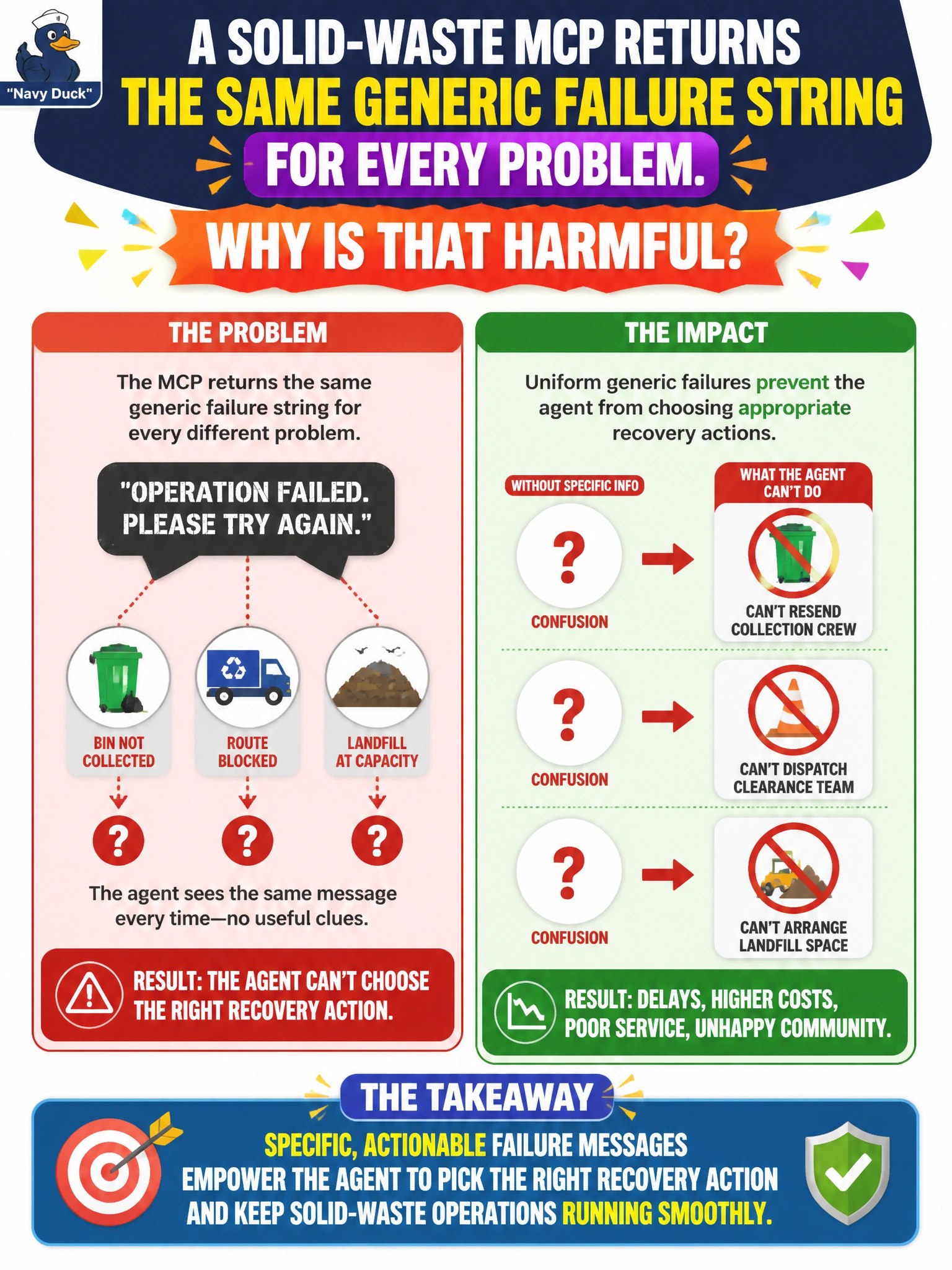
A solid-waste MCP returns the same generic failure string for every problem. Why is that harmful?
Select an answer to reveal the explanation.
Short Explanation
One bland "failed" for every solid-waste glitch leaves the agent blind. Without categories and retry hints, recovery is just guessing.
Full Explanation
A solid-waste MCP that returns the same generic failure string for every problem is harmful because uniform generic failures prevent the agent from choosing appropriate recovery actions. Without category, retryability, or actionable description, the model cannot tell a transient route-service outage from a validation error on a cart request or a permission denial on a commercial account.
Differentiated structured errors work because recovery branches differ: retry with backoff, ask the resident to fix input, escalate permissions, or explain a business rule. Solid-waste operations need those branches to keep service requests moving without blind loops.
Claiming generic strings always maximize agent recovery quality is false—they minimize signal. Asserting uniform failures automatically classify retryability for the model is wrong; classification requires explicit metadata. Saying agents never need category or retry metadata in civic systems ignores how municipal MCP agents decide next actions under failure.
Exam caveat: do not expose only engineer stack traces; provide agent-facing fields even when logging internals separately. Operational check: trigger three distinct solid-waste failures and verify distinct errorCategory/isRetryable values that change agent behavior appropriately.