
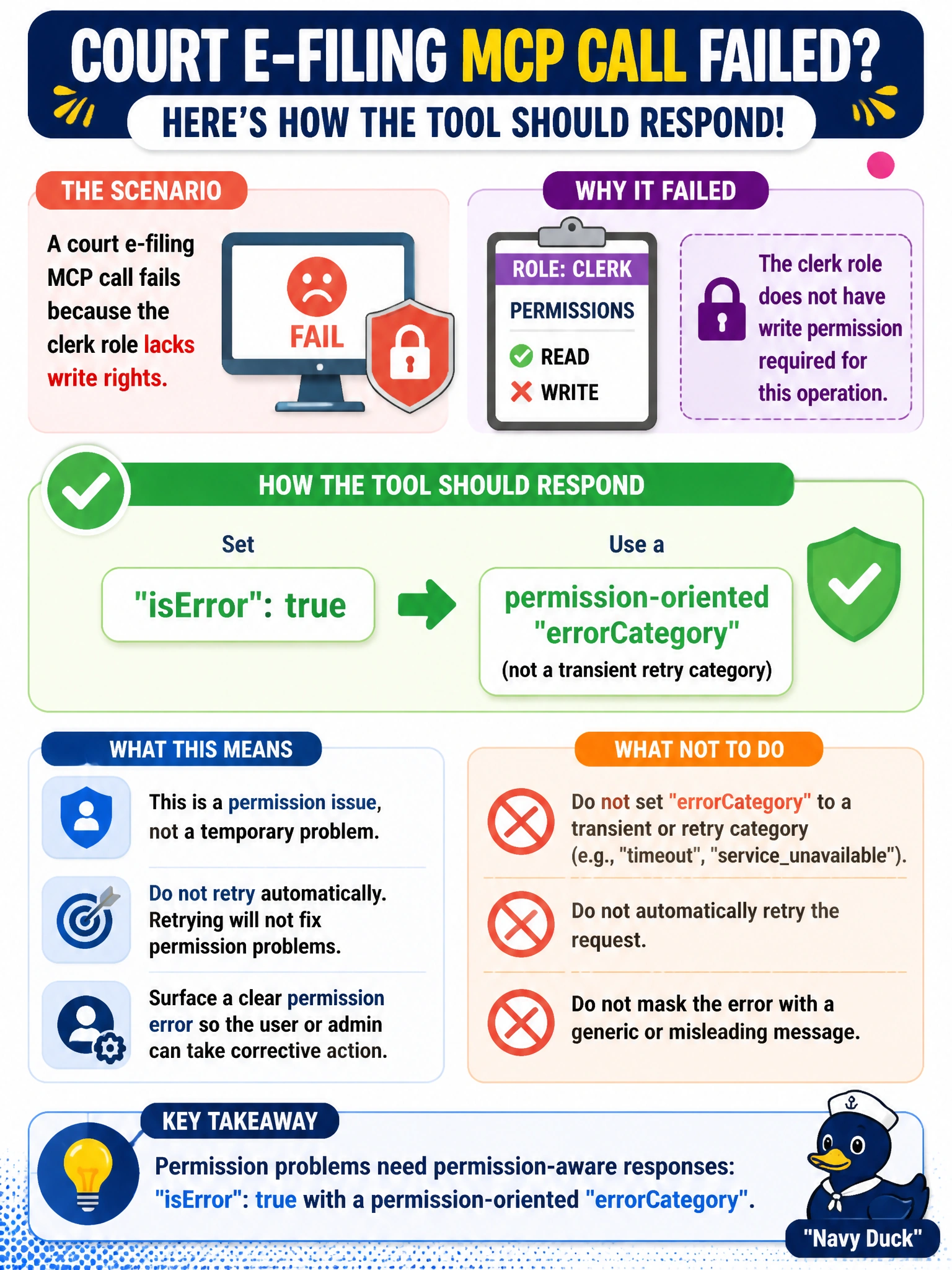
A court e-filing MCP call fails because the clerk role lacks write rights. How should the tool respond?
Select an answer to reveal the explanation.
Short Explanation
No write rights is a permission problem, not a blip. Flag isError with a permission category so the e-filing agent stops pretending a retry will help.
Full Explanation
When a court e-filing MCP call fails because the clerk role lacks write rights, the tool should set isError true with a permission-oriented errorCategory rather than a transient retry category. Missing write rights are an authorization problem; retries without a role change will not create a valid filing and may flood the clerk system.
Permission categorization works because recovery policy depends on cause. Agents should escalate credentials, switch roles, or explain the denial to court staff—not treat the failure like a momentary network blip. Accurate isError plus category keeps e-filing agents aligned with court access control.
Returning isError false and pretending the filing succeeded creates false docket state and severe civic integrity risk. Using only a transient timeout category so the agent retries endlessly mis-labels a durable permission fault. Omitting isError and returning an unstructured string denies machine-readable recovery signals and invites brittle string parsing.
Exam caveat: map IAM/RBAC denials to permission (or equivalent) categories consistently across court MCP tools. Operational check: invoke e-filing with a read-only clerk role and confirm isError true, permission category, and that the agent stops blind retry loops.