
A housing search subagent hits a transient timeout on one source. What error-handling pattern should it follow?
Select an answer to reveal the explanation.
Short Explanation
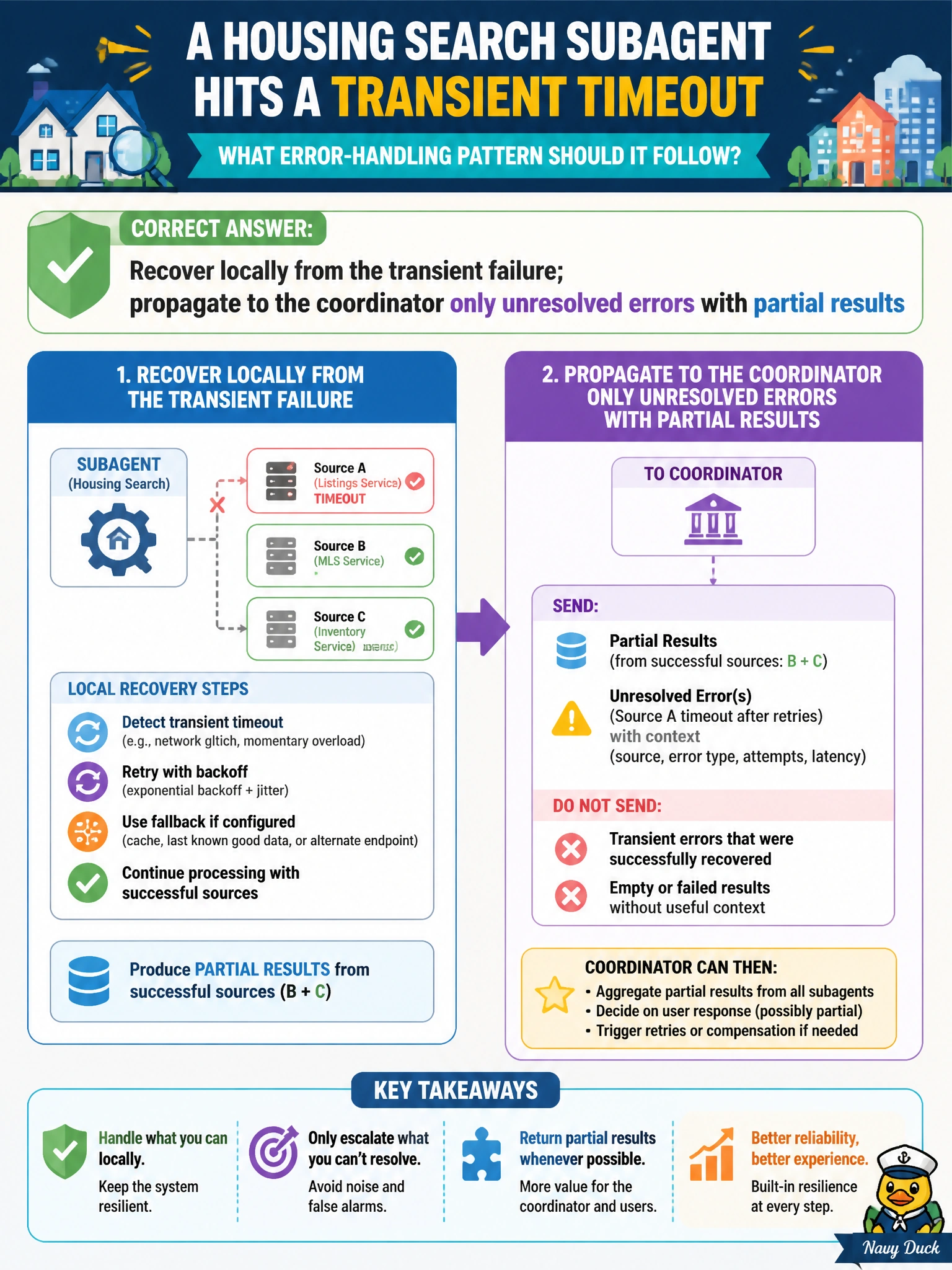
A flaky housing source timeout isn't the end of the world. Retry locally first; only escalate what's still broken, and bring partial results along.
Full Explanation
When a housing search subagent hits a transient timeout on one source, it should recover locally from the transient failure and propagate to the coordinator only unresolved errors, preferably with partial results. Local retry/backoff keeps the coordinator from failing the entire housing workflow on a single flaky feed while still preserving visibility into what remains broken.
Local recovery plus partial propagation works because multi-source housing search is partially fail-able: listings from healthy sources remain useful to caseworkers even when one source times out. Escalating only unresolved errors maintains observability without discarding salvageable progress.
Immediately aborting the entire coordinator workflow on the first timeout over-penalizes a transient fault and denies residents any partial housing options. Hiding the failure and inventing listing data to keep the report complete is integrity fraud—fabricated units must never ship. Retrying forever with no backoff and never surfacing partial findings creates silent hangs and loses evidence the coordinator needs.
Exam caveat: cap local retries and classify timeout as transient; do not invent data to “complete” the report. Operational check: simulate one source timeout after partial listings arrive and confirm the subagent retries locally, then returns partial results plus a structured unresolved error to the coordinator.