
A parks reservations MCP often confuses group versus individual bookings. What description content reduces ambiguous selection?
Select an answer to reveal the explanation.
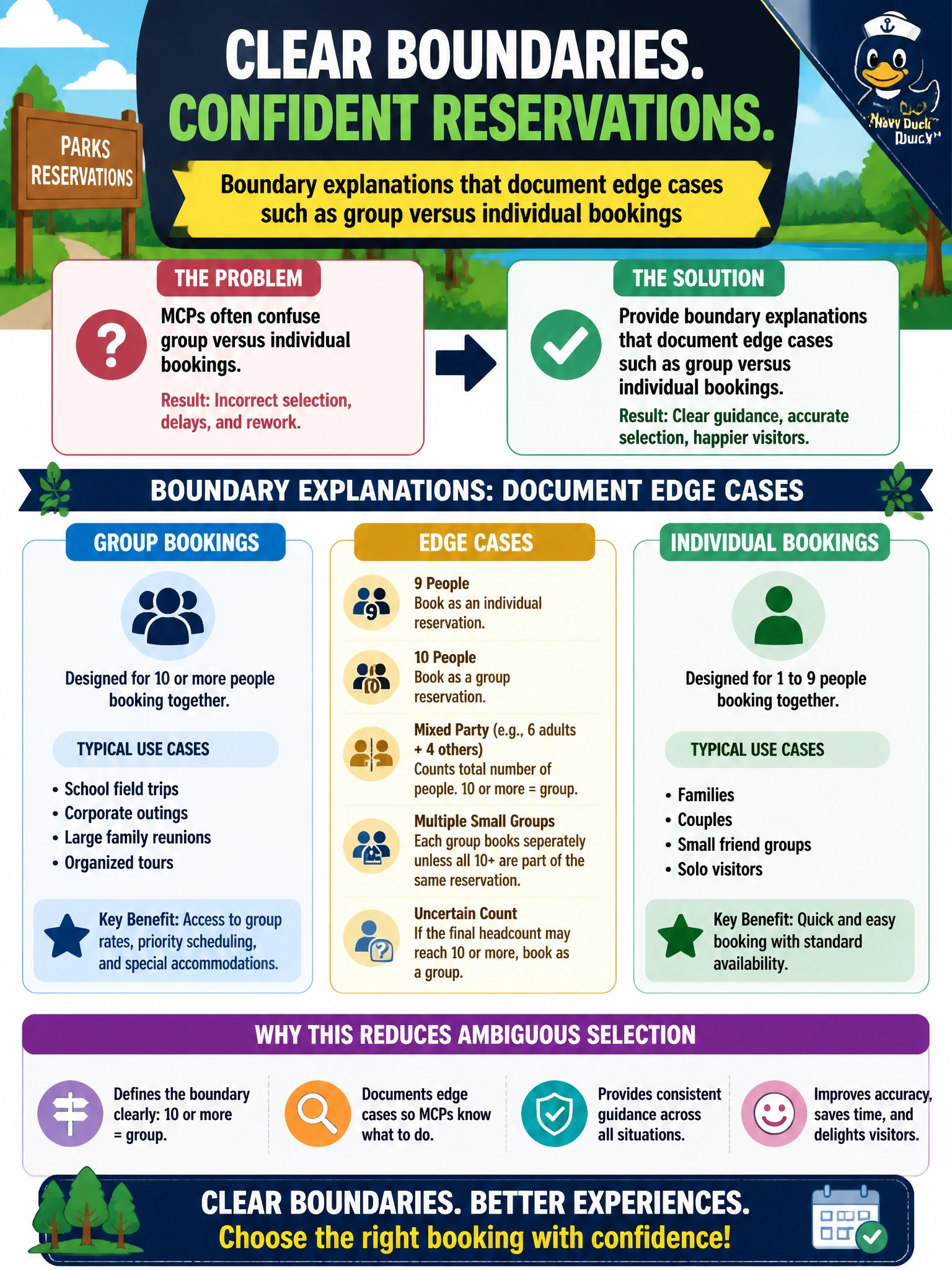
Short Explanation
Group picnic vs solo tennis court are different worlds. Put those booking edge cases in the tool description so parks reservations stop picking the wrong path.
Full Explanation
A parks reservations MCP that often confuses group versus individual bookings needs boundary explanations that document those edge cases in the tool description. Spelling when group picnic shelters, multi-party permits, or solo court bookings apply—and which tool or mode owns each—gives the model selection cues that names alone rarely provide.
Boundary and edge-case prose works because parks booking intents share vocabulary (“reserve,” “park,” “date”) while differing in capacity rules, deposits, and eligibility. Documenting the group-versus-individual distinction reduces ambiguous selection and incorrect reservation paths for municipal recreation systems.
Omitting all edge cases so the model invents booking rules replaces policy with hallucination and risks overbooking or illegal group use of individual resources. Listing only server hostnames with no booking semantics tells infrastructure trivia while saying nothing about civic booking behavior. Stating that group and individual bookings are identical in every way erases the very distinction operators need the agent to respect.
Exam caveat: edge cases should include failure modes (capacity exceeded, conflicting holds), not only happy-path definitions. Operational check: issue near-identical “reserve a park” prompts that differ only by group size and confirm the agent selects the path whose description documents that edge.