
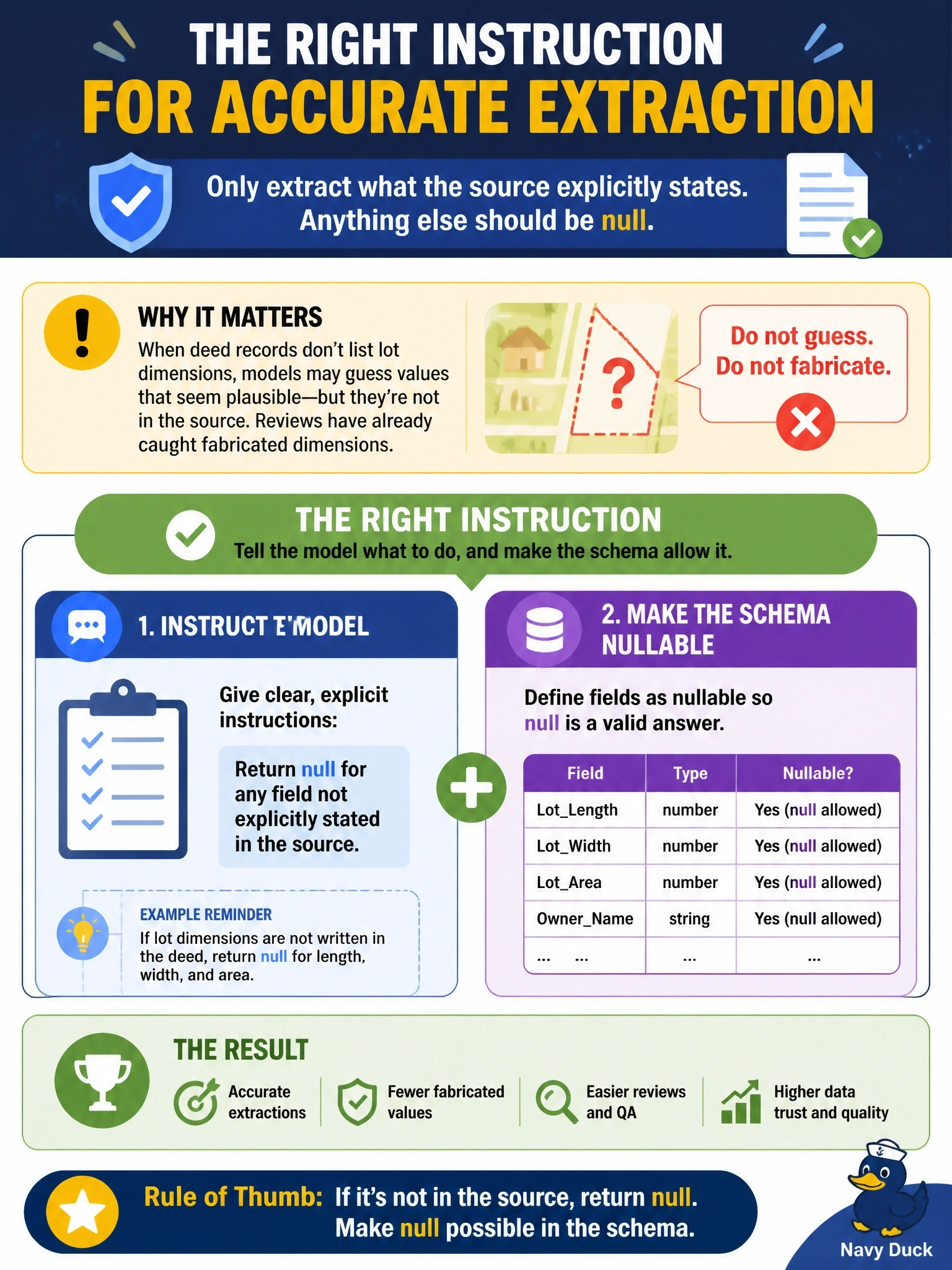
A GIS team extracts parcel attributes from scanned deed records. When a deed does not state the lot dimensions, the model produces dimensions that are plausible for the neighborhood, and reviewers have caught several fabricated values already. Which prompt-and-schema instruction addresses this most directly?
Select an answer to reveal the explanation.
Short Explanation
If the schema demands a number the deed does not contain, the model must either break the contract or invent one. Allow null and it can say the deed is silent.
Full Explanation
Fabrication in extraction is usually a contract problem before it is a model problem. When a non-nullable dimensions field meets a deed that never states lot dimensions, there is no compliant way to express absence, and a plausible neighborhood-typical value becomes the only output that satisfies the schema the GIS team wrote.
Instructing the model to return null for any field not explicitly stated in the source, and making the field nullable so null validates, gives absence a legitimate representation. "Not stated in the deed" becomes an explicit and accurate outcome that reviewers can act on directly. The prompt and the schema have to agree, because either one alone leaves open the gap the model has been filling.
Appending a question mark to low-confidence values still records a fabricated number while corrupting the field's type for every consumer; permitting estimates when neighboring parcels are similar sanctions exactly the inference reviewers are catching, and a deed record should reflect the deed; and dumping the full deed text into a notes field pushes extraction work back onto humans while leaving the invented dimensions in the structured fields.
Exam caveat: allowing null lowers the pressure to fabricate without eliminating it, and a model can over-report nulls on hard-to-read scans, which looks safe while quietly losing real data. Operational check: run deeds where dimensions are known present and known absent, and measure both the fabrication rate and the false-null rate rather than only the first.