
A library system uses Claude to decide whether a donated book fits its collection policy, returning a JSON verdict plus a rationale. A reviewer notices the model often commits to 'accept' in the first field and then writes a rationale that partly argues against it. How should the output be restructured?
Select an answer to reveal the explanation.
Short Explanation
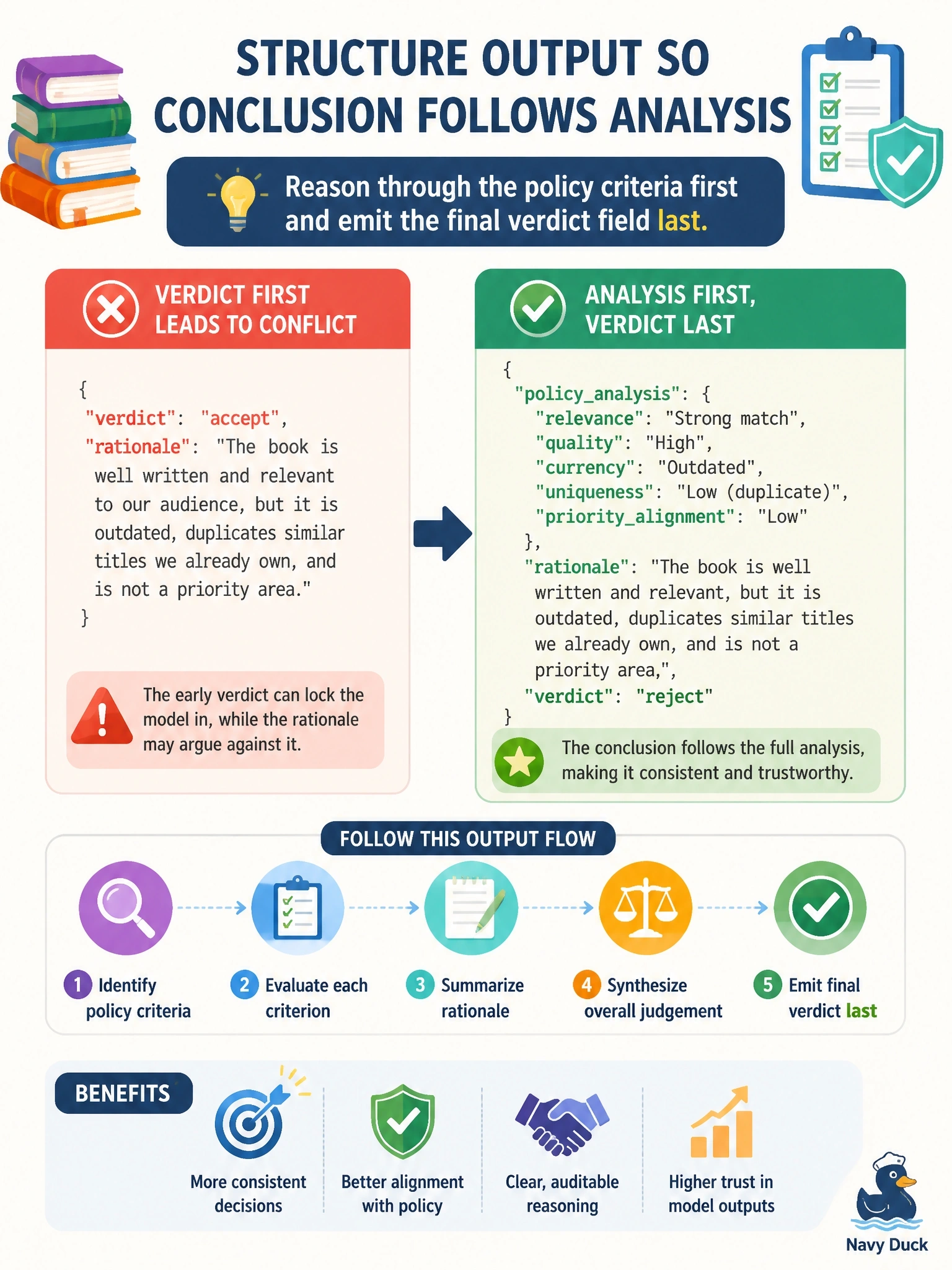
Autoregressive models write forward, so whatever comes first is what the rest must live with. Put the criteria analysis before the verdict and the conclusion rests on the reasoning.
Full Explanation
Field order in a structured output is not cosmetic, because generation is sequential and earlier tokens condition everything that follows. A verdict emitted in the first field is a commitment made before any analysis exists, which is exactly why the rationale that follows reads as though it is arguing with the answer sitting above it.
Having the model reason through the collection-policy criteria first and emit the verdict last means the decision is generated with the analysis already in context. The reasoning genuinely informs the conclusion instead of decorating it, which is the entire value of asking for a rationale, and the ordering rule generalizes to any output that pairs a judgment with its justification.
Dropping the rationale removes both the reviewer's audit trail and the reasoning that would have improved accuracy; instructing the rationale to agree with an already-emitted verdict institutionalizes post-hoc justification rather than curing it; and two parallel calls generate verdict and rationale independently, so neither informs the other and they can flatly contradict.
Exam caveat: reasoning first improves the decision but does not make the written rationale a faithful account of the model's internal computation, so it is an aid to human review rather than a proof. Operational check: reorder the fields, re-score a set of donations with known outcomes, and track both accuracy and how often the rationale still contradicts the verdict it accompanies.