
An elections office runs a nightly job that extracts the precinct number, ballot style, and machine serial from scanned poll-worker incident forms. Two runs over the identical batch produced records that differed in wording and, on a few forms, in which serial was picked. Which sampling setting best matches this workload?
Select an answer to reveal the explanation.
Short Explanation
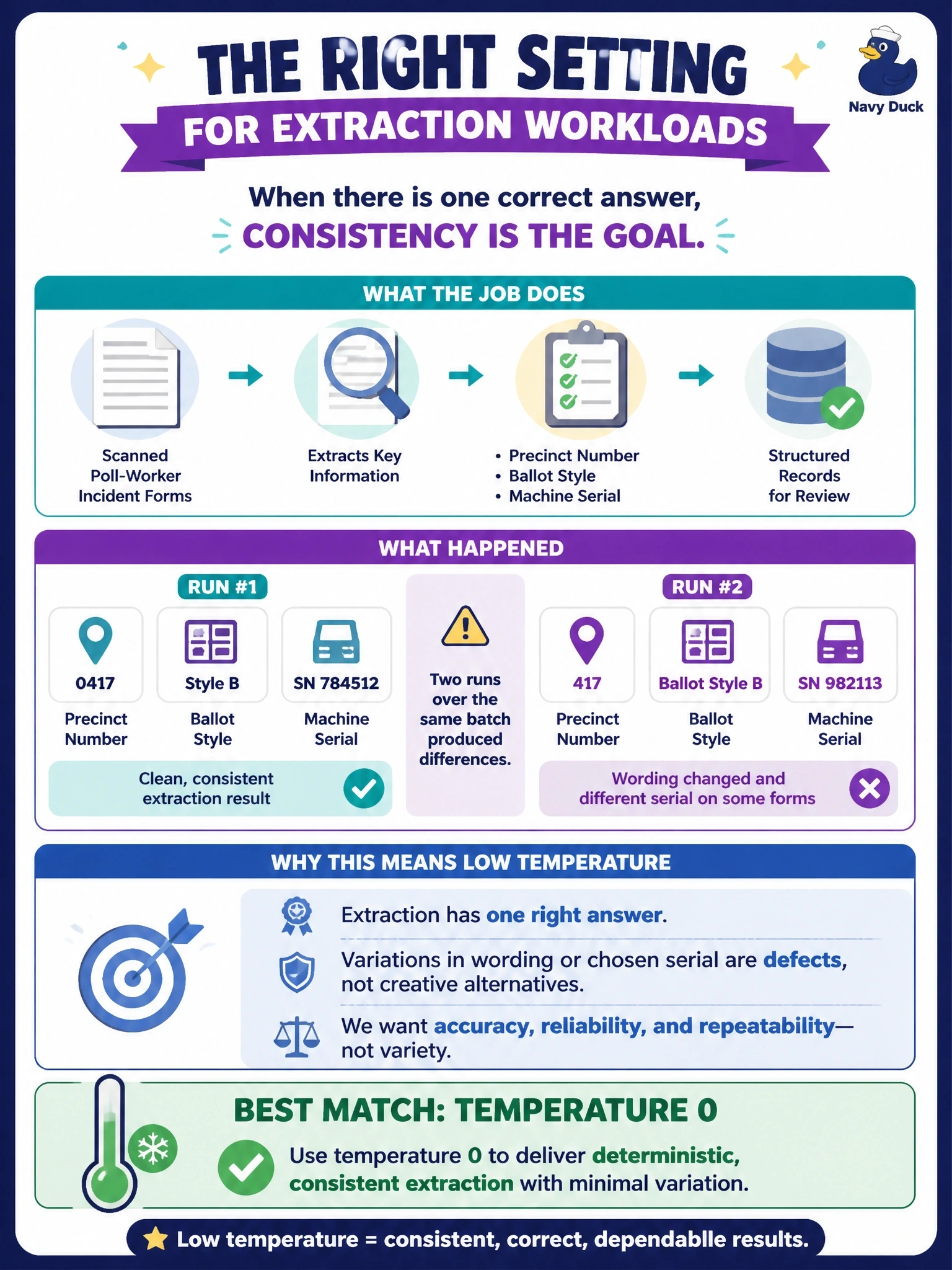
Temperature is a creativity dial, and extraction wants it on the floor. Set it to 0 and the same incident form yields the same precinct number and serial run after run.
Full Explanation
Sampling settings should follow from whether a task has one right answer. Pulling a precinct number, ballot style, and machine serial off a poll-worker incident form is a deterministic read of a fixed source, so run-to-run variation is not creativity; it is a defect that makes two passes over the same batch impossible to compare.
Temperature scales how much randomness enters token selection, and at 0 the model consistently favors the most probable continuation. Variation across identical inputs collapses toward nil, which lets the elections office diff a re-run against the prior run and treat any difference as a real change in the input rather than noise introduced by the sampler.
Temperature 1.0 maximizes variability and is the setting most likely to produce the inconsistent serials already observed; 0.7 is a sensible default for open-ended drafting but still admits exactly the variation being eliminated; lowering max_tokens constrains response length only, and a terse answer can be every bit as inconsistent as a verbose one.
Exam caveat: temperature 0 minimizes sampling variance rather than guaranteeing bit-identical output, and it cannot resolve a genuinely ambiguous smudged serial, so determinism is not accuracy. Operational check: run the same batch twice at temperature 0, diff the extracted records, and route forms that still differ to human review as inherently unreadable rather than treating them as a model defect.