
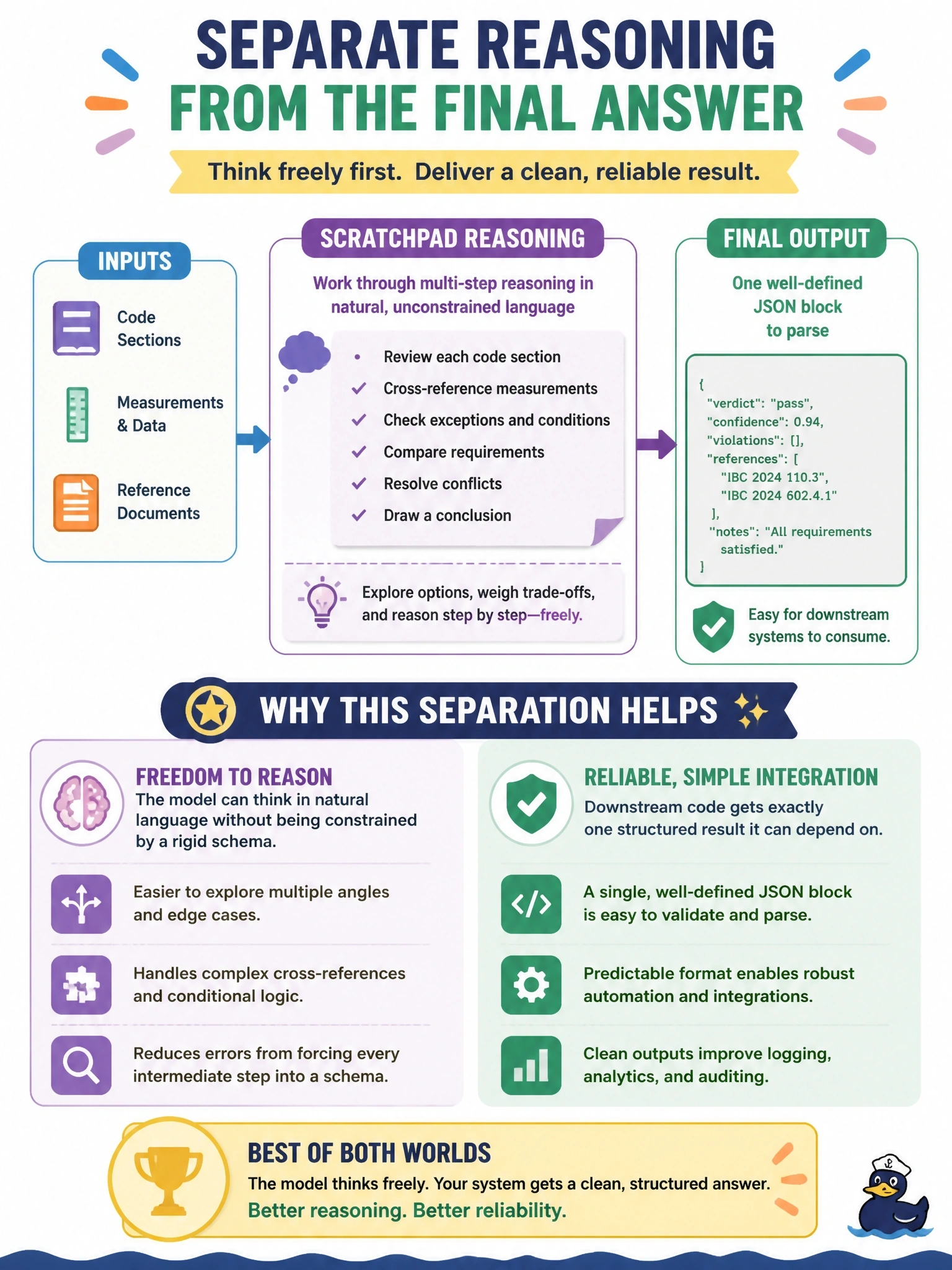
A building-inspection assistant must review several code sections, cross-reference measurements, and only then emit a single structured pass/fail verdict as JSON. The team has Claude reason through the cross-references in an unstructured scratchpad section of its response, then emit the final verdict in a clearly delimited JSON block at the end. What is the benefit of separating scratchpad reasoning from the final structured answer this way?
Select an answer to reveal the explanation.
Short Explanation
Let the inspector take clipboard notes before filling out the official form. Unconstrained reasoning first, then one clearly delimited JSON verdict at the end that downstream code can parse without wading through the thinking.
Full Explanation
Reasoning and reporting have different requirements. Cross-referencing several code sections and measurements needs room to compare values, note exceptions, and reconsider, while a machine consumer needs one predictable structure. Forcing both jobs into the same schema makes each of them worse.
Separating an unstructured scratchpad from a delimited final block lets the multi-step reasoning happen in natural language, where the model is never pushed to make every intermediate thought valid against the verdict schema, while the parser reads only the block at the end. The building-inspection verdict stays a single well-defined JSON object even though the work that produced it was exploratory and messy.
Calling scratchpad text free ignores that it is generated output, billed and counted like any other tokens, so the pattern buys reasoning quality rather than economy; claiming it removes the need for a schema confuses the reasoning trace with the contract, since downstream code parses the final block and still needs its shape defined; and promising freedom from bias overreaches, because ordering effects act on the reasoning itself and separating the answer from the reasoning does nothing to undo them.
Exam caveat: the split helps only when the delimiter is unambiguous, because a scratchpad that discusses JSON, or a fenced block appearing mid-reasoning, will confuse a naive parser that grabs the first match. Operational check: extract the last delimited block rather than the first, validate it against the schema, and fail loudly on a missing or non-conforming block instead of falling back to scraping the scratchpad.