
An emergency-management after-action report is drafted by one agent, and leadership is concerned that a single pass may miss factual inconsistencies against the incident logs. What pattern improves reliability here?
Select an answer to reveal the explanation.
Short Explanation
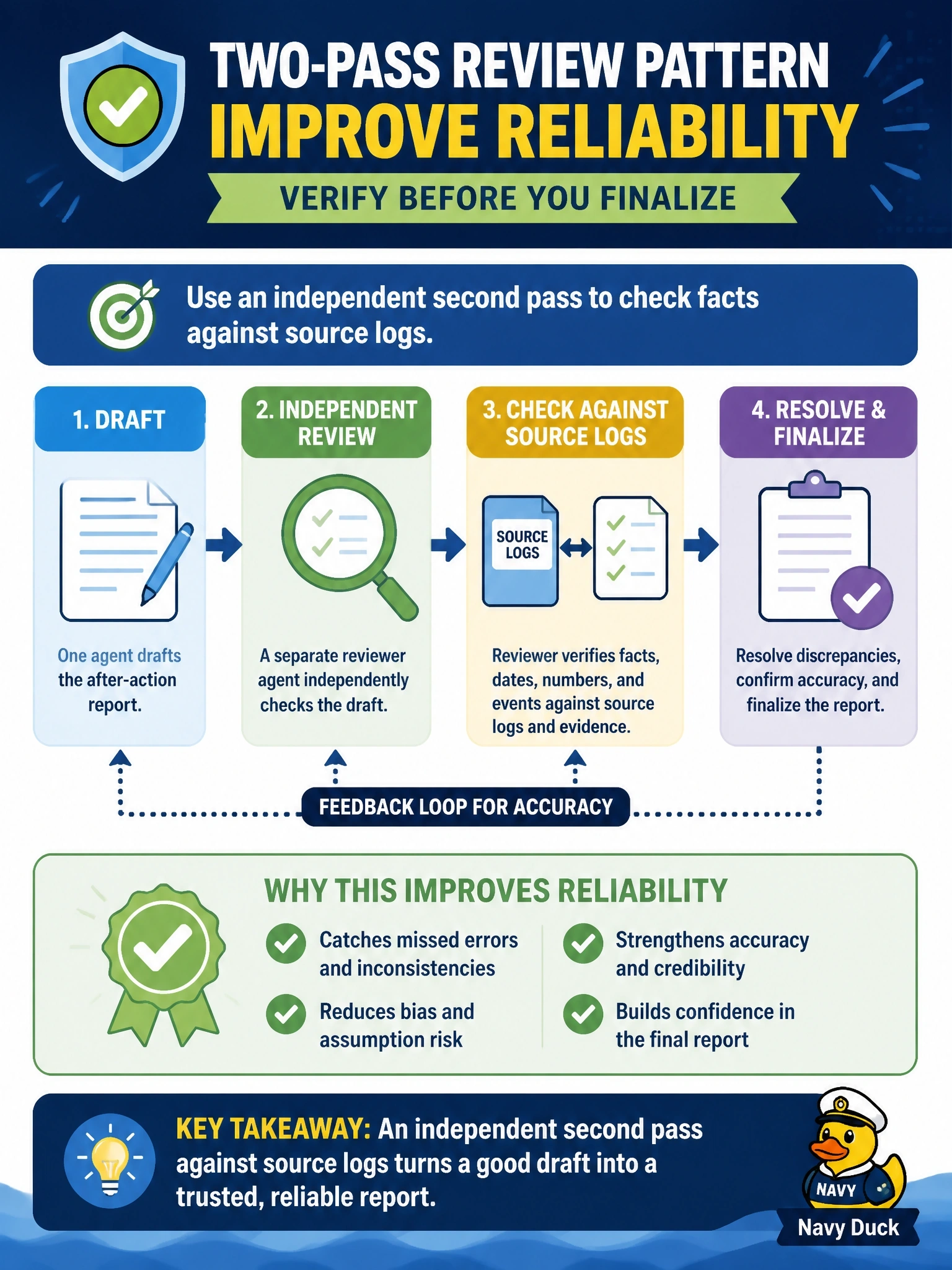
One writer checking their own after-action report is an incident commander grading their own drill. An independent pass against the actual logs catches what the author is built to miss.
Full Explanation
Self-review is bounded by the reasoning that produced the draft. The same assumptions that generated a factual error about an incident timeline are the assumptions the author applies when rereading, which is why reliability improves most when verification comes from a different vantage point rather than a longer one.
An independent second pass, or a separate reviewer agent, checks the drafted after-action report against the source incident logs with no stake in the draft's phrasing. Because the reviewer's task is comparison rather than composition, discrepancies between a claim and the logged record surface as mismatches instead of being smoothed over—which is exactly the assurance leadership is asking for before the report is finalized.
Having the same agent immediately reread its own draft in the same pass carries the identical blind spots forward. Skipping review assumes agentic drafts are reliable by default, which is precisely the assumption a high-stakes after-action report should not rest on. Lengthening the original prompt adds instructions to a single pass without introducing any independent verification step at all.
Exam caveat: an independent reviewer helps only if it is given the source logs—review against the draft alone checks internal coherence, not factual accuracy. Operational check: seed a draft with one known contradiction against the incident logs and confirm the review pass flags it before the report is finalized.