
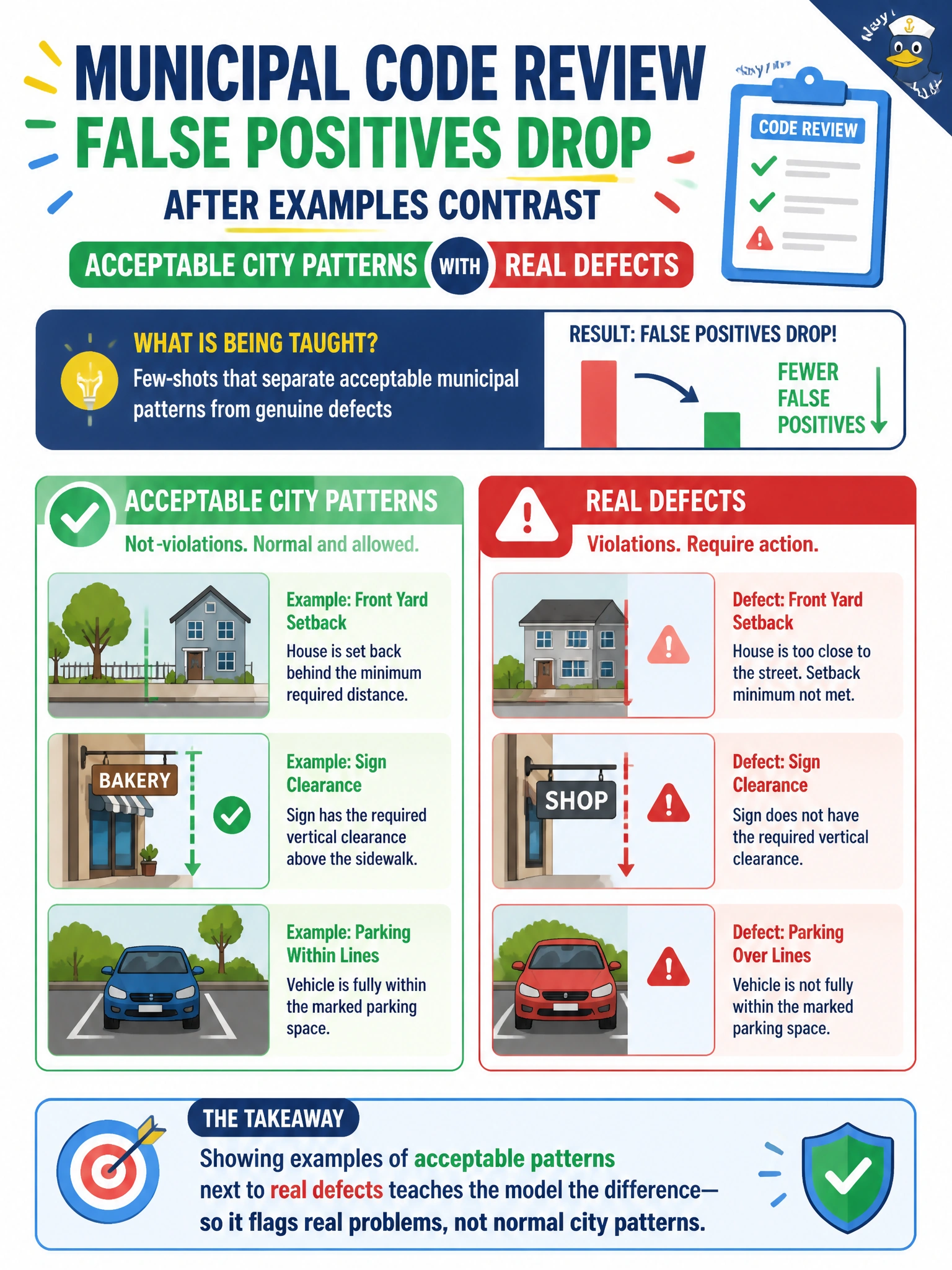
Municipal code review false positives drop after examples contrast acceptable city patterns with real defects. What is being taught?
Select an answer to reveal the explanation.
Short Explanation
Show the difference between a legal municipal shortcut and a real bug—like labeling which jars are pickles and which are jam. Those few-shots cut false positives.
Full Explanation
Municipal code-review false positives drop when few-shots explicitly contrast acceptable city patterns with genuine defects. Teaching the difference—legacy civic naming, approved framework idioms, or documented exceptions versus real bugs and security flaws—calibrates judgment so the bot stops treating every local convention as an incident. Contrastive exemplars are especially useful in long-lived municipal repos where style history differs from greenfield private-sector norms.
Examples that mark every local pattern as a critical defect fail because they weaponize false positives and erase legitimate municipal conventions that policy already accepts. Prompts that forbid distinguishing style from bugs fail by collapsing categories that must stay separate for trust and triage. Training that treats all civic conventions as security flaws fails conceptually and culturally: not every city-specific pattern is a vulnerability, and that framing floods security queues with noise instead of real risk.
Exam caveat: contrastive few-shots reduce false positives; they must be curated by people who know which local patterns are approved so examples do not bless unsafe shortcuts. Operational check: add paired acceptable-versus-defect exemplars from real city repos, re-score a known noisy PR set, and verify style/convention false positives fall while true defects remain flagged.