
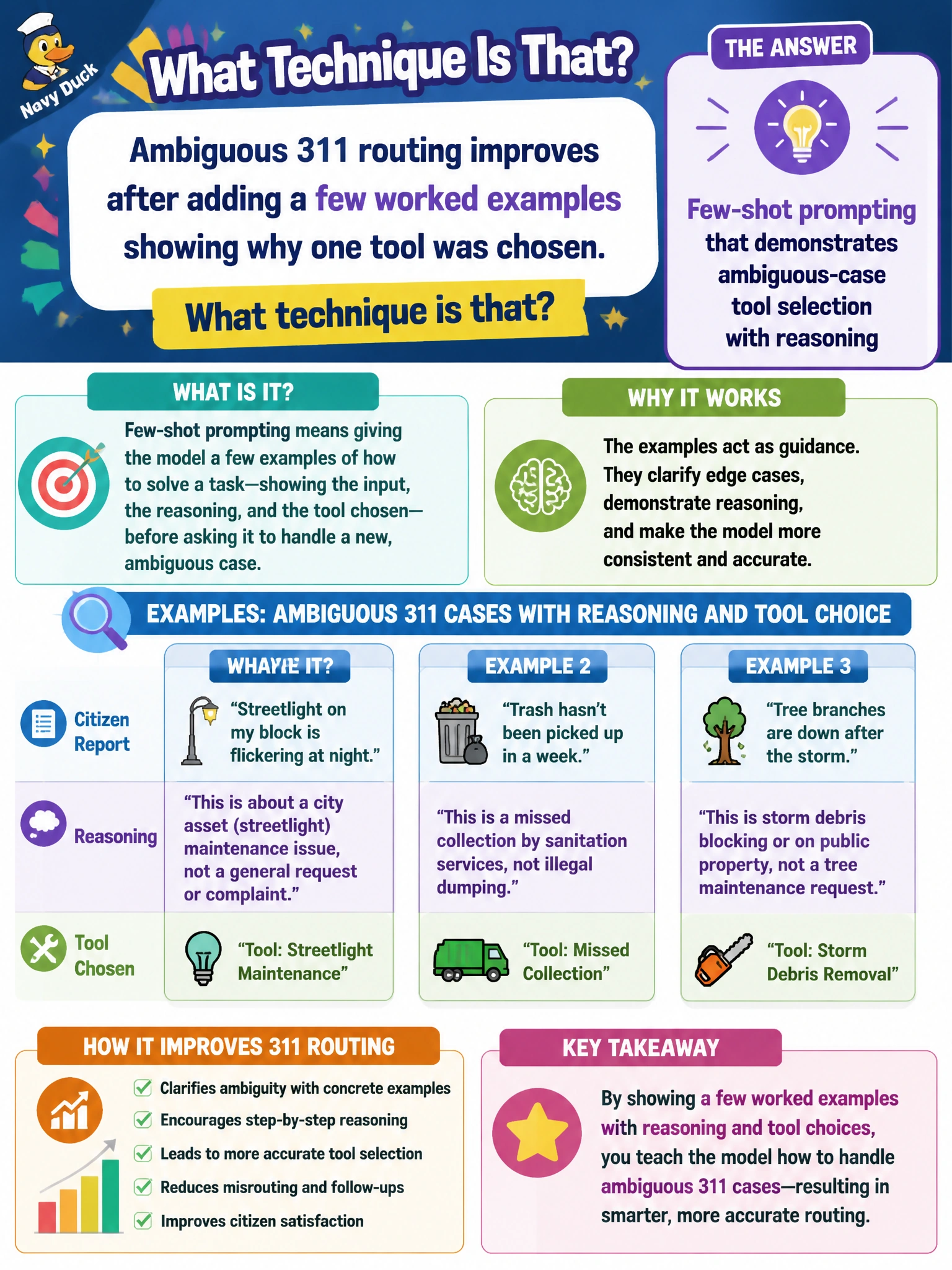
Ambiguous 311 routing improves after adding a few worked examples showing why one tool was chosen. What technique is that?
Select an answer to reveal the explanation.
Short Explanation
When the 311 call could be potholes or streetlights, a few worked examples are like ride-alongs with a veteran dispatcher. That's few-shot for ambiguous tool picks.
Full Explanation
Ambiguous 311 routing improves when the agent sees few-shot examples that demonstrate how to choose a tool on borderline resident requests and why that tool fits. Worked ambiguous cases teach decision boundaries—pothole versus streetlight, noise versus code enforcement—so the municipal agent selects the right MCP tool with brief reasoning instead of guessing under pressure.
Removing all examples so the model guesses tools freely fails because overlapping civic language produces unstable tool choice and misrouted work orders. Relying only on a one-word pick-a-tool instruction fails conceptually: a bare imperative supplies no boundary conditions for ambiguity and yields brittle routing. Forbidding tool use on any ambiguous resident request fails operationally; 311 desks live on ambiguous phrasing, and refusing tools strands residents instead of resolving tickets through the correct system of record.
Exam caveat: few-shot ambiguous-case demos improve tool selection; they must stay aligned with current service catalogs and should not invent tools the city's MCP server does not expose. Operational check: add several ambiguous 311 dialogues with chosen tool plus reasoning, evaluate on held-out tickets, and confirm correct tool_use rates rise without elevating unauthorized tool calls.