
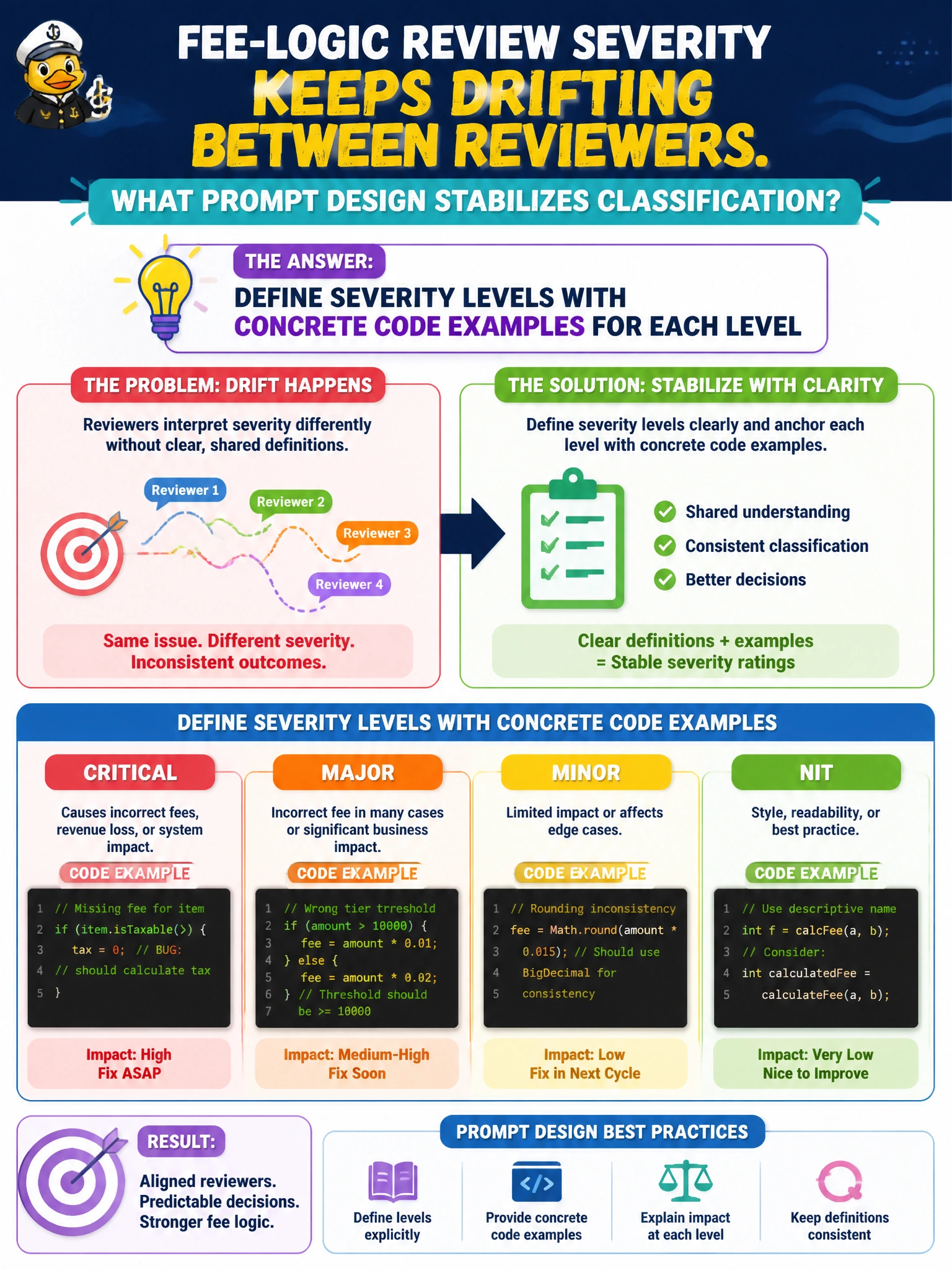
Fee-logic review severity keeps drifting between reviewers. What prompt design stabilizes classification?
Select an answer to reveal the explanation.
Short Explanation
Severity without examples is like a "spicy" label with no Scoville number. Concrete code examples per level keep fee-logic findings classified the same way.
Full Explanation
Fee-logic review severity that drifts between reviewers is a calibration problem. Defining severity levels with concrete code examples for each level—what counts as critical fee miscalculation versus informational naming nits—anchors Claude and human reviewers to the same municipal scale. Examples turn abstract labels into shared judgments so the same defect class gets the same severity across PRs.
Using severity labels with no examples so Claude improvises each time fails because labels like "high" are ambiguous without anchors; improvisation recreates the drift. Removing severity entirely and only emitting unstructured prose fails because pipelines and humans then cannot prioritize or gate on impact. Mapping every finding to critical regardless of impact fails by crying wolf: when everything is critical, nothing is, and fee-risk triage collapses.
Exam caveat: severity examples stabilize classification; they must stay aligned with the city's actual incident severity policy and should be updated when fee products change. Operational check: add a small severity rubric with one code snippet per level to the review prompt, score a fixture set of known fee defects, and confirm inter-run agreement before enforcing severity-based merge gates.