
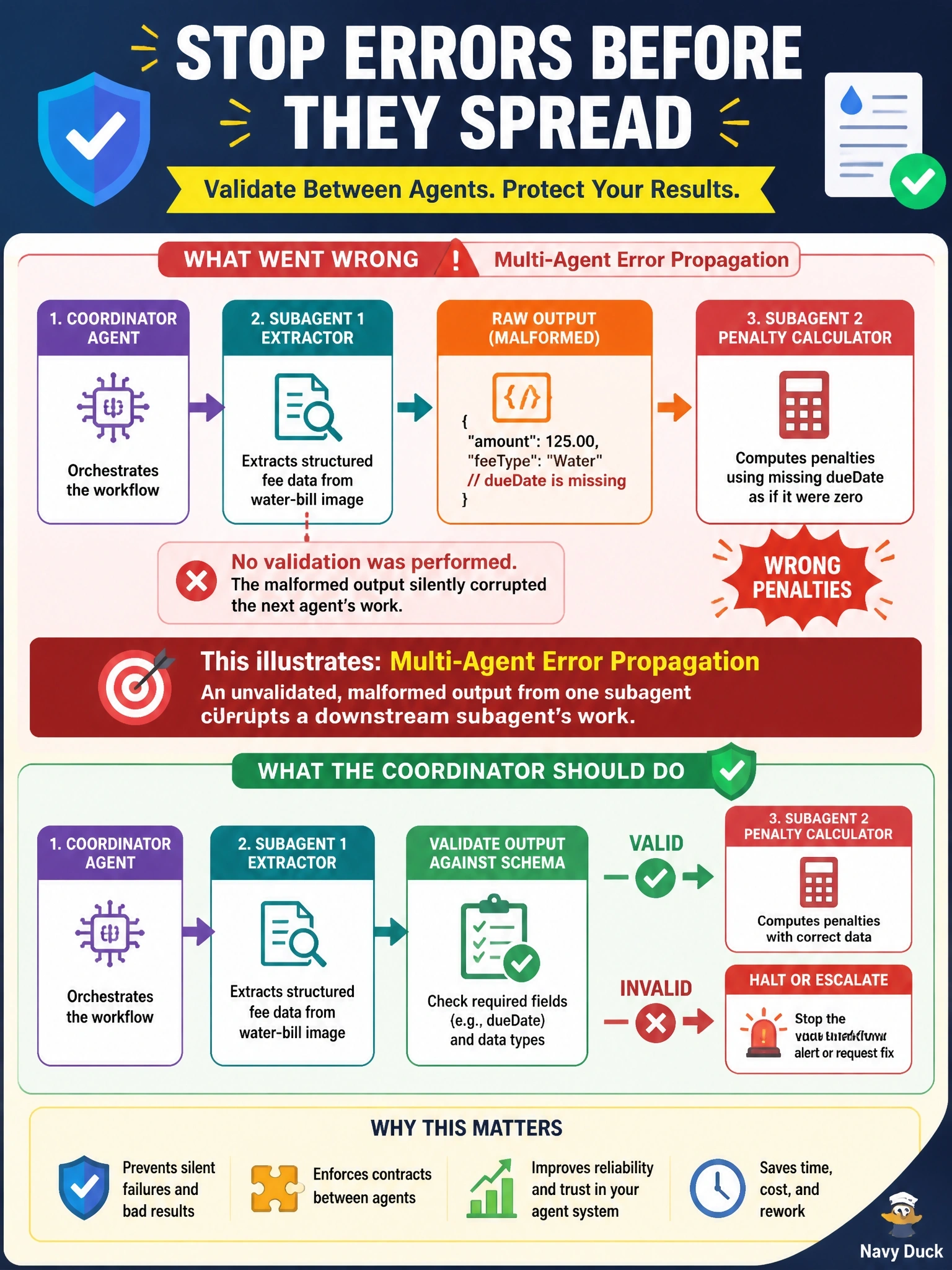
A coordinator agent spawns a subagent to extract structured fee data from scanned water-bill images, then immediately passes that subagent's raw output into a second subagent that calculates late-payment penalties, without checking the first output's shape. The second subagent silently computes penalties against a missing dueDate field as if it were zero. What does this scenario illustrate, and what should the coordinator do differently?
Select an answer to reveal the explanation.
Short Explanation
One runner drops the baton and the next keeps sprinting with an empty hand. Validate each subagent output against its schema before handing it downstream, and halt when validation fails.
Full Explanation
Every handoff between subagents is a trust boundary. A coordinator that pipes one subagent's raw output straight into the next has silently assumed the first stage succeeded, and in a fee-extraction chain that assumption is load-bearing: a missing dueDate is not an error anyone raised, it is simply an absent key that the next stage reads as zero.
Validating each subagent's output against its expected schema before passing it forward turns a silent gap into a caught defect. The penalty calculator never sees a record missing a required field, and the coordinator can halt, retry the extraction, or escalate to a human, a decision that only exists while the failure is still visible.
Lost-in-the-middle describes attention degradation across a long context inside a single call, not data corruption across separate invocations; tool_choice governs whether and which tool one call must invoke and says nothing about inspecting a result before reuse; and the Message Batches API is asynchronous bulk processing, so putting both subagents in one batch changes scheduling, not validation.
Exam caveat: schema validation catches shape, not truth, and a dueDate that parses cleanly can still be the wrong date read off a smudged scan, so confidence signals and spot audits still matter. Operational check: feed the coordinator a water bill with the due date deliberately obscured and confirm the run halts at the validation step rather than emitting a penalty computed from zero.