
A municipal GIS team's parcel-QA skill has grown to include a full coordinate-reference-system conversion table and the county's twelve-page attribute-domain dictionary. Both are needed occasionally but not on most runs, and the SKILL.md is now unwieldy. What is the recommended structure?
Select an answer to reveal the explanation.
Short Explanation
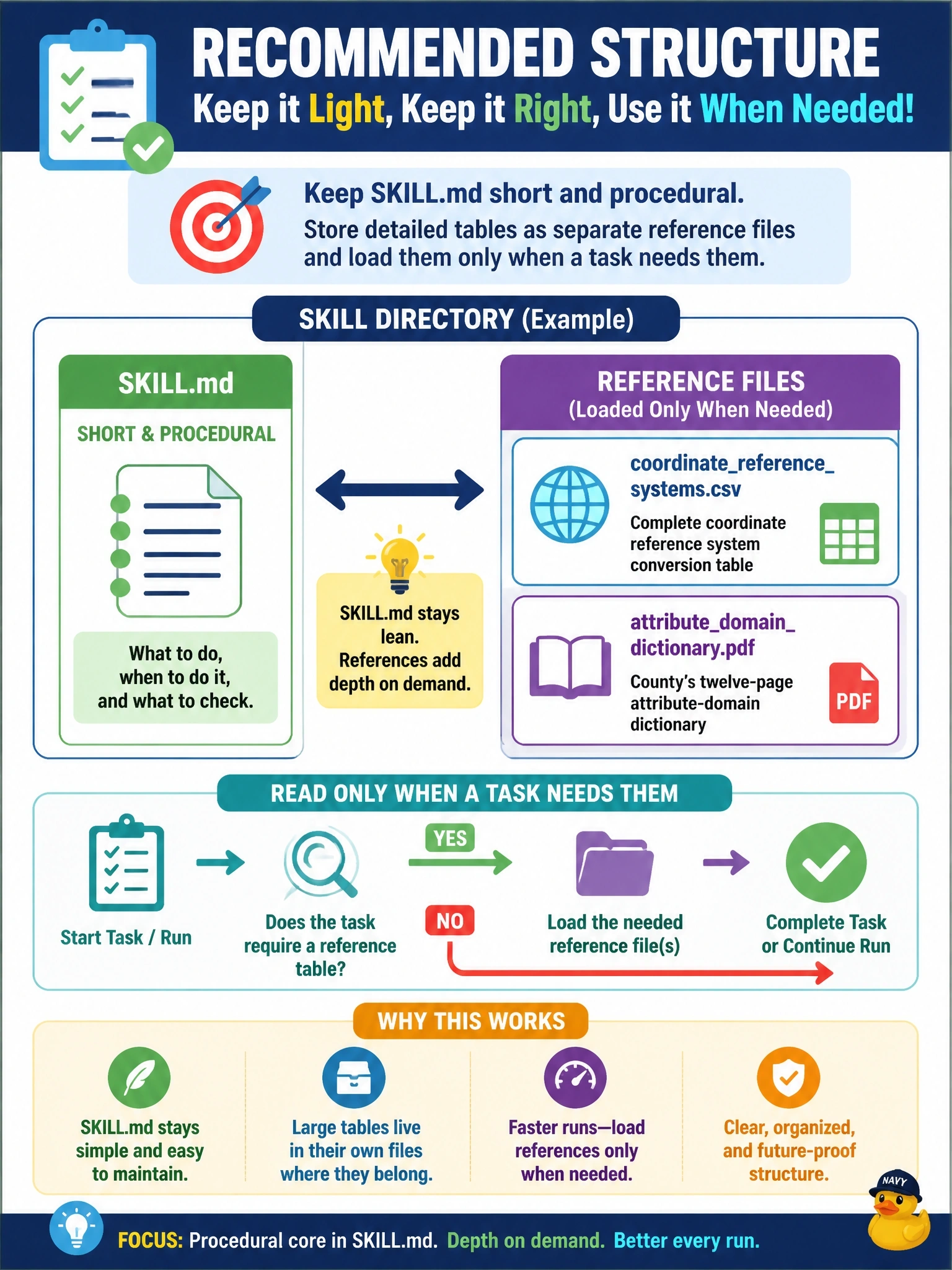
Treat SKILL.md as the table of contents and the bundled tables as appendices. The coordinate-reference table comes off the shelf only on the run that needs it, instead of loading on every routine parcel check.
Full Explanation
Context is a budget, and the real question is when each piece of material gets charged against it. Skills are built for progressive disclosure across three levels: the description decides whether the skill applies at all, the SKILL.md body carries the procedure once the skill is selected, and bundled files carry bulk material that is read only on demand.
Keeping SKILL.md short and procedural means a routine parcel-QA run pays only for the steps it actually follows, while the coordinate-reference-system conversion table and the twelve-page attribute-domain dictionary sit beside it in the skill's own directory, referenced by relative path and read when a task genuinely needs them. The material stays authoritative and complete without being loaded into every invocation.
Splitting into twelve smaller skills multiplies the routing surface and makes selection less reliable, since the model must now discriminate among near-identical descriptions; moving the tables into CLAUDE.md inverts the goal by loading them into every session, including the many with nothing to do with parcels; and abbreviating the tables in place keeps them loaded on every run and adds a new hazard, because a lossy compression of a coordinate-reference table can silently change what the skill asserts.
Exam caveat: on-demand loading only pays off if the body tells the model when to reach for each file, since a bundled reference nobody is pointed at is a file that never gets read. Operational check: run one parcel task that needs the conversion table and one that does not, and confirm the reference file is read in the first and left untouched in the second.