
A civic ETL team wants Claude to implement a mapper with strong behavioral coverage. What should they prepare first?
Select an answer to reveal the explanation.
Short Explanation
Ask Claude to build the mapper after you've already laid out the obstacle course—behavior, edges, performance. Then let failing hurdles steer the next lap.
Full Explanation
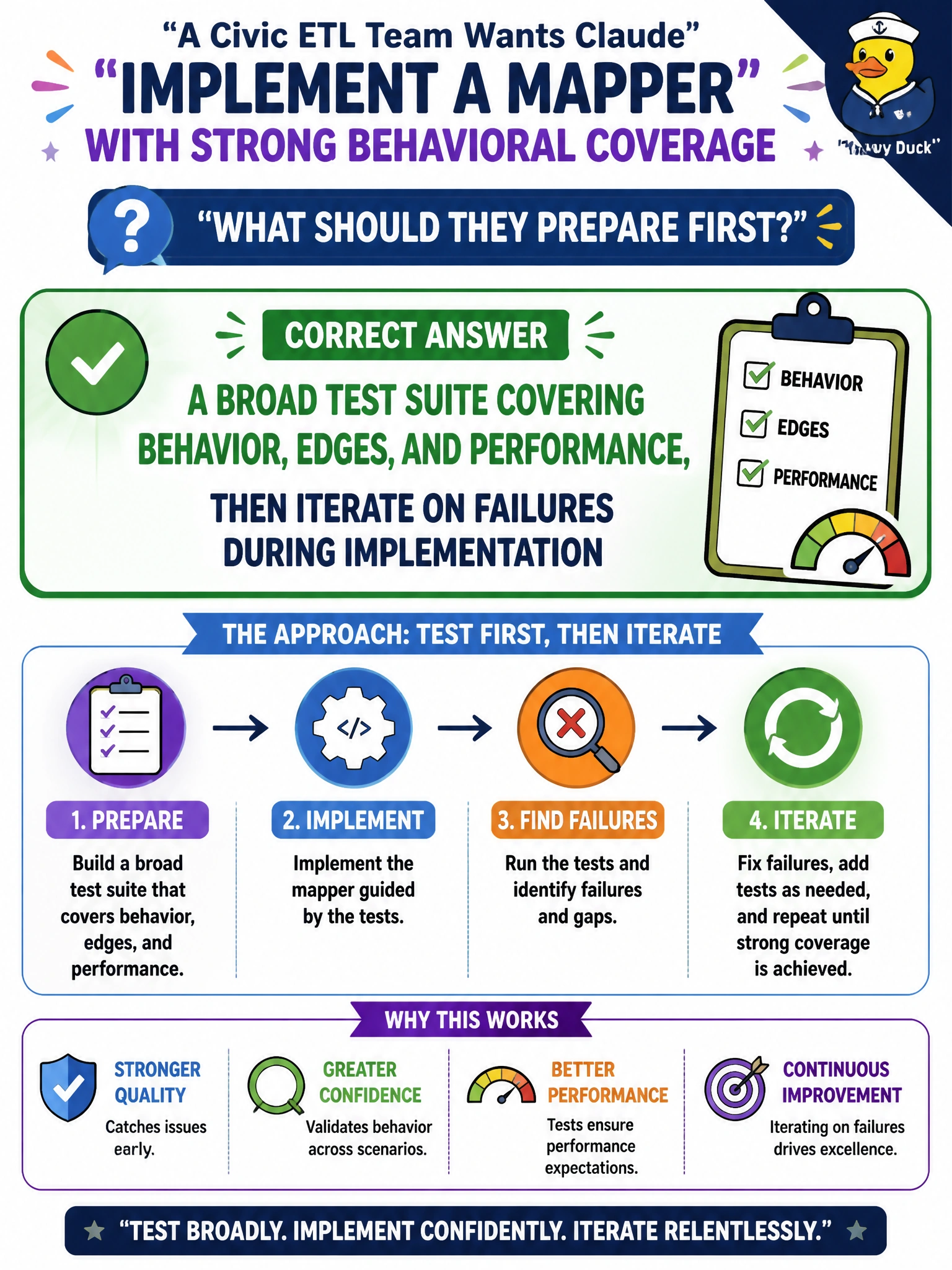
A civic ETL team that wants Claude to implement a mapper with strong behavioral coverage should prepare first a broad test suite covering behavior, edges, and performance, then iterate on failures during implementation. Tests are the executable specification Claude optimizes toward.
A broad suite works because mappers fail on edges and load characteristics as often as on the happy path—nulls, duplicates, oversized batches, and slow paths matter for municipal ETL windows. Writing those expectations first gives Claude clear red/green targets. Iterating on failures progressively closes gaps instead of declaring victory after one sample row works.
Deferring all tests until after production traffic validates the mapper live fails by using residents and ops incidents as the test harness. A single happy-path assert with instructions to skip edge cases fails by deliberately under-specifying the hard parts. Screenshots of dashboards instead of executable expectations fail by concept: screenshots are not deterministic assertions Claude can re-run after each edit.
Exam caveat: breadth means behavior plus edges plus performance-relevant cases—not infinite tests, but more than a single happy path. Operational check: land the mapper test suite first, implement against failures with Claude, and refuse production promotion until behavior, edge, and performance cases pass.