
Why prefer path-scoped .claude/rules/ over always-on subdirectory CLAUDE.md files for niche GIS conventions?
Select an answer to reveal the explanation.
Short Explanation
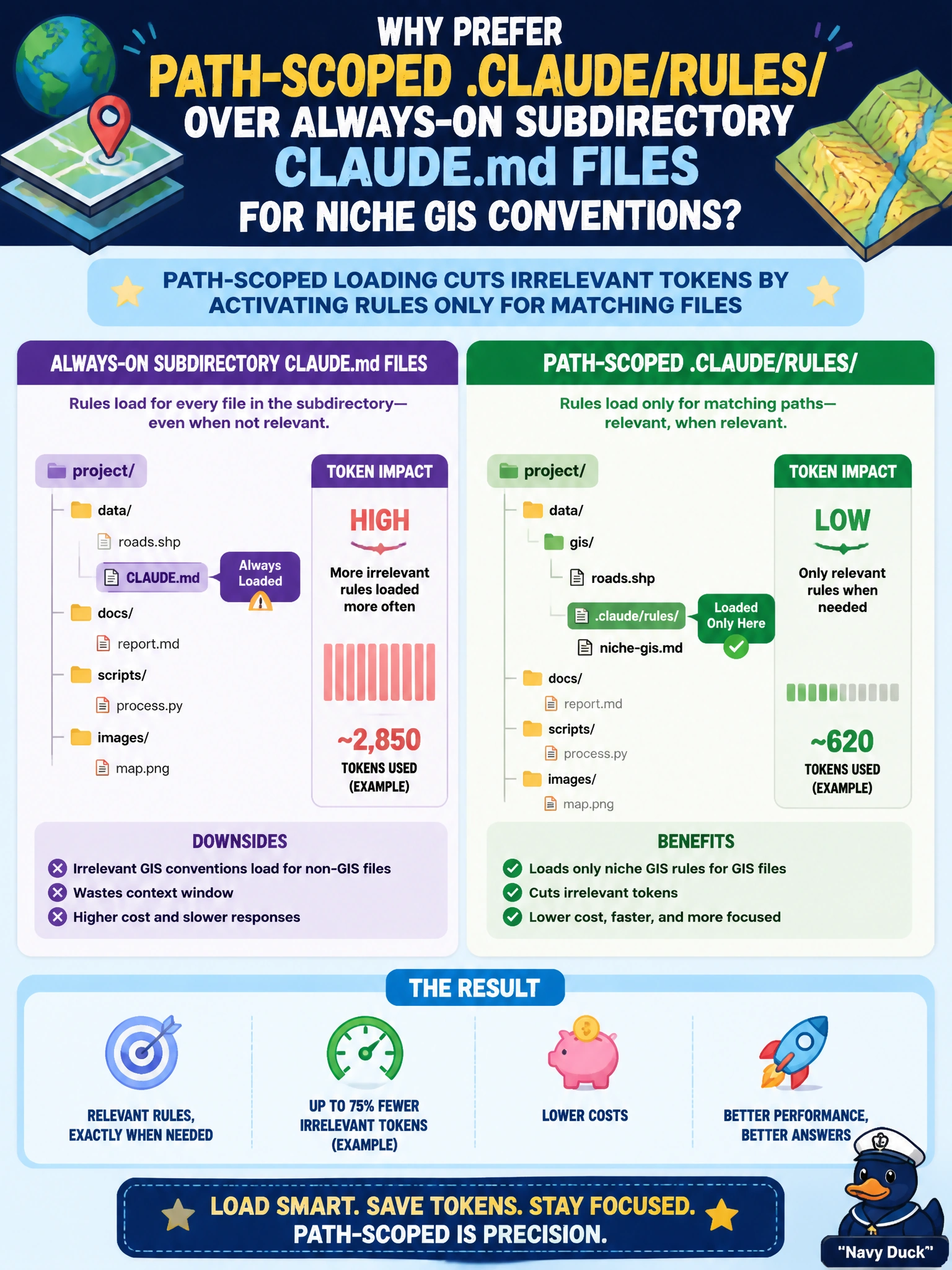
Always-on GIS notes in every chat are like blasting flood maps during a library meeting—extra noise. Path-scoped rules wake up only when you're actually touching matching files, saving tokens.
Full Explanation
Niche GIS conventions should prefer path-scoped .claude/rules/ over always-on subdirectory CLAUDE.md files because path-scoped loading cuts irrelevant tokens by activating rules only for matching files. Municipal GIS projection, CRS, and layer conventions matter when geo modules are open; they are costly noise in every unrelated chat.
Path-scoped rules work by tying activation to edited paths. When an engineer works in GIS packages, the rules inject; when they work in billing or 311 UI code, those tokens stay out of context. That is the architectural win for niche domain conventions in a broader civic codebase: share the standards in git, pay for them only when relevant.
Path-scoped rules do not delete the GIS package from disk when unused—that confuses configuration with destructive filesystem behavior. Subdirectory CLAUDE.md files are not forbidden in every Claude Code project; they remain valid for package-local always-relevant guidance, but they are a weaker fit when the goal is conditional activation and token hygiene for niche GIS content. Path rules do not force Bash execution on every file open; they are instruction-loading rules, not shell hooks.
Exam caveat: prefer path-scoped rules specifically when the problem is irrelevant always-on tokens for niche domains—not because subdirectory CLAUDE.md is illegal. Operational check: compare context with a GIS file versus a non-GIS file open and verify GIS rules appear only for matching paths.