
A housing authority needs on-demand release notes and always-on coding standards. How should those be split?
Select an answer to reveal the explanation.
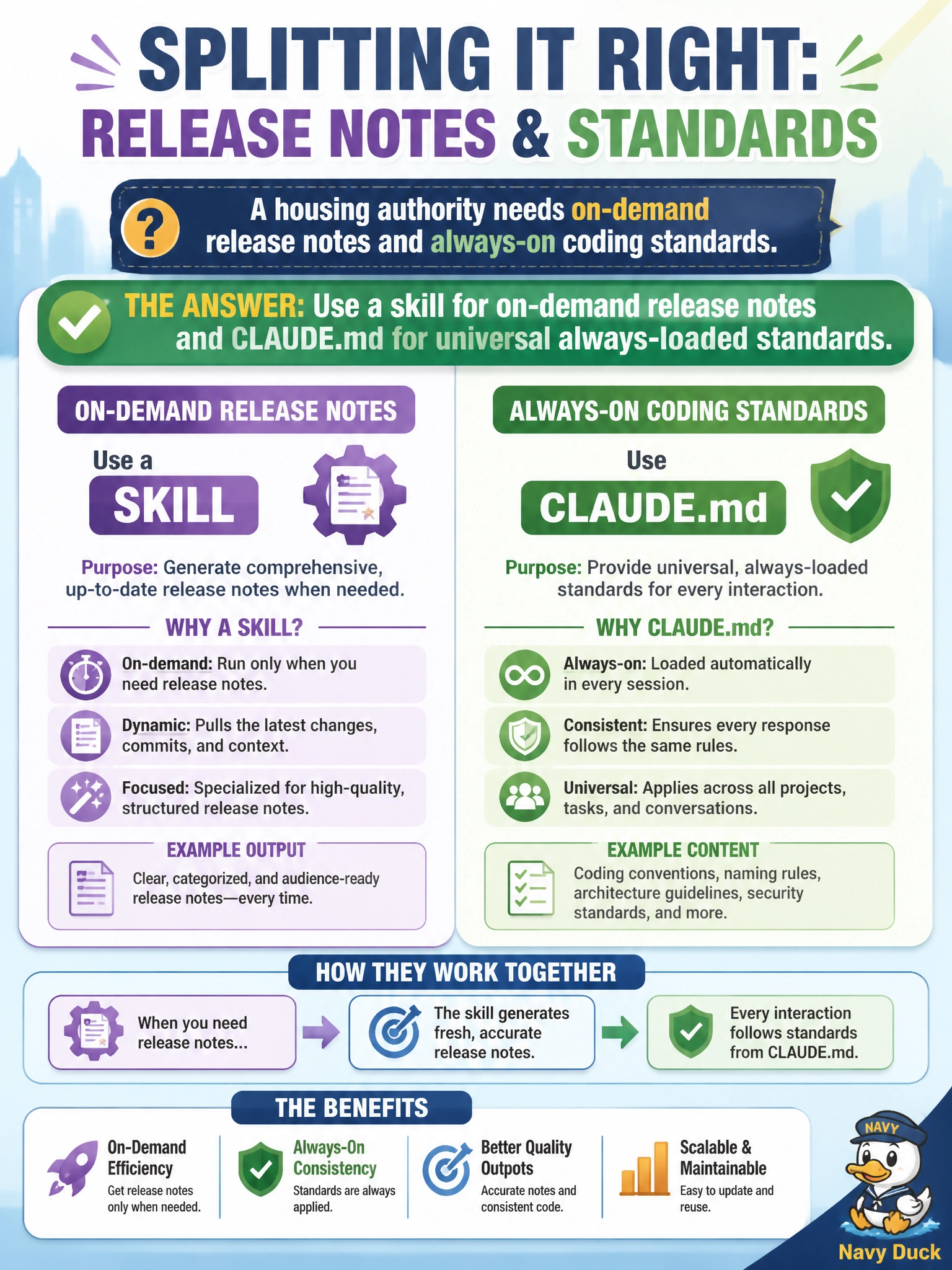
Short Explanation
Always-on standards belong on the wall chart everyone sees walking in; release notes are the checklist you pull when shipping. Skill for on-demand notes, CLAUDE.md for the forever rules.
Full Explanation
A housing authority that needs on-demand release notes and always-on coding standards should split those concerns by configuration type: a skill for release notes invoked when shipping, and CLAUDE.md for universal coding standards that load every session. Skills are the right vehicle for procedural workflows you call deliberately; CLAUDE.md is the right vehicle for baseline conventions that must constrain every prompt.
The skill-plus-CLAUDE.md split works because release-note generation is episodic—run at cut time with a checklist—while coding standards are continuous guardrails for naming, testing, and review. Putting standards in CLAUDE.md ensures every housing-authority session sees them without requiring engineers to remember a slash command. Keeping release notes in a skill avoids paying always-on token cost for a procedure used only at release.
Putting both only in a user-level skill fails because teammates and clones never receive shared standards or a shared release-note workflow from the repo. Storing release-note steps in CLAUDE.md and coding standards in a rarely used slash command inverts the load model: release prose would inflate every session while standards would be easy to skip. Embedding both as Bash aliases outside Claude Code configuration fails by concept because aliases do not participate in Claude Code skill discovery, CLAUDE.md loading, or team-shared agent guidance inside the product.
Exam caveat: on-demand versus always-on is the primary split criterion—not whether the content is "important." Operational check: open a fresh Claude Code session in the housing repo and confirm coding standards appear from CLAUDE.md without invocation; then run the release-notes skill only when cutting a release and confirm it is not always injected.