
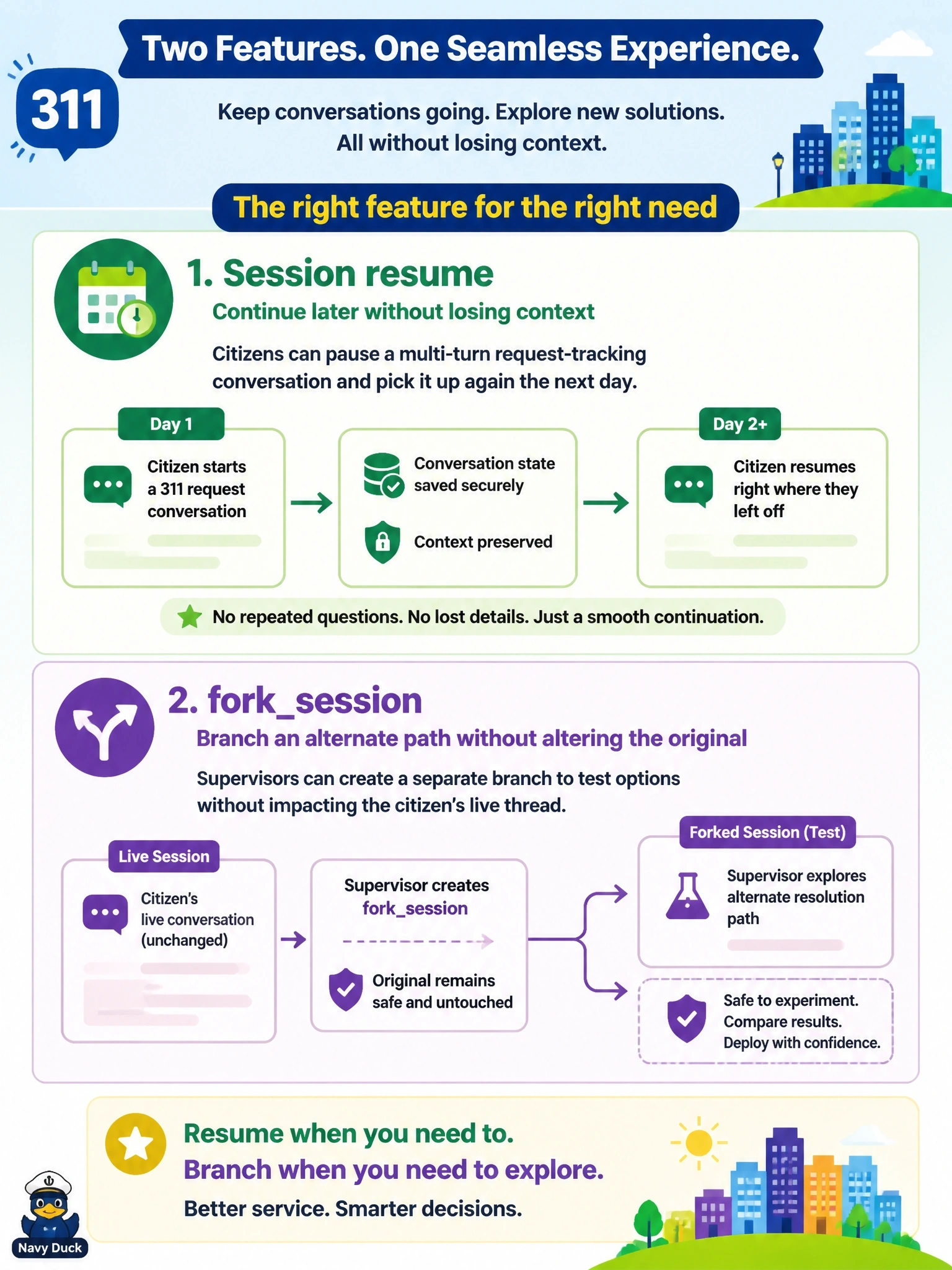
A resident-facing 311 assistant built on Claude Code needs to let a citizen pause a multi-turn request-tracking conversation and pick it up again the next day without losing prior context, and separately lets a supervisor branch off an alternate resolution path to test without touching the citizen's live thread. Which two features respectively address these needs?
Select an answer to reveal the explanation.
Short Explanation
Session resume is picking a phone call back up tomorrow. fork_session is duplicating the thread so a supervisor can try a different resolution in a copy while the resident's live conversation stays untouched.
Full Explanation
Continuity and branching are two different properties of session state, and a resident-facing 311 assistant needs both without confusing one for the other. Continuity means reloading an existing conversation's state later; branching means deriving a second, independent line of work from that state while the original keeps running.
Session resume reloads a stored session, so the citizen's request-tracking thread continues with its prior context instead of starting cold the next day. fork_session creates a new session seeded from an existing one's state, so the supervisor's alternate resolution path evolves inside the fork and nothing from that exploration reaches the citizen's live thread.
CLAUDE.md hierarchy distributes shared instructions and conventions and holds no conversation state, while a slash command is a reusable prompt trigger rather than a branching primitive; starting a brand-new session each day discards exactly the context continuity was meant to preserve, and hand-copied transcripts are a lossy manual reconstruction rather than a feature; a PostToolUse hook fires around tool calls and an MCP resource exposes external data, so neither touches session lifecycle at all.
Exam caveat: a fork inherits conversation state, not the outside world, so files, tickets, and case records the original session touched are shared and a supervisor experimenting in a fork can still cause real side effects. Operational check: fork a live thread, have the fork write to the case record, and confirm whether the original thread's system of record changed; scope the fork's tool permissions if it did.