
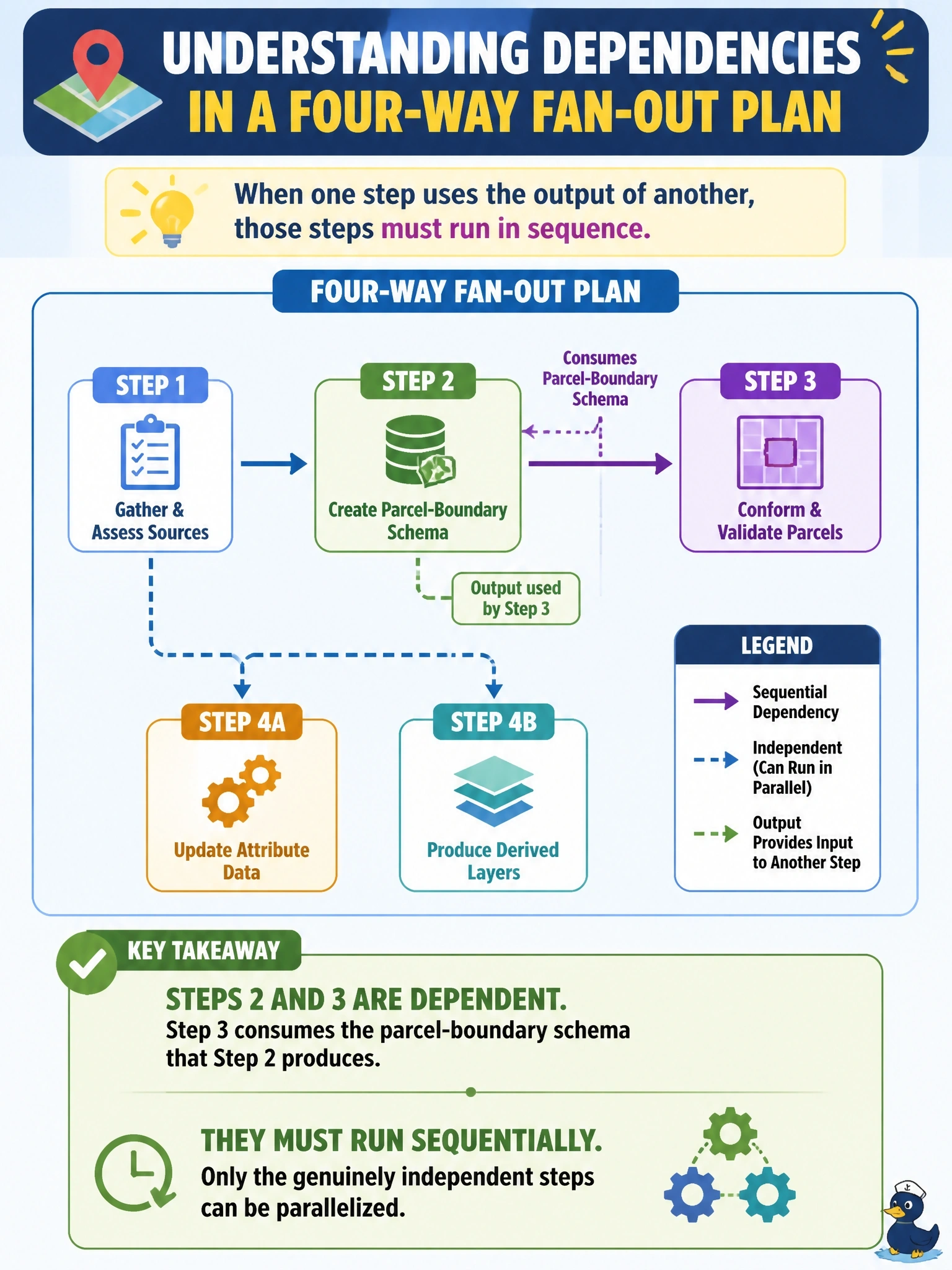
A GIS team plans a four-way parallel fan-out for a parcel-data modernization job. Reviewing the plan, an architect notices that step three consumes the parcel-boundary schema that step two produces. What is the correct reading of this plan?
Select an answer to reveal the explanation.
Short Explanation
A fan-out is only a fan-out if the branches do not need each other. Step three waits on step two's schema, so those two are a chain wearing a parallel costume.
Full Explanation
The test for parallelism is whether a step consumes anything another step has not yet produced. Subagents run in isolated contexts and return only a final message, so a downstream step launched alongside its upstream step has nothing to read. A dependency in the plan is a fact about the work, not an inconvenience the topology can override.
Recognizing that step three consumes step two's parcel-boundary schema yields a hybrid plan—parallelize the genuinely independent slices, then run the dependent pair in order, feeding step two's schema into step three's launch prompt. Most of the speedup survives, and the one real ordering constraint is honored rather than hoped past.
Having step three poll for a file turns a subagent into a busy waiter, spending turns and tokens with no guarantee the file it eventually observes is complete rather than half-written; having step three derive the schema itself duplicates work and lets two independently derived schemas diverge, a subtler bug than a plain ordering error; assuming the parent's final merge repairs the violation misunderstands merging, which can only combine outputs that were correct when produced.
Exam caveat: dependencies are easiest to miss when implicit—a shared file or a schema referenced by convention rather than passed explicitly. Operational check: before launching, list each step's inputs and outputs and confirm that no step's input appears as another step's output within the same parallel batch.