
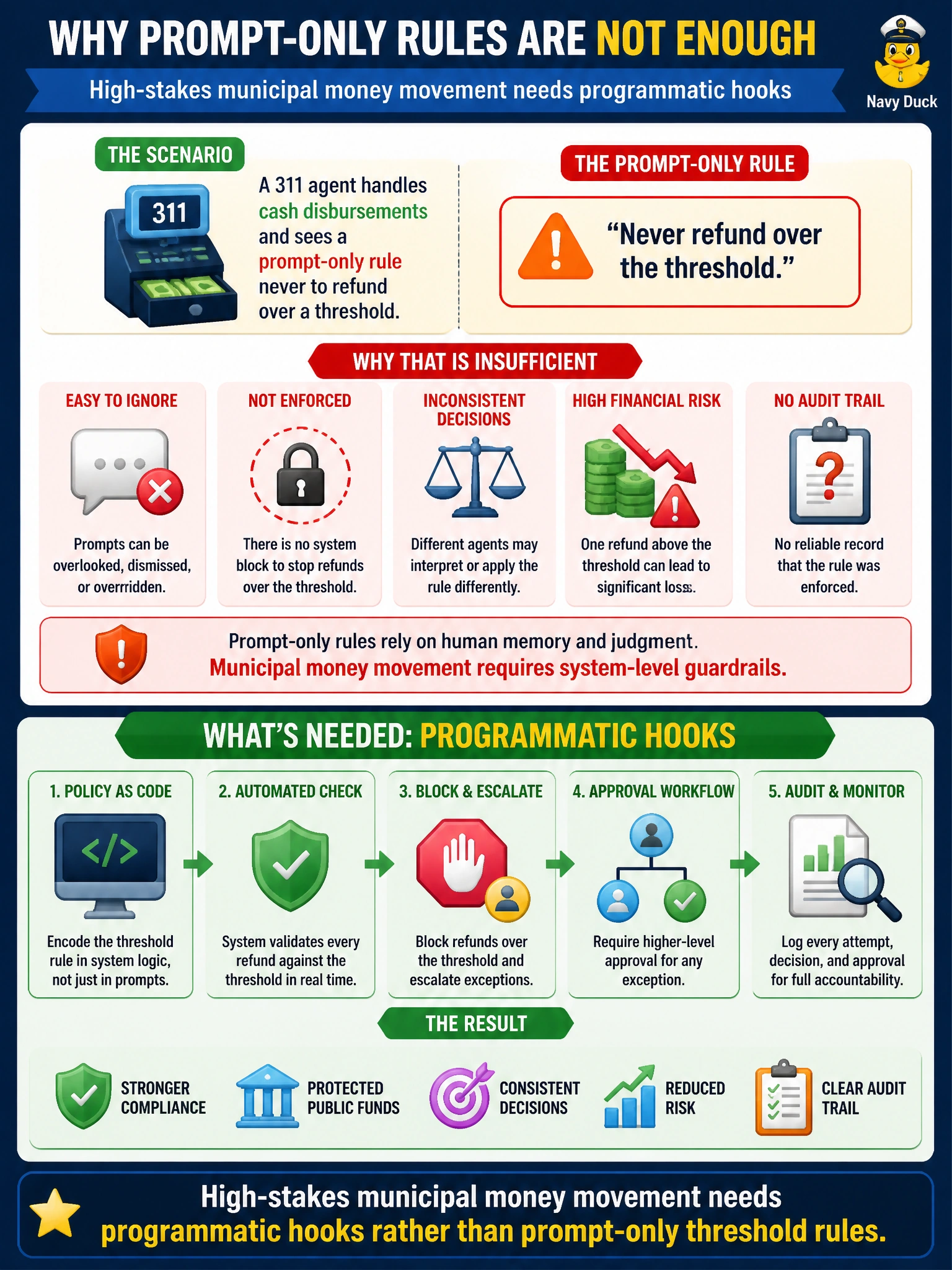
A 311 agent handles cash disbursements and sees a prompt-only rule never to refund over a threshold. Why is that insufficient?
Select an answer to reveal the explanation.
Short Explanation
When 311 can push cash, a prompt saying "please don't go over" is not a vault. Put the threshold in a programmatic hook so over-limit refunds cannot sneak through.
Full Explanation
A prompt-only rule never to refund over a threshold is insufficient for a 311 agent that handles cash disbursements because high-stakes municipal money movement needs programmatic hooks, not advisory text. Thresholds that protect city funds must deny tool execution when exceeded; prompts cannot provide that determinism across every refund call.
Claiming prompt-only money rules are deterministic across every refund tool call fails because instruction following is probabilistic, especially when residents argue hardship or tools are nested. Asserting cash disbursements are exempt from compliance controls in civic agents fails conceptually—cash movement is among the highest-control civic actions. Treating thresholds as advisory slogans that never belong in runtime enforcement fails because the exam (and municipal practice) place thresholds in interception and policy gates, not motto text alone.
Exam caveat: programmatic thresholds still need dual-control or human escalation paths for legitimate exceptions; a hard block without an allowed override workflow can freeze valid hardship relief. Operational check: enforce refund ceilings in an outgoing tool-call hook, escalate over-limit requests with amount and reason codes, and reconcile daily disbursement totals against hook allow/deny logs.