
A housing subsidy agent has business rules that must never be probabilistically skipped. When should hooks be selected?
Select an answer to reveal the explanation.
Short Explanation
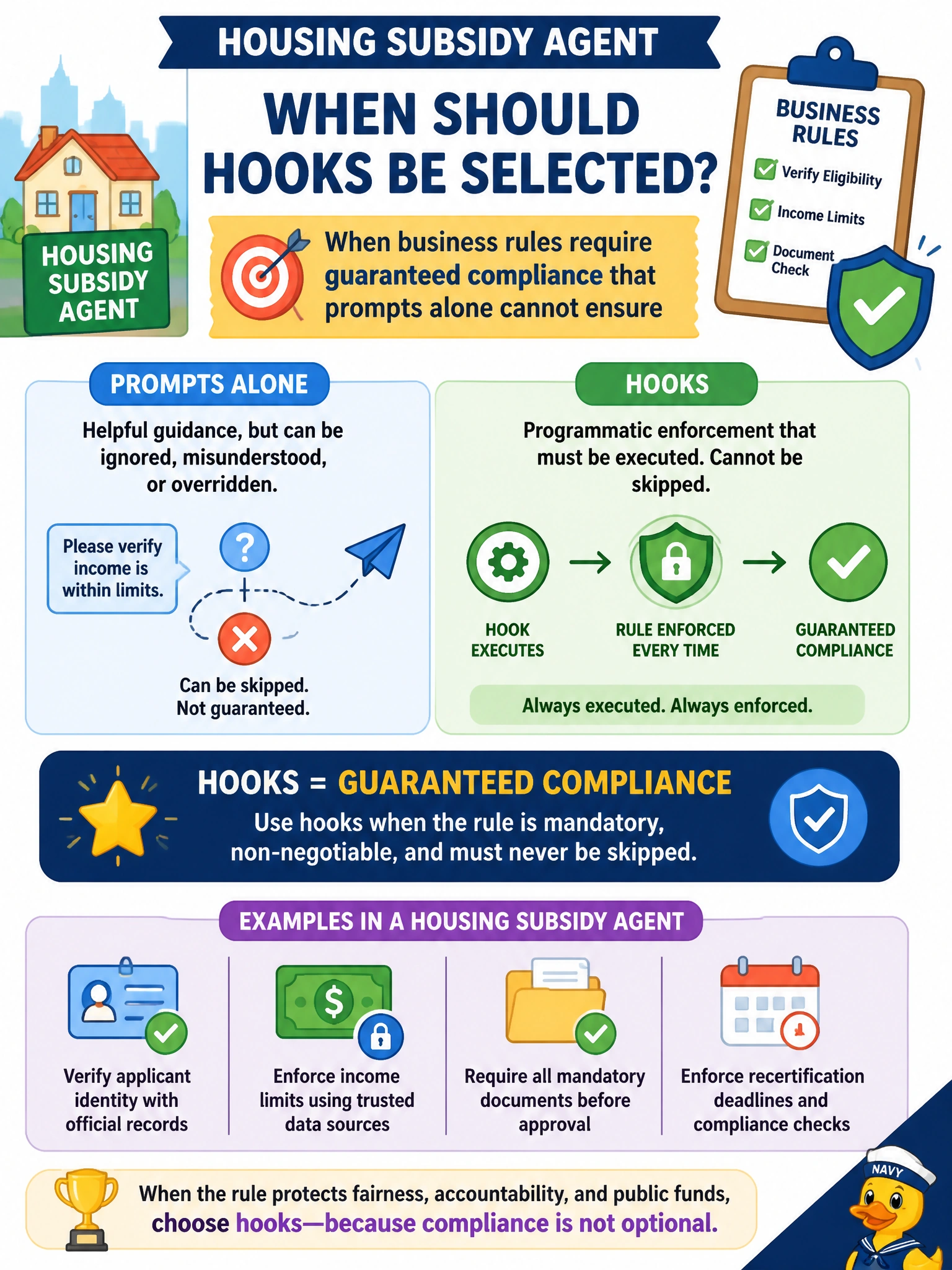
Skipping a subsidy rule that hurts a resident is not something to leave to chance. Reach for hooks whenever the business rule has to fire every single time.
Full Explanation
Hooks should be selected for a housing subsidy agent when business rules require guaranteed compliance that prompts alone cannot ensure. Subsidy eligibility, payment caps, and household composition checks are high-impact civic rules; probabilistic skip risk translates directly into wrongful payments or wrongful denials for residents.
Selecting hooks only when rules are decorative and failure has no resident impact fails because decorative rules do not justify control investment—and real subsidy rules are not decorative. Claiming prompts are always sufficient for subsidy eligibility gates fails conceptually for the same reason prompt-only money and eligibility controls fail elsewhere: non-zero compliance failure. Waiting until after a production incident has already paid the wrong subsidy fails because controls should be preventive; incident-driven gating accepts avoidable resident harm first.
Exam caveat: guaranteed enforcement of a bad or incomplete rule set still harms residents—hooks amplify the quality of the encoded policy. Operational check: inventory subsidy rules that are must-never-skip, implement hook gates for those tools, run adversarial prompt tests that try to bypass them, and require zero successful bypasses before production release.