
A parks master-plan coordinator writes prompts for research subagents that may discover unexpected trail-usage patterns. How should those prompts be designed?
Select an answer to reveal the explanation.
Short Explanation
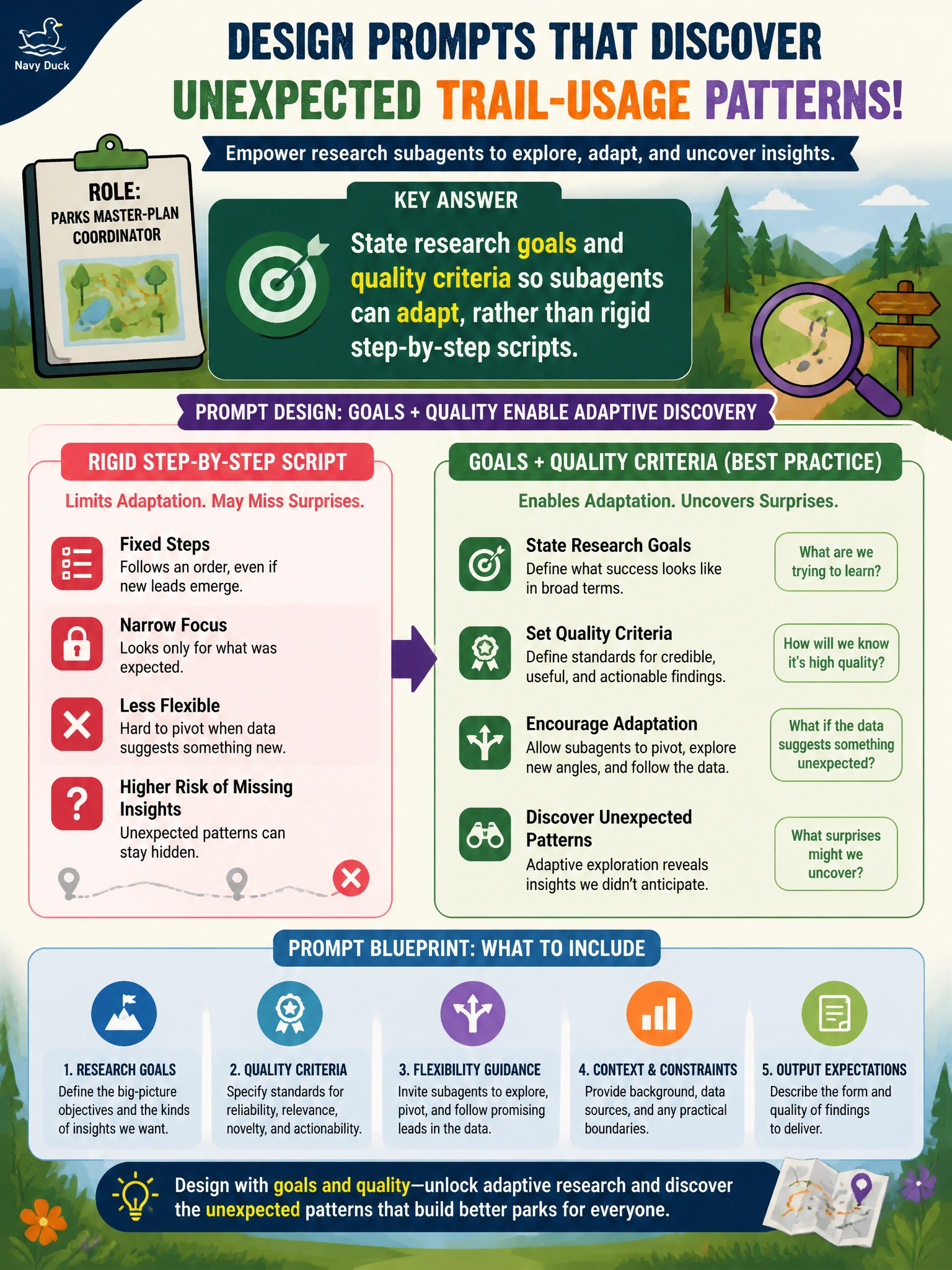
Tell the scouts what good coverage looks like and what question to answer—not a paint-by-numbers script that falls apart when trail data surprises them. Goals plus quality criteria keep them adaptable.
Full Explanation
A parks master-plan coordinator writing prompts for research subagents that may discover unexpected trail-usage patterns should state research goals and quality criteria so subagents can adapt, rather than rigid step-by-step scripts. Goal-and-criteria prompts tell specialists what good coverage looks like and what question to answer, while leaving room to follow surprising but relevant data in the parks system.
Goals plus criteria work in exploratory civic research because trail sensors, complaints, and permit logs rarely match a preconceived click path. Adaptive specialists can deepen on emergent peak-hour patterns without waiting for a rewritten micro-script from the coordinator.
Listing every click-path command with no deviation fails when reality diverges and the script cannot proceed usefully. Omitting goals and providing only a maximum word count yields unfocused prose that does not serve the master plan. Requiring subagents to mirror the coordinator's hidden reasoning trace verbatim couples them to unavailable chain-of-thought and blocks independent investigation.
Exam caveat: adaptability is not absence of constraints—still restrict tools and require citation standards in the same prompt. Operational check: inject an unexpected trail-usage spike in fixture data and verify goal-driven agents investigate it, while rigid scripts skip or error.