
A permit-research subagent needs prior GIS findings to continue a parcel review. How should those findings be supplied?
Select an answer to reveal the explanation.
Short Explanation
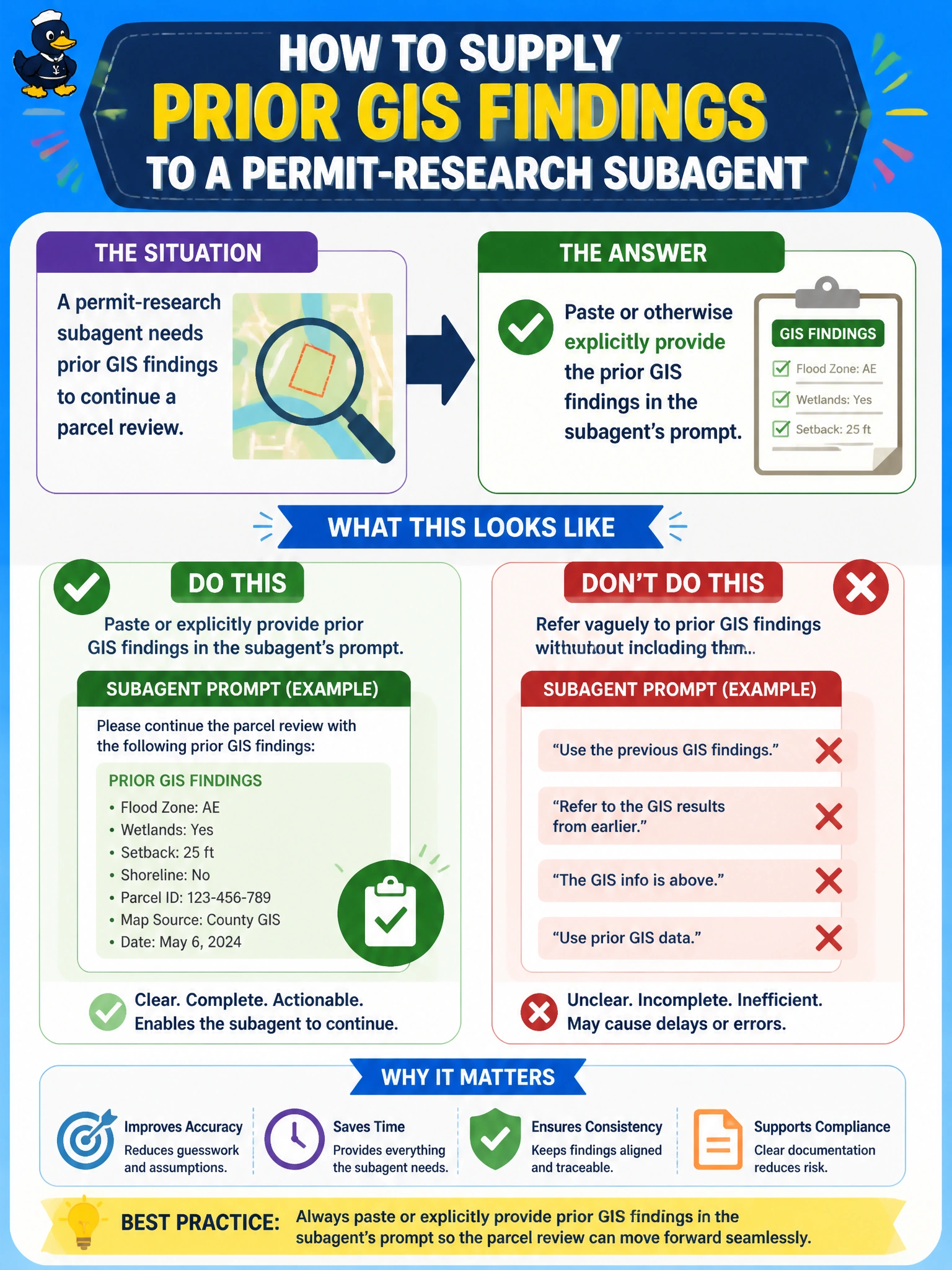
Do not assume the new subagent sat through the GIS briefing—it did not. Paste the prior findings right into its prompt so the parcel review starts with facts, not vibes.
Full Explanation
A permit-research subagent that needs prior GIS findings to continue a parcel review must receive those findings explicitly in its prompt or structured Task input. Subagents start with isolated context; they do not automatically inherit the parent coordinator's GIS memory. Pasting prior layers, parcel IDs, zoning hits, and caveats into the subagent prompt is how continuity is established for municipal parcel review.
Explicit provision works because it makes dependencies visible and testable: reviewers can see exactly which GIS facts the specialist was given. It also prevents hallucinated memory of surveys the child never saw, which is especially dangerous when setbacks or floodplain overlays affect permit outcomes.
Assuming automatic inheritance of the parent's GIS memory fails isolation defaults and yields incomplete parcel reviews. Storing GIS notes only in the coordinator UI never reaches the model that must reason about the parcel. Waiting for the subagent to scrape the parent's hidden transcript without permission is neither a supported pattern nor acceptable for governed permitting systems.
Exam caveat: pass the minimum necessary GIS facts under need-to-know, not the entire unrelated parent transcript. Operational check: spawn the parcel-review subagent with and without pasted GIS findings and confirm only the explicit-handoff run cites correct prior layer attributes.