
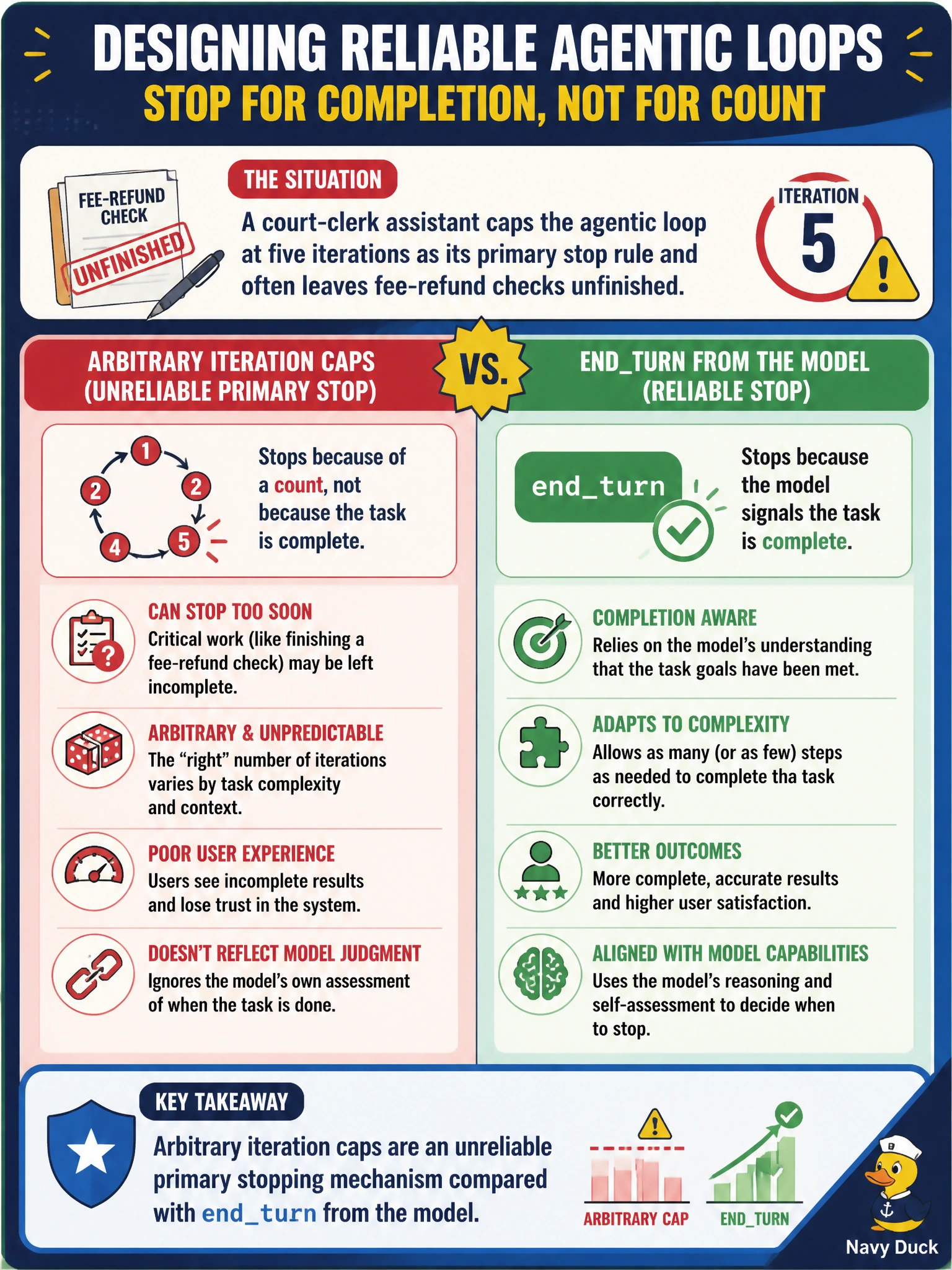
A court-clerk assistant caps the agentic loop at five iterations as its primary stop rule and often leaves fee-refund checks unfinished. What should architects recognize about that design?
Select an answer to reveal the explanation.
Short Explanation
A hard five-try ceiling is like telling the clerk to leave the counter after five stamps whether the refund finished or not. Use the model's end_turn as the real stop, and treat caps as a safety net—not the main rule.
Full Explanation
Capping a court-clerk assistant's agentic loop at five iterations as the primary stop rule is an unreliable design. Iteration limits are useful as safety backstops against runaway tool calls, but they are not the Anthropic-aligned primary completion signal. The model's end_turn, with no pending tool_use, indicates the clerk workflow believes fee-refund checks and related MCP steps are finished. An arbitrary five-step ceiling can exit while refund verification is still incomplete, leaving residents without a finished determination.
Recognizing caps as secondary works because civic refund flows vary in length: identity confirmation, payment history, eligibility rules, and ledger posting may need more than five round trips on complex cases and fewer on simple ones. Primary reliance on end_turn lets the model finish when the work is actually done while a high safety ceiling still bounds abuse.
Treating five as an Anthropic-required default is false; no such universal civic default exists. Replacing stop_reason checks with iteration caps so refunds complete faster confuses speed with correctness and systematically under-serves multi-step cases. Interpreting unfinished refunds as proof that tool_use should be ignored after the third call doubles down on premature termination instead of fixing the stop policy.
Exam caveat: keep a high safety max_iterations, but never let it be the first condition that ends successful work. Operational check: run a refund scenario known to need more than five tool rounds and confirm the loop continues while stop_reason is tool_use, exiting only on end_turn or the safety cap if truly runaway.