
During clinical rounds in a rehabilitation facility, an infection preventionist sees a wheelchair-bound resident with an indwelling urinary catheter whose drainage bag is resting on the resident's lap above waist level and whose tubing has a dependent loop. Which maintenance practice should the infection preventionist reinforce to prevent catheter-associated urinary tract infection?
Select an answer to reveal the explanation.
Short Explanation
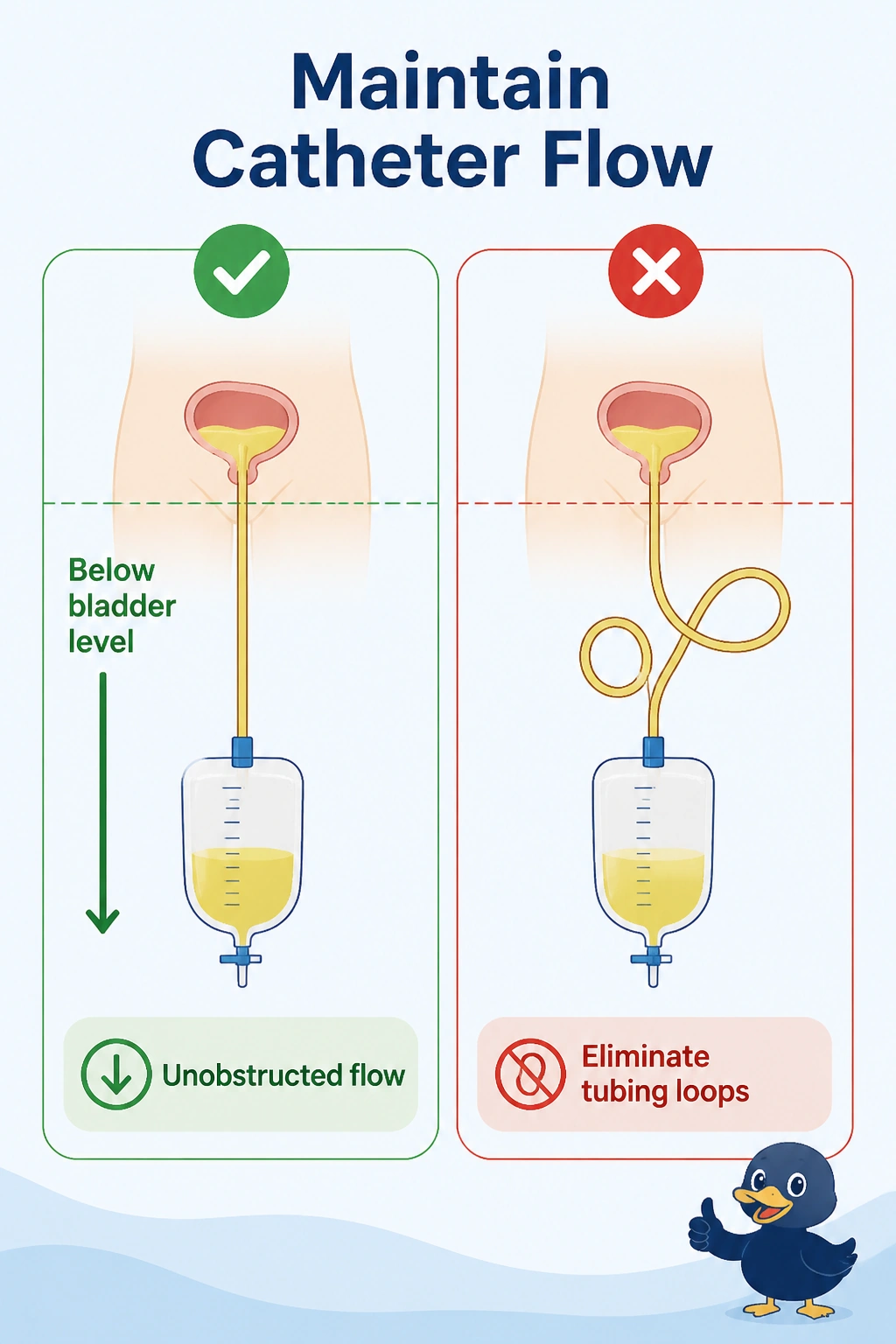
Gravity is your best friend with an indwelling urinary catheter, and letting the bag sit above the bladder turns it into a backward slide for bacteria. The trap is thinking routine catheter changes or bladder flushes prevent infection when they actually break the closed system. Keep the bag below the bladder and the tubing kink-free so urine flows one way.
Full Explanation
Once an indwelling urinary catheter is in place, preventing retrograde movement of contaminated urine from the drainage bag into the bladder is essential to reducing catheter-associated urinary tract infections. Choosing Keep the closed drainage bag below bladder level and eliminate tubing loops to maintain unobstructed flow follows CDC and HICPAC CAUTI prevention guidelines by using gravity to prevent urine stasis and backflow while preserving a sterile closed system. The other options increase infection risk. Choosing Disconnect the drainage tubing daily to irrigate the bladder with sterile saline breaks the closed drainage system and introduces microorganisms unless specifically ordered for obstruction. Choosing Clamp the catheter tubing for two hours before emptying the collection bag causes urine stasis inside the bladder and increases intravesical pressure without proven benefit. Choosing Change the indwelling urinary catheter routinely every seven days regardless of function subjects the resident to unnecessary urethral trauma and biofilm disruption when catheters should be replaced only for clinical indications such as obstruction or infection. As a caveat, never allow the drainage bag or spigot to rest directly on the floor. For an operational check, include wheelchair and bed positioning checks during unit rounds to verify unobstructed, dependent drainage.
Prefer to study offline? Printable PDF study book + test engine ($7.50, unofficial). These questions stay free here.