
An inpatient in an Airborne Infection Isolation Room with suspected pulmonary tuberculosis must be transported to radiology for an urgent CT scan. Which precaution should the transport team implement for the patient during movement through hospital corridors?
Select an answer to reveal the explanation.
Short Explanation
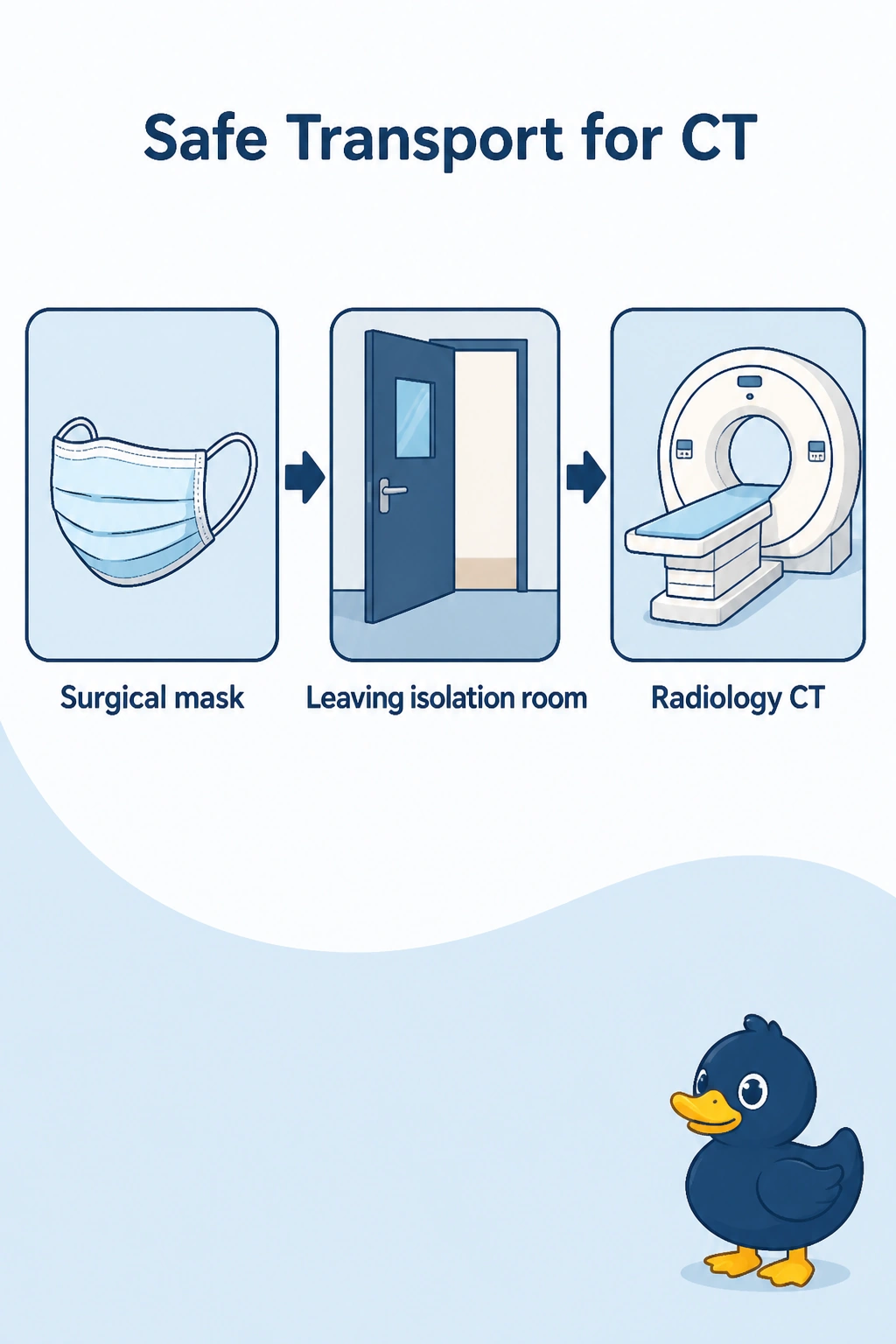
You’re right to focus on source control when moving a patient with suspected TB through hospital corridors. Have the patient wear a surgical mask outside the isolation room; a valved N95 respirator is not the routine source-control choice, and its emission reduction varies by design. Keep transport low-traffic to protect others.
Full Explanation
Having the patient wear a surgical mask while outside the isolation room follows CDC Isolation Precautions guidance for Airborne Precautions when medically necessary transport cannot be avoided. The mask provides source control by capturing respiratory secretions before they form infectious droplet nuclei. A fit-tested N95 respirator with an exhalation valve is not the routine TB transport recommendation: a surgical or procedure mask is recommended when tolerated, and although valved respirators can reduce emissions, performance varies by design. Requiring sterile gloves and an isolation gown addresses contact transmission rather than airborne respiratory aerosols. Postponing all diagnostic imaging until three sputum smears are negative would unnecessarily delay urgent care when appropriate transport precautions and scheduling can mitigate exposure. A key exam caveat is that transport should be avoided unless medically necessary, but urgent imaging may proceed with precautions. As a practical check, notify radiology ahead of arrival so the patient does not wait in shared areas.
Prefer to study offline? Printable PDF study book + test engine ($7.50, unofficial). These questions stay free here.