
A trauma patient has a central venous catheter inserted and first accessed on Monday (hospital day 1) and develops fever and a positive blood culture for Klebsiella pneumoniae on Wednesday (hospital day 3) with no other identified infection source. Under CDC NHSN surveillance definitions, how does catheter duration affect CLABSI eligibility?
Select an answer to reveal the explanation.
Short Explanation
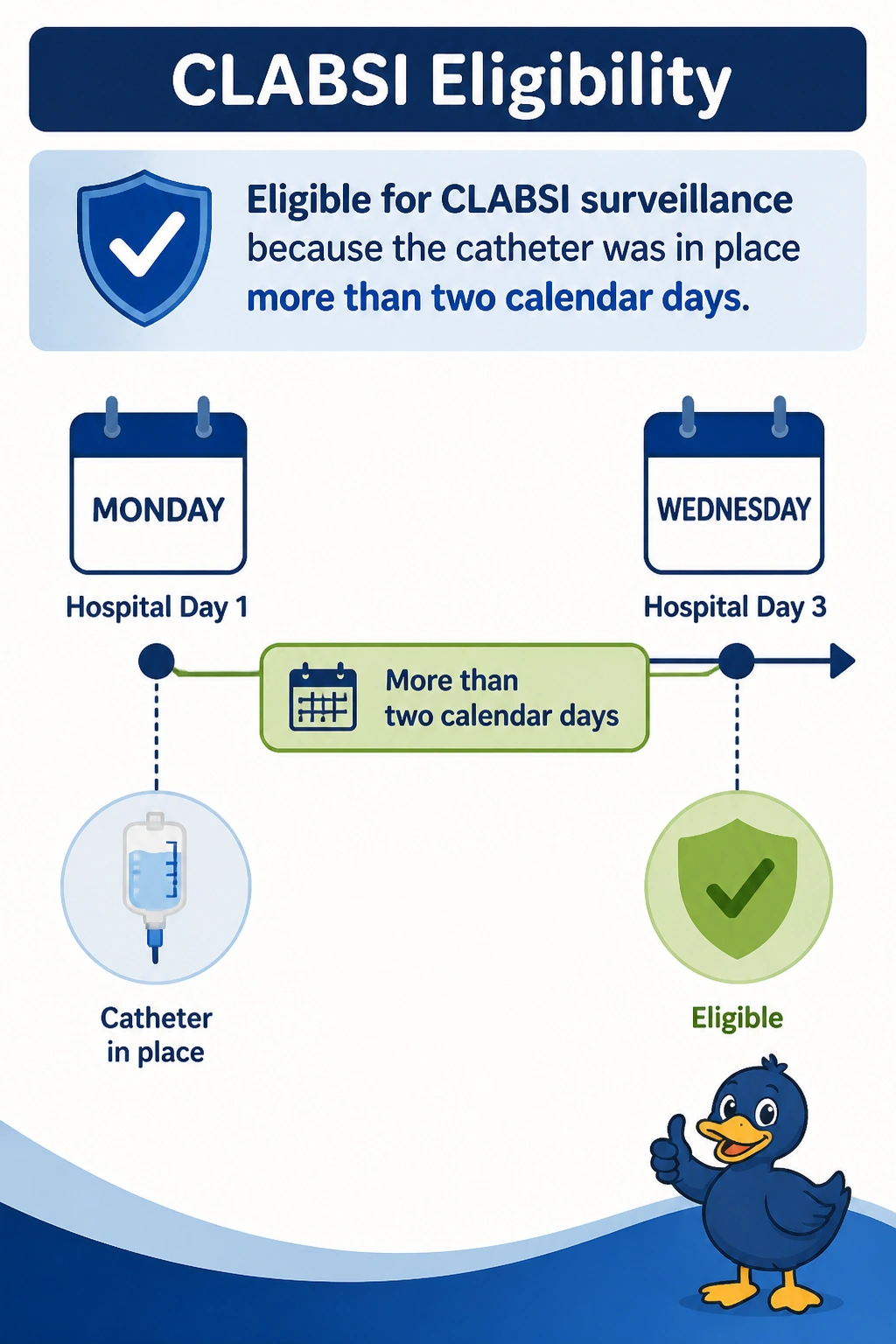
You can count from the first inpatient access day: Monday is day one, so Wednesday is day three. The key is that NHSN does not require a full 72 hours or seven days for CLABSI eligibility.
Full Explanation
Count eligible-line days from the first inpatient access during this admission, not merely from insertion; the line must meet NHSN eligibility and be present on the date of event or the preceding day. Here, the patient is eligible for CLABSI surveillance because the catheter was in place for more than two calendar days by Wednesday, hospital day 3, and the infection meets the healthcare-associated timeline. A seven-day minimum is not required: NHSN uses the greater-than-two-calendar-day threshold. The bloodstream infection is not classified as present on admission regardless of catheter duration; the event timing here is healthcare-associated. The POA timeframe includes the two days before admission, admission day, and the next day, so verify the actual date of event rather than relying on the culture date alone. Catheter days do not depend on the same lumen being accessed continuously: NHSN eligibility tracks the presence of any central line on consecutive calendar days, regardless of which lumen is accessed. As a caveat, if a central line is removed, it remains eligible for CLABSI attribution on the day of removal and the next calendar day. As a practical check, confirm the first inpatient access date, consecutive line presence, and NHSN date of event.
Prefer to study offline? Printable PDF study book + test engine ($7.50, unofficial). These questions stay free here.