
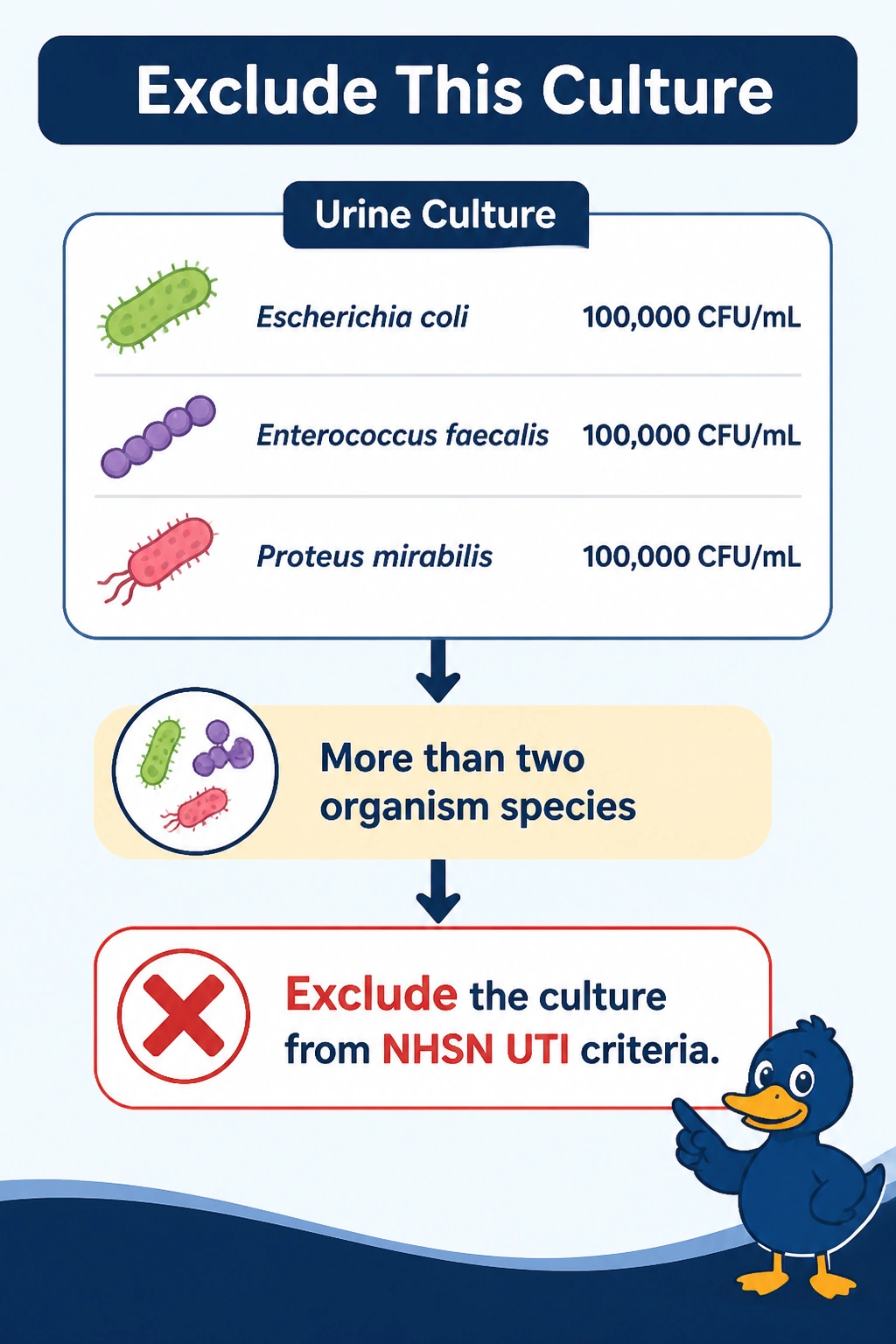
An adult intensive care unit patient with an indwelling urinary catheter for five days develops a fever of 38.6 degrees Celsius, and a urine culture grows 100,000 CFU/mL each of Escherichia coli, Enterococcus faecalis, and Proteus mirabilis. Under CDC NHSN surveillance definitions, how should the infection preventionist classify this culture?
Select an answer to reveal the explanation.
Short Explanation
Think of a urine culture with three or more bacteria like a crowded phone line where you cannot tell who is actually calling. The trap is assuming high colony counts automatically equal a reportable infection, even when the specimen fails basic NHSN eligibility.
Full Explanation
Under the CDC National Healthcare Safety Network (NHSN) Urinary Tract Infection surveillance protocol, a urine culture must contain no more than two species of organisms to be eligible for meeting symptomatic urinary tract infection or catheter-associated urinary tract infection criteria. When three or more species grow, the specimen is ineligible for this surveillance definition; clinically it may represent contamination or true polymicrobial bacteriuria and requires separate assessment. So the correct action is to Exclude the culture from NHSN UTI criteria because more than two organism species grew. You cannot Report a polymicrobial catheter-associated urinary tract infection using all three pathogens, because NHSN caps eligible urine cultures at two species regardless of colony count. Likewise, you cannot Assign a symptomatic urinary tract infection using only the predominant Gram-negative organism, because surveillance rules do not allow cherry-picking one organism from an ineligible culture. Finally, you would not Classify the event as asymptomatic bacteremic urinary tract infection if blood cultures are negative, since ABUTI requires a matching positive blood culture and an eligible urine culture with at most two species. Caveat: an ineligible urine culture does not prevent the clinical team from treating the patient or investigating another source for the fever during the Infection Window Period. Operational check: verify the microbiology report's organism count before entering any fever-paired urine result into NHSN.
Prefer to study offline? Printable PDF study book + test engine ($7.50, unofficial). These questions stay free here.