
An adult inpatient meets NHSN criteria for a catheter-associated urinary tract infection on hospital day 5 after a urine culture grows Escherichia coli. On hospital day 11, while the same urinary catheter remains in place, a repeat urine culture grows Enterococcus faecalis. Under NHSN surveillance rules, how should the day 11 culture be classified?
Select an answer to reveal the explanation.
Short Explanation
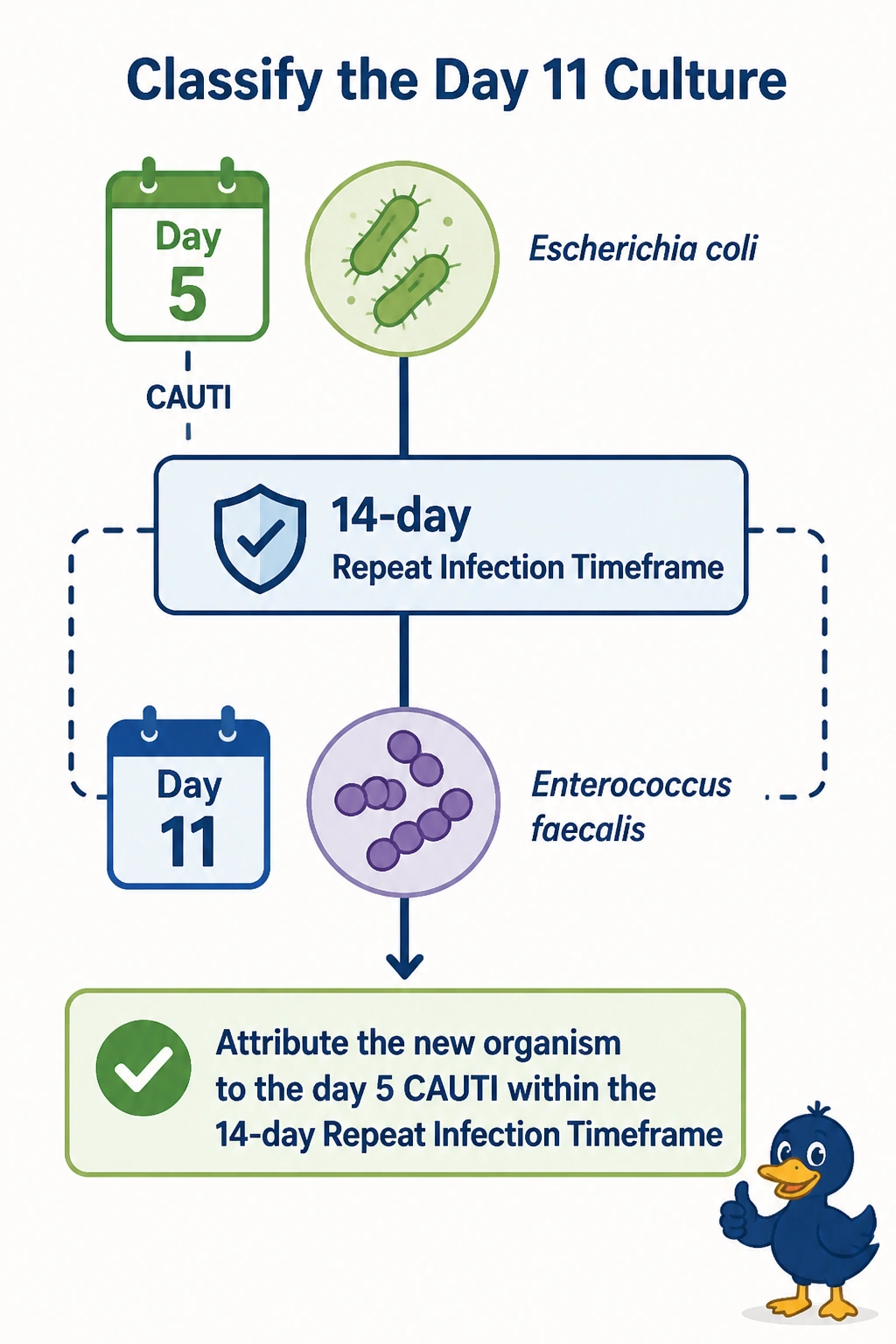
Think of the NHSN 14-day Repeat Infection Timeframe like a two-week umbrella over your patient's infection site: new bugs found underneath it join the original event rather than starting a fresh count. The trap is logging a second CAUTI just because a different organism grew on day 11. Keep both pathogens under the day 5 event so you do not double-count.
Full Explanation
Under NHSN surveillance rules, you must "Attribute the new organism to the day 5 CAUTI within the 14-day Repeat Infection Timeframe" because days 5 through 18 belong to the same site-specific Repeat Infection Timeframe, where day 5 is day 1 of the 14-day window. Additional pathogens meeting site criteria during that window are added to the original event rather than generating a new healthcare-associated infection. Choosing to "Report a second distinct CAUTI event because a different bacterial species was isolated on hospital day 11" would artificially inflate unit infection rates by double-counting within the same timeframe. Attempting to "Reset the infection window period to hospital day 11 and extend the original event by another two weeks" violates NHSN rules, because the 14-day Repeat Infection Timeframe is fixed from the date of event and does not reset when new organisms appear. Deciding to "Reclassify both cultures as asymptomatic bacteriuria because two organisms were identified" is incorrect because polymicrobial or sequential organisms within an active event do not erase the documented day 5 infection. As a surveillance caveat, the Repeat Infection Timeframe applies per infection type, so a new bloodstream or surgical site infection could still be evaluated separately if criteria are met. For an operational check, verify the date of event on your surveillance worksheet before entering secondary pathogens in NHSN.
Prefer to study offline? Printable PDF study book + test engine ($7.50, unofficial). These questions stay free here.