
A community hospital's infection preventionist drafts a new hospital-wide central line maintenance policy after rising CLABSI rates, but surgical and critical care units continue using different legacy protocols because no governing body has formally approved or enforced the change. What governance action should the infection preventionist take to establish consistent facility-wide adherence?
Select an answer to reveal the explanation.
Short Explanation
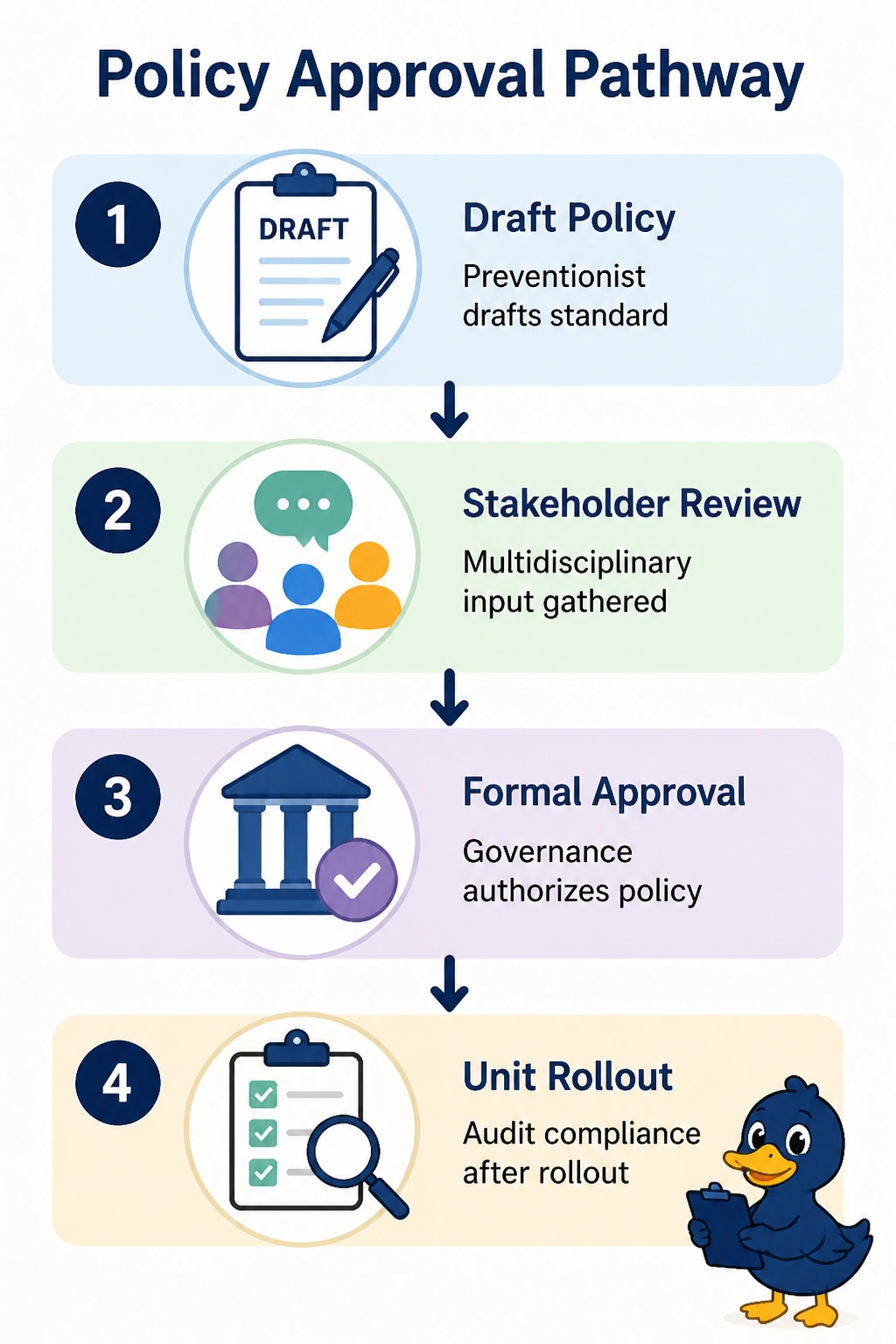
Think of a hospital policy like traffic laws: if every neighborhood writes its own rules, collisions follow. When you route a policy through the facility’s multidisciplinary infection-control and designated policy-approval process, it gains the organizational authority needed for consistent adoption across units. The trap is assuming that emailing nurses or collecting breakroom signatures creates enforceable standards without formal governance.
Full Explanation
To establish consistent practice across clinical departments, infection prevention policies must be vetted and approved through formal organizational governance. Choosing to Submit the policy through the facility’s multidisciplinary infection-control and designated policy-approval process for formal adoption engages medical staff, nursing, and executive leaders who have the authority to standardize workflows, allocate resources, and hold units accountable, with final approval authority depending on hospital governance rather than universally belonging to an infection-control committee. By contrast, deciding to Distribute the revised policy directly to unit charge nurses by email without formal committee review bypasses stakeholder vetting and lacks administrative enforcement. Opting to Allow each clinical department to maintain its legacy protocol whenever unit managers prefer local autonomy fragments care and perpetuates the exact variation driving inconsistent outcomes. Similarly, choosing to Post the draft policy in clinical breakrooms and ask bedside staff to sign a voluntary acknowledgment log treats an institutional standard as optional awareness rather than a mandatory clinical expectation. Committee approval alone does not change bedside practice without leader accountability and workflow integration. For an operational check, review minutes for approval dates and audit compliance 30 days after rollout.
Prefer to study offline? Printable PDF study book + test engine ($7.50, unofficial). These questions stay free here.