
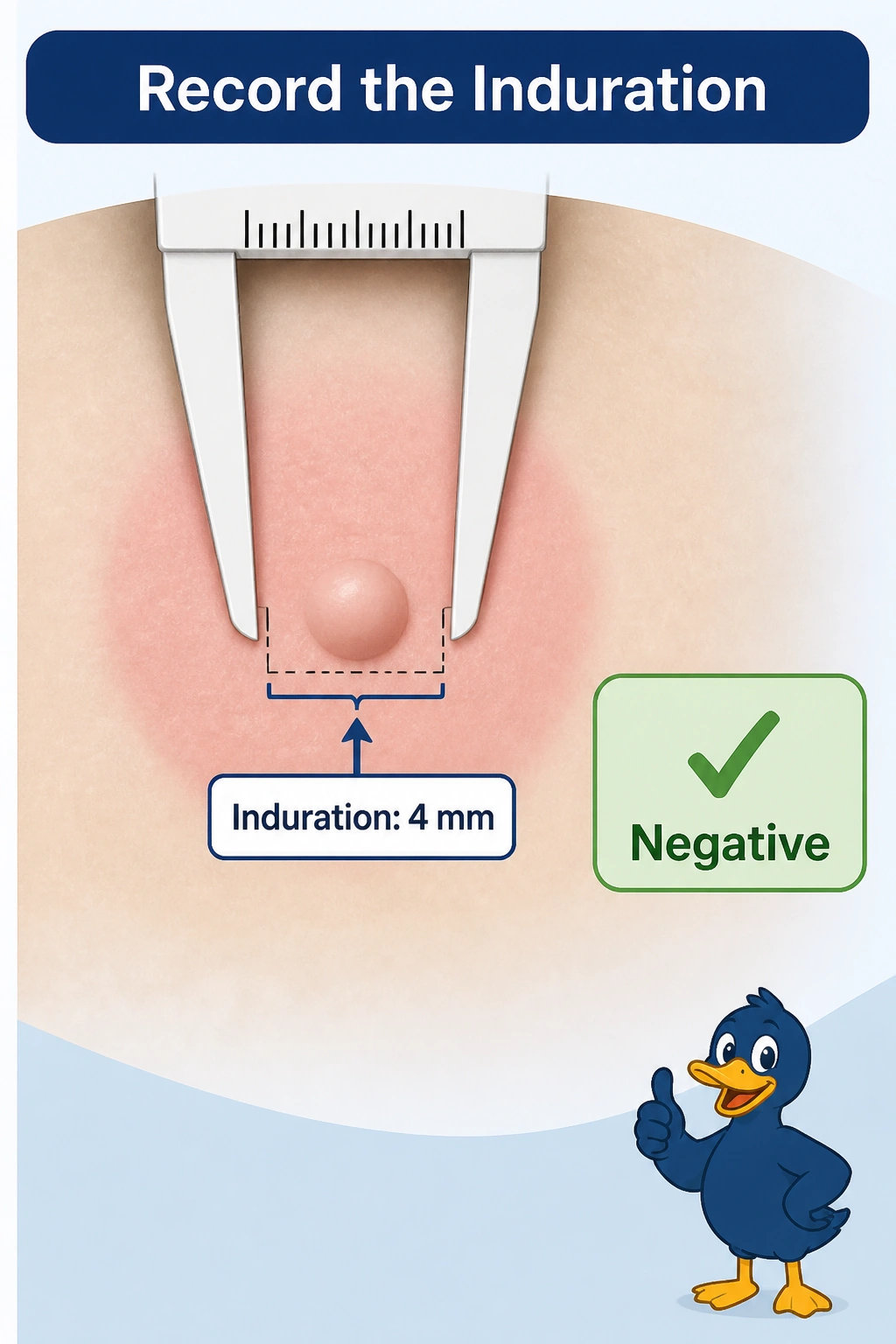
Forty-eight hours after placing a tuberculin skin test on a healthcare worker, an occupational health nurse observes a 22-millimeter area of surrounding redness (erythema) with a firm, raised central bump (induration) measuring 4 millimeters in transverse diameter. How should the nurse record and interpret this result?
Select an answer to reveal the explanation.
Short Explanation
When reading a tuberculin skin test, redness is just background noise—your ruler only cares about the firm, raised bump underneath. You measure the transverse induration in millimeters and ignore the surrounding erythema completely. The trap is letting a dramatic 22-millimeter ring of redness trick you into calling a 4-millimeter negative test positive.
Full Explanation
CDC tuberculosis testing guidelines specify that clinicians must Measure only the 4-millimeter transverse induration and record it as negative for this worker because induration—the palpable, raised, hardened area—reflects the delayed-type hypersensitivity response, whereas erythema does not. At 4 millimeters, the induration falls below every standard CDC positivity threshold, including the 5-millimeter cutoff used for highest-risk contacts and immunocompromised individuals. Choosing to Measure the 22-millimeter area of erythema and record the test as positive for latent infection misinterprets nonspecific skin flushing as immune reactivity, leading to unnecessary chest imaging and treatment. Trying to Average the 22-millimeter erythema and 4-millimeter induration to record a 13-millimeter result invents a nonexistent calculation that distorts clinical interpretation. Deciding to Repeat the skin test immediately on the opposite forearm because erythema invalidates the reading is unnecessary because surrounding redness is a common, benign finding that does not invalidate a properly placed test. One caveat is that a tuberculin skin test must be read within 48 to 72 hours of placement, and exact millimeter measurements—not just 'positive' or 'negative'—should be documented. As an operational check, train occupational health staff to palpate across the forearm perpendicular to its long axis with a ballpoint pen or fingertips before measuring.
Prefer to study offline? Printable PDF study book + test engine ($7.50, unofficial). These questions stay free here.