
A hospital epidemiologist briefs clinical leaders on why a novel influenza A virus emerging from animal reservoirs can trigger a global pandemic in an immunologically naive population, whereas seasonal influenza viruses cause annual epidemics. Sequencing shows genome segments derived from different influenza A lineages. Which viral mechanism explains pandemic emergence?
Select an answer to reveal the explanation.
Short Explanation
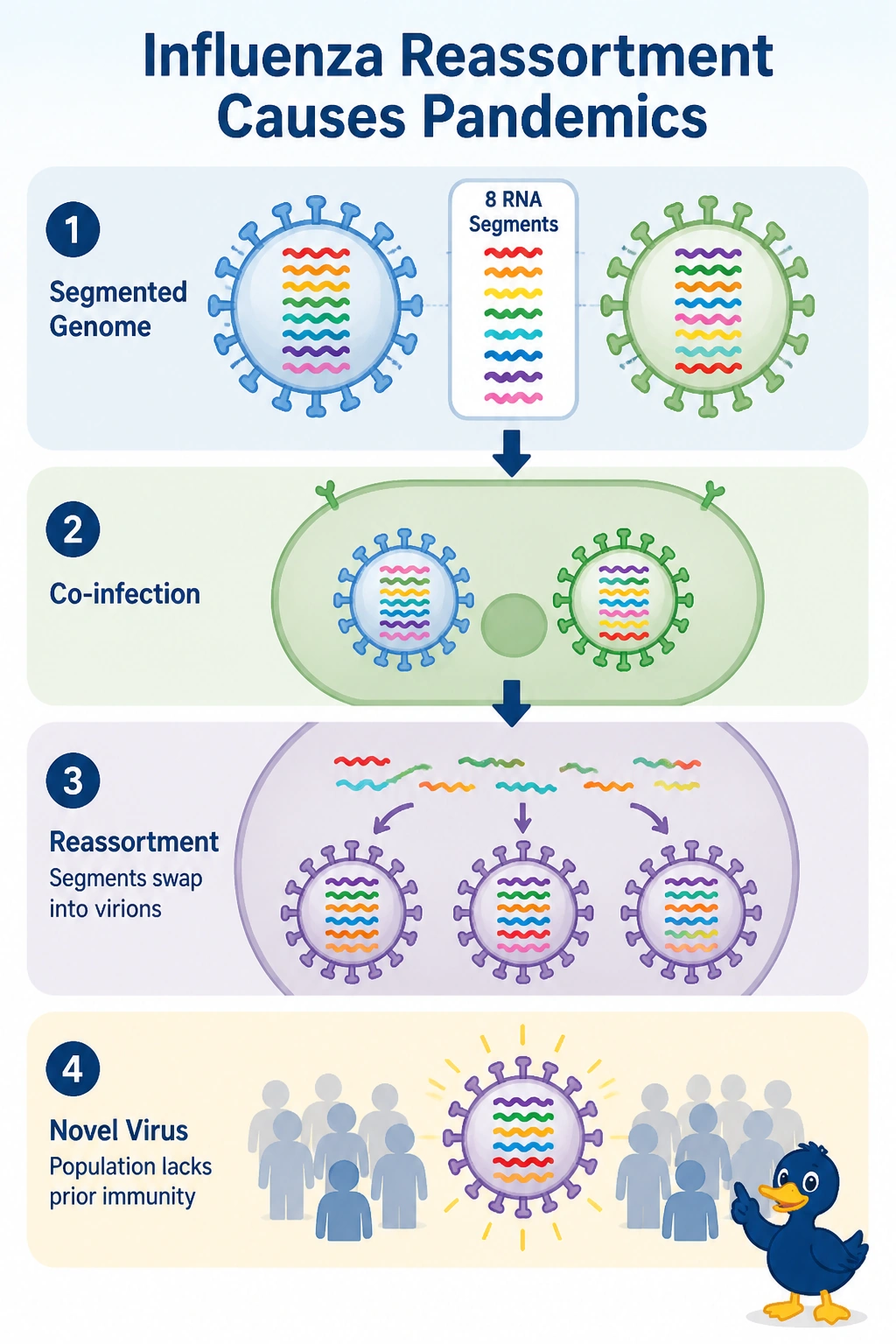
You can picture reassortment as two influenza A viruses swapping whole genome segments, creating a novel virus that an immunologically naive population may have little immunity to. Don’t confuse this sudden change with gradual point mutations in hemagglutinin and neuraminidase within a single strain, which contribute to seasonal epidemics and vaccine updates.
Full Explanation
Influenza A has an eight-segment negative-sense RNA genome. When two distinct strains co-infect a host cell, they can exchange entire segments through genetic reassortment, creating a new combination of influenza A genes that an immunologically naive population may not recognize. Animal reservoirs can provide the lineages involved, and animal-origin viruses can adapt to infect humans. Gradual point mutations in hemagglutinin and neuraminidase within a single human influenza strain describe antigenic drift, which supports seasonal epidemics and partial immune escape; they do not explain the mixed segment origins shown by sequencing. Horizontal transfer of plasmid-encoded resistance genes between respiratory bacteria and viruses is not the mechanism, because influenza viruses do not exchange bacterial plasmids. Activation of latent proviral influenza DNA integrated into host respiratory epithelial cells also cannot explain emergence: influenza is an RNA virus that replicates without integrating proviral DNA into the host genome. One caveat is that novel antigenicity does not require a previously unseen hemagglutinin/neuraminidase subtype number. In practice, monitor public health alerts for novel influenza A subtypes and update triage screening for travel and animal exposure.
Prefer to study offline? Printable PDF study book + test engine ($7.50, unofficial). These questions stay free here.