
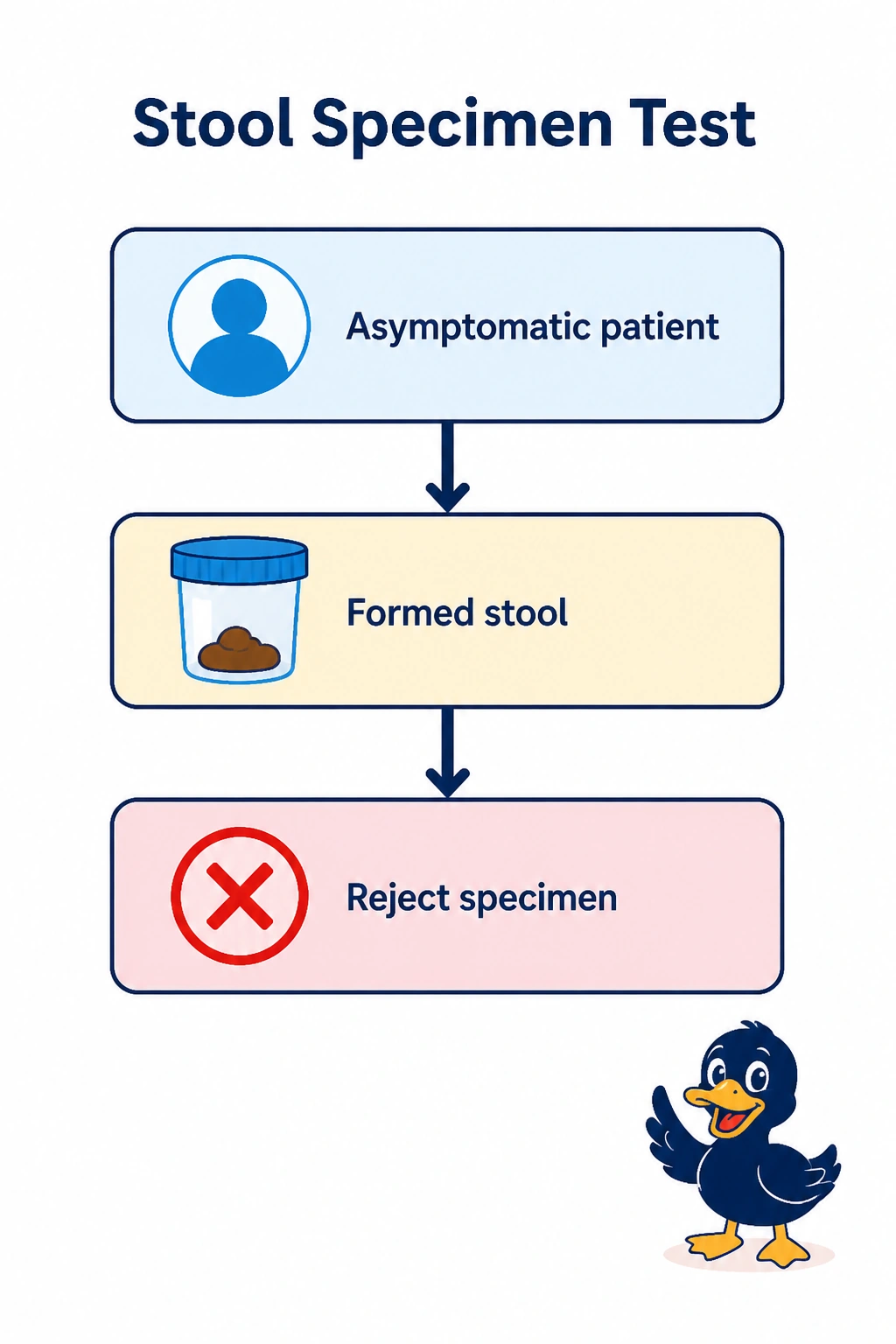
A nurse on a general medicine ward collects a formed stool specimen from an asymptomatic patient receiving broad-spectrum antibiotics and sends it to the laboratory for Clostridioides difficile testing. Why should the laboratory reject this specimen?
Select an answer to reveal the explanation.
Short Explanation
Testing a solid stool for C. diff is like pulling a fire alarm when there is no smoke: you will catch harmless colonization and trigger unneeded antibiotics. The trap is thinking early screening helps, when guidelines restrict testing strictly to unformed stools.
Full Explanation
Do not test asymptomatic patients routinely; suspected ileus/toxic megacolon requires clinician–laboratory consultation about appropriate validated testing, and formed stool may be accepted in that specific symptomatic exception. Choosing to Reject the formed stool because testing may identify asymptomatic colonization rather than disease prevents false attribution of active disease, unnecessary isolation, and inappropriate antimicrobial therapy. Choosing to Process the formed stool with a reflex EIA test to rule out early carrier status violates diagnostic stewardship, because asymptomatic carriage does not warrant treatment or routine screening. Choosing to Culture the formed stool on selective media to confirm toxin production directly is flawed because routine culture alone identifies organism presence rather than in vivo toxin disease and should not be run on formed stool. Choosing to Hold the formed stool at room temperature for 24 hours before running a NAAT assay degrades specimen integrity and still tests an inappropriate formed sample. For an operational check, audit microbiology rejection logs weekly to ensure automated laboratory criteria block testing on formed stools.
Prefer to study offline? Printable PDF study book + test engine ($7.50, unofficial). These questions stay free here.