
An infection preventionist helps an ambulatory infusion clinic redesign discharge education for patients going home with peripherally inserted central catheters. Which educational strategy best verifies that patients and caregivers can safely perform home catheter care?
Select an answer to reveal the explanation.
Short Explanation
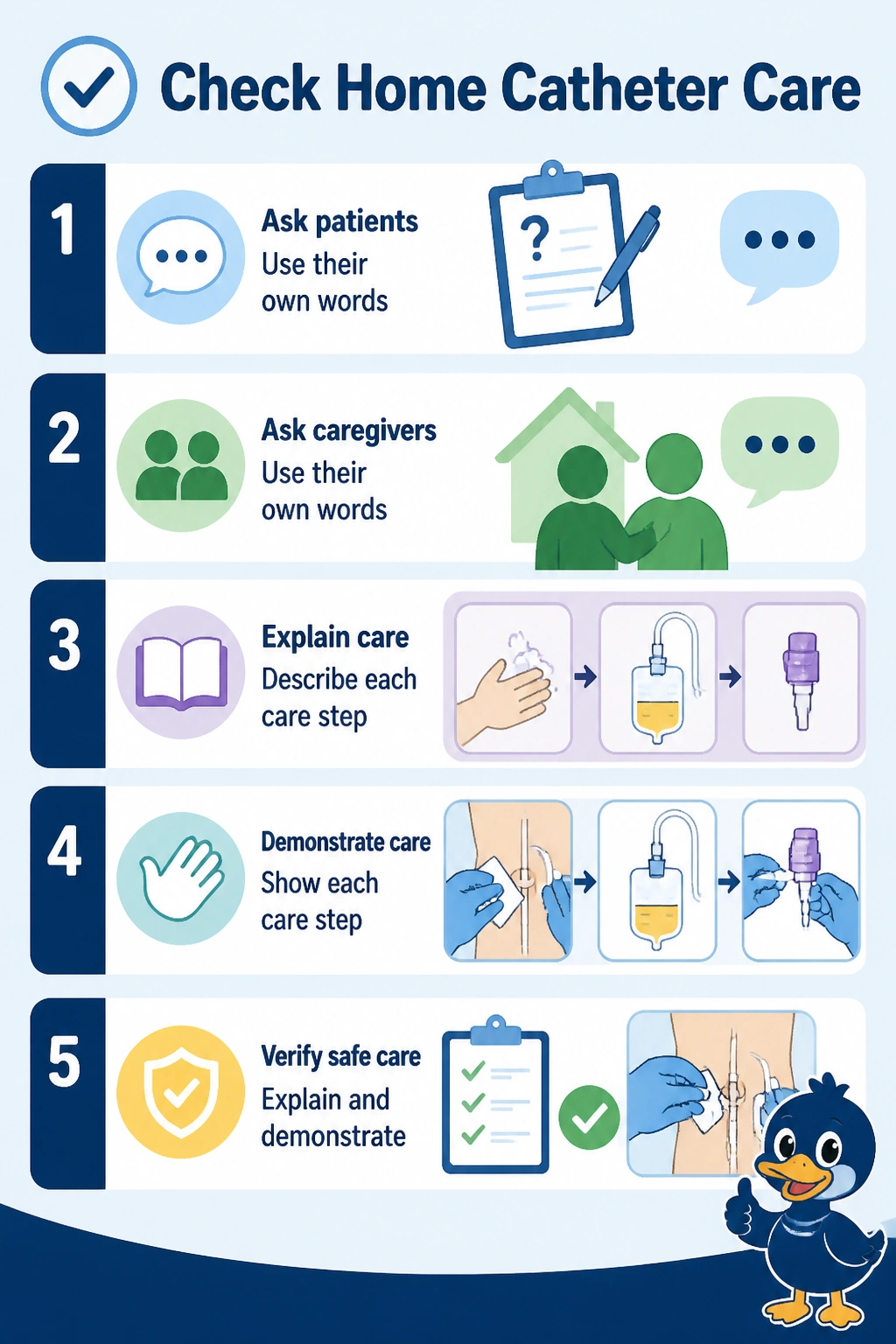
A college-level booklet, a question about whether you have questions, or a video can leave gaps in understanding, even when you want to do things correctly. With teach-back, you explain and demonstrate the catheter-care steps in your own words, so your care team can spot and correct mistakes before you go home.
Full Explanation
To verify that you and your caregiver can perform home catheter care safely, ask you to explain and demonstrate the steps in your own words using teach-back. This checks both understanding and practical skill in real time, allowing the educator to correct missed steps, such as hub disinfection or hand hygiene, before discharge. A detailed printed booklet written at a college reading level may overwhelm you with complex language, and reading alone does not demonstrate skill mastery. Asking whether you have any questions before signing the discharge form is not a reliable check: you may say no out of politeness, fatigue, or uncertainty about what to ask. Playing a recorded instructional video during the final five minutes of the visit provides passive information at a rushed moment and does not confirm that you or your caregiver can perform aseptic steps. One caveat is to frame teach-back as a check on how clearly the clinician explained the material, not as a test of you. A practical check is to add a documented return-demonstration checklist to the discharge workflow and audit completion rates alongside home-infusion bloodstream infection trends.
Prefer to study offline? Printable PDF study book + test engine ($7.50, unofficial). These questions stay free here.