
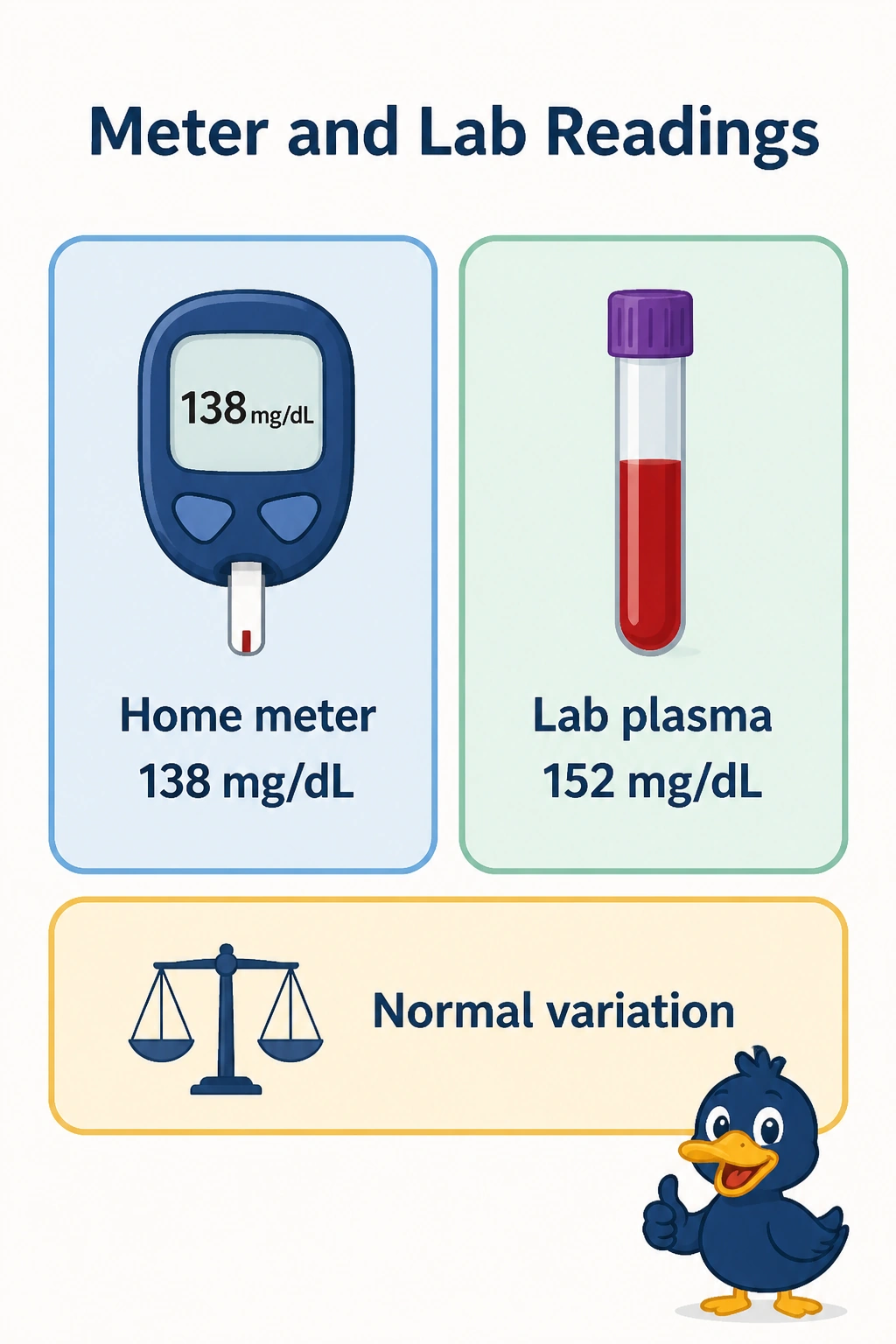
A 55-year-old woman with type 2 diabetes brings her home meter to clinic because it read 138 mg/dL right before a fasting blood draw that returned a laboratory plasma glucose of 152 mg/dL, and she worries her meter is broken. Which explanation should the diabetes care and education specialist provide?
Select an answer to reveal the explanation.
Short Explanation
Your home meter and a laboratory venous plasma test can normally differ within accepted accuracy standards, so this 14 mg/dL gap alone does not mean your meter is broken. You don’t need every result to match within 5% or to recalibrate to one lab result, and a fingerstick does not always read higher than a venous draw.
Full Explanation
The meter reading of 138 mg/dL and laboratory result of 152 mg/dL differ by 14 mg/dL, or roughly 9%, which is consistent with accepted accuracy tolerances for FDA-cleared home blood glucose meters compared with laboratory reference methods. Home meters and laboratory venous plasma tests can normally differ within those standards, although this single paired comparison does not establish overall meter accuracy. Requiring agreement within 5% with every laboratory result sets an unrealistic standard for home-meter accuracy. Claiming that capillary fingerstick checks always read higher than venous laboratory draws is inaccurate: fasting capillary and venous levels are often similar, while postprandial capillary readings tend to be higher. Recalibrating a meter to match one laboratory result is not appropriate; patients do not adjust meters to a single value. Sample source differences between capillary and venous blood, hematocrit, and timing can also contribute to minor variance. As an exam caveat, suspect true meter inaccuracy if readings conflict sharply with symptoms or vary wildly on repeat checks. For a practical check, repeat the measurement and compare it with a laboratory result obtained at the same time, following the meter’s instructions.
Prefer to study offline? Printable PDF study book + test engine ($7.50, unofficial). These questions stay free here.