
A 56-year-old woman with type 2 diabetes and moderately increased albuminuria has a history of hypertension, now controlled, and persistent UACR 30–299 mg/g. Her blood pressure is 128/78 mm Hg and she asks why her clinician prescribed an ACE inhibitor when her blood pressure is not severely elevated. Which explanation should the diabetes care and education specialist provide?
Select an answer to reveal the explanation.
Short Explanation
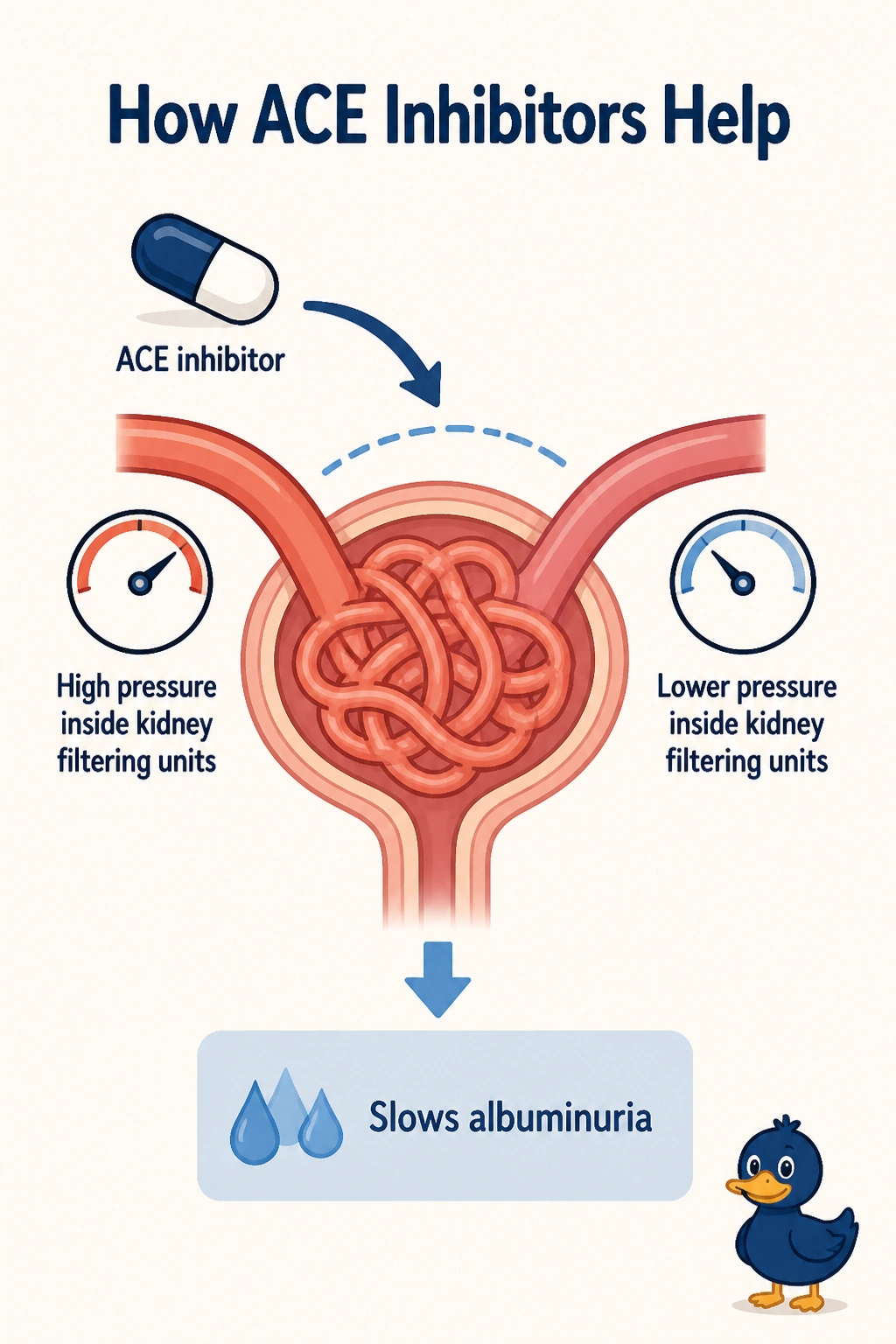
Think of an ACE inhibitor like a pressure-relief valve protecting delicate water filters from wear and tear. The trap is assuming these medications only treat high blood pressure readings, so you should explain their direct kidney-protective role.
Full Explanation
In a patient with diabetes, hypertension, and persistent albuminuria, elevated intraglomerular pressure accelerates glomerular damage and protein leakage even when clinic blood pressure appears controlled. Explaining that "It reduces pressure inside kidney filtering units to slow albuminuria" helps the patient understand why an ACE inhibitor is continued for renal protection in the setting of hypertension with UACR 30–299 mg/g. Claiming that "It directly lowers blood glucose by increasing renal glucose excretion in urine" confuses ACE inhibitors with SGLT2 inhibitors, which act on proximal tubular glucose reabsorption. Stating that "It compensates for declining filtration by increasing intraglomerular pressure" reverses the hemodynamic effect, since ACE inhibitors lower efferent arteriolar tone and intraglomerular pressure rather than raising it to boost filtration. Suggesting that "It prevents acute urinary tract infections that commonly damage the kidneys" misrepresents the vascular mechanism and does not explain albuminuria management. As a clinical caveat, patients starting or titrating an ACE inhibitor should be advised to report persistent dry cough, dizziness, or pregnancy plans promptly, as these agents are contraindicated in pregnancy. For an operational check, confirm that baseline and follow-up serum creatinine and potassium after initiation/titration plus urine albumin-to-creatinine ratio labs are scheduled.
Prefer to study offline? Printable PDF study book + test engine ($7.50, unofficial). These questions stay free here.