
A 38-year-old man with type 1 diabetes who uses an insulin pump and a continuous glucose monitor is scheduled for an outpatient magnetic resonance imaging (MRI) scan of his knee. Which safety instruction should the diabetes care and education specialist provide before the imaging appointment?
Select an answer to reveal the explanation.
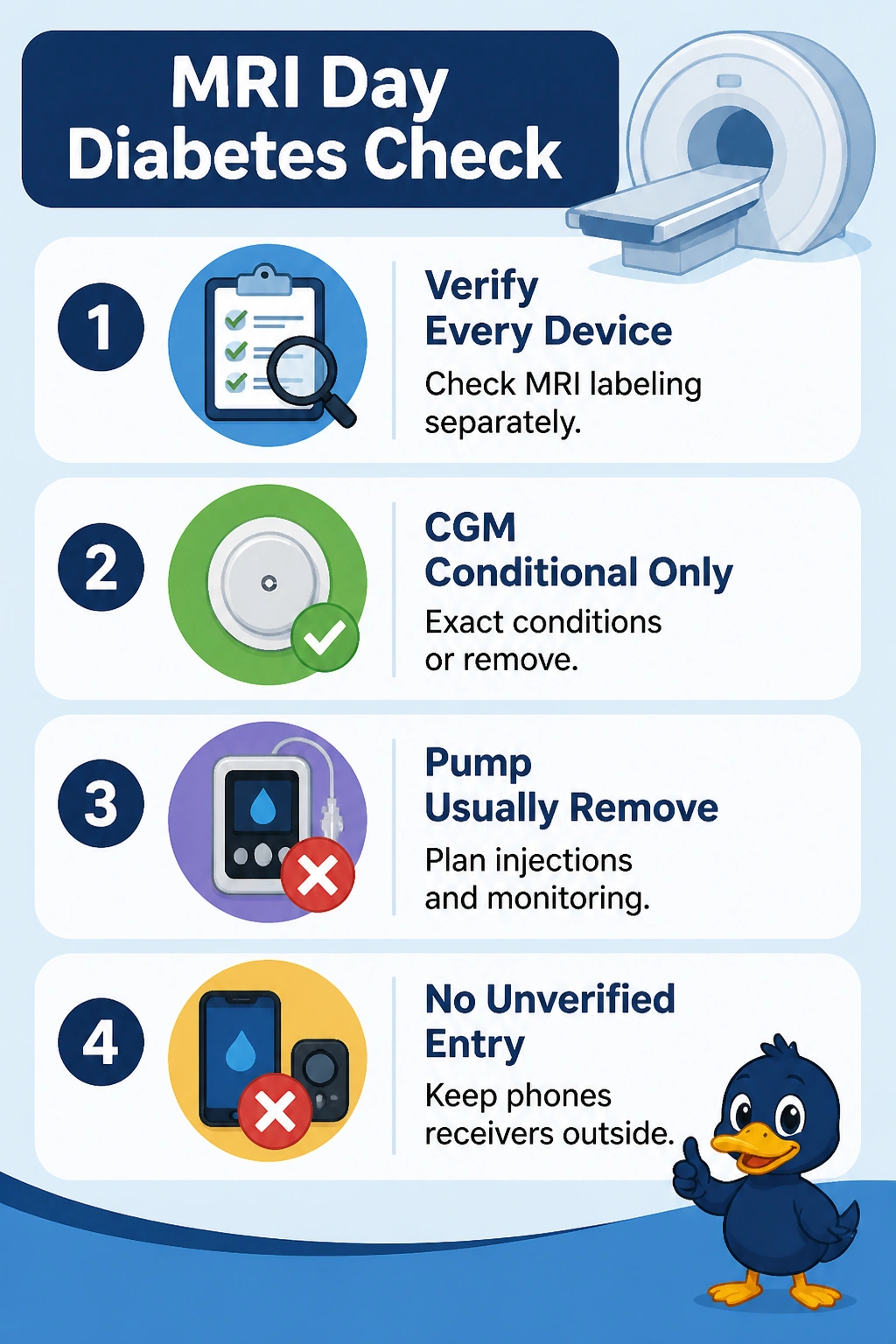
Short Explanation
Think of an MRI scanner as a giant magnet that can damage diabetes devices, so you verify each device with the imaging team and plan backups. Some CGMs may remain only under their exact MR Conditional conditions; pumps, transmitters, receivers and phones require separate checks. Do not enter the MRI environment with an unverified device.
Full Explanation
Strong magnetic fields and radiofrequency energy can damage electronics, heat metal, or exert force, so the correct instruction is to have the imaging team verify each device’s MRI labeling, remove devices not permitted and plan alternative insulin and glucose monitoring. Some CGMs may remain only under their exact MR Conditional conditions; pumps, transmitters, receivers and phones require separate checks. Do not enter the MRI environment with an unverified device. Choosing to switch to suspend mode and cover with lead fails because lead shields ionizing radiation, not magnetic fields, and a suspended pump and sensor remain vulnerable to malfunction and thermal injury. Advising to disconnect only infusion tubing while leaving the sensor in place is unsafe because the sensor filament, transmitter battery and electronics would still be exposed without verification. Assuming that a sensor’s MRI permission extends to the pump is incorrect because MRI safety labeling is device-specific and each pump, transmitter, receiver and phone needs its own check. Check ahead about temporary injection needs and confirm backup rapid-acting insulin, syringes or pens, meter, and spare sensor for afterward.
Prefer to study offline? Printable PDF study book + test engine ($7.50, unofficial). These questions stay free here.