
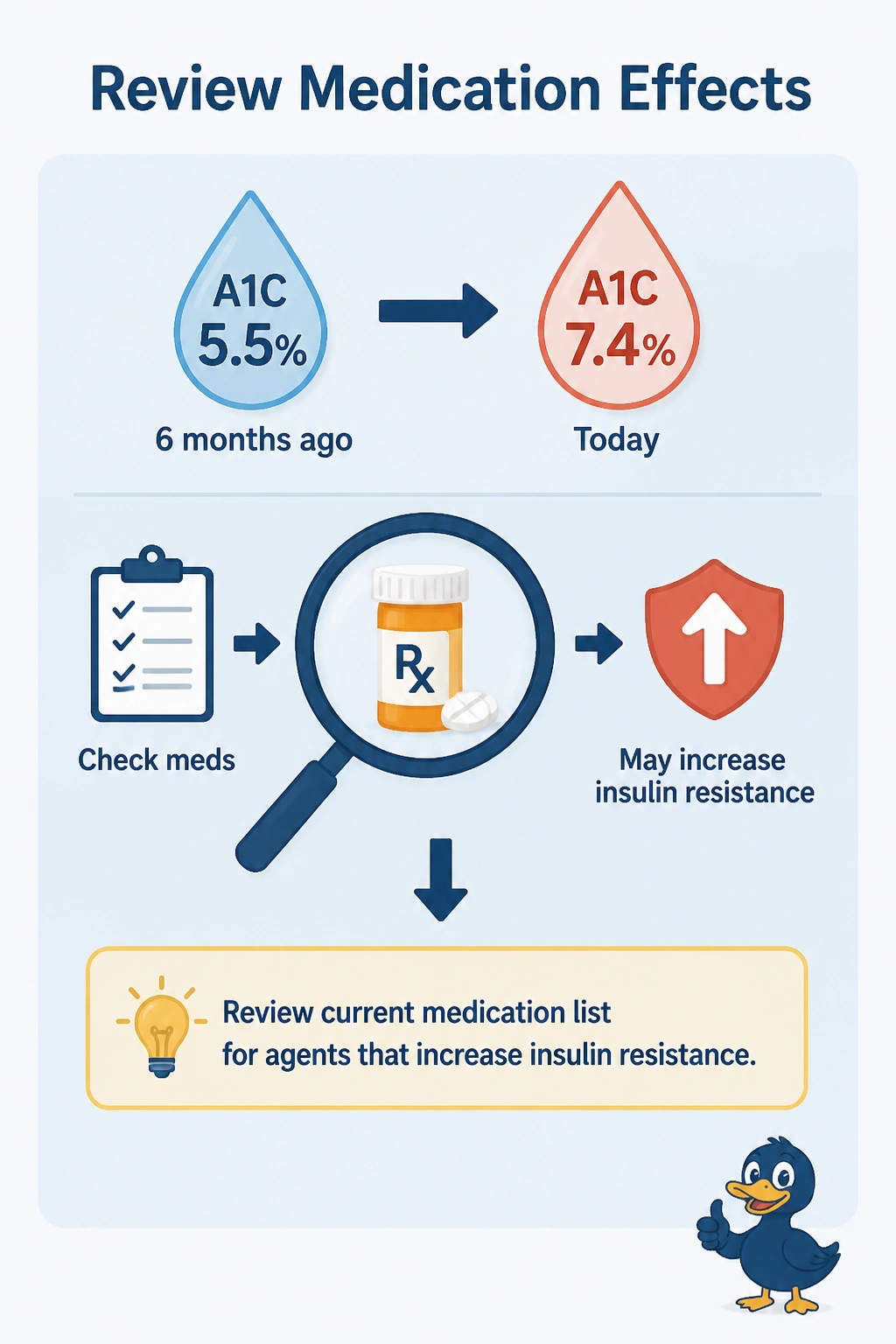
A 37-year-old man with no family history of diabetes presents for initial education after his A1C rose from 5.5% to 7.4% over six months, following a new psychiatric medication prescribed for bipolar disorder. Which assessment factor should the diabetes care and education specialist prioritize?
Select an answer to reveal the explanation.
Short Explanation
When a patient's A1C jumps right after starting a new prescription, you have a major clue sitting right in the timeline. Your priority is reviewing his current medication list for agents like atypical antipsychotics that drive weight gain and insulin resistance. Do not get sidetracked by blaming his meter or diet soda when a classic drug effect is staring at you.
Full Explanation
Prioritizing Reviewing his current medication list for agents that increase insulin resistance addresses the most likely driver of his rapid glycemic shift. Second-generation antipsychotics, glucocorticoids, and certain immunosuppressants can impair insulin signaling, stimulate appetite, and rapidly elevate blood glucose even without a family history of diabetes. Focusing on Screening his home blood glucose meter for calibration errors would not explain an elevated laboratory A1C, which reflects average glycemia over roughly three months independent of home meter accuracy. Focusing on Evaluating his intake of nonnutritive sweeteners in diet beverages overlooks a potent pharmacological trigger in favor of a minor dietary factor that does not cause a nearly two-point A1C surge. Focusing on Checking his urine for ketones to rule out latent autoimmune diabetes is misaligned with an asymptomatic, medication-timed presentation, though ketones remain vital if acute catabolic symptoms or severe hyperglycemia emerge. Urine ketones cannot rule out autoimmune diabetes; islet-autoantibody testing is used when classification is uncertain, and acute ketosis assessment has a different purpose. As an important caveat, never advise a patient to stop a psychiatric medication independently because abrupt discontinuation risks mood relapse; instead, collaborate with the prescriber. As an operational check, obtain a complete reconciled medication timeline and baseline weight trend before co-creating nutrition and activity goals.
Prefer to study offline? Printable PDF study book + test engine ($7.50, unofficial). These questions stay free here.