
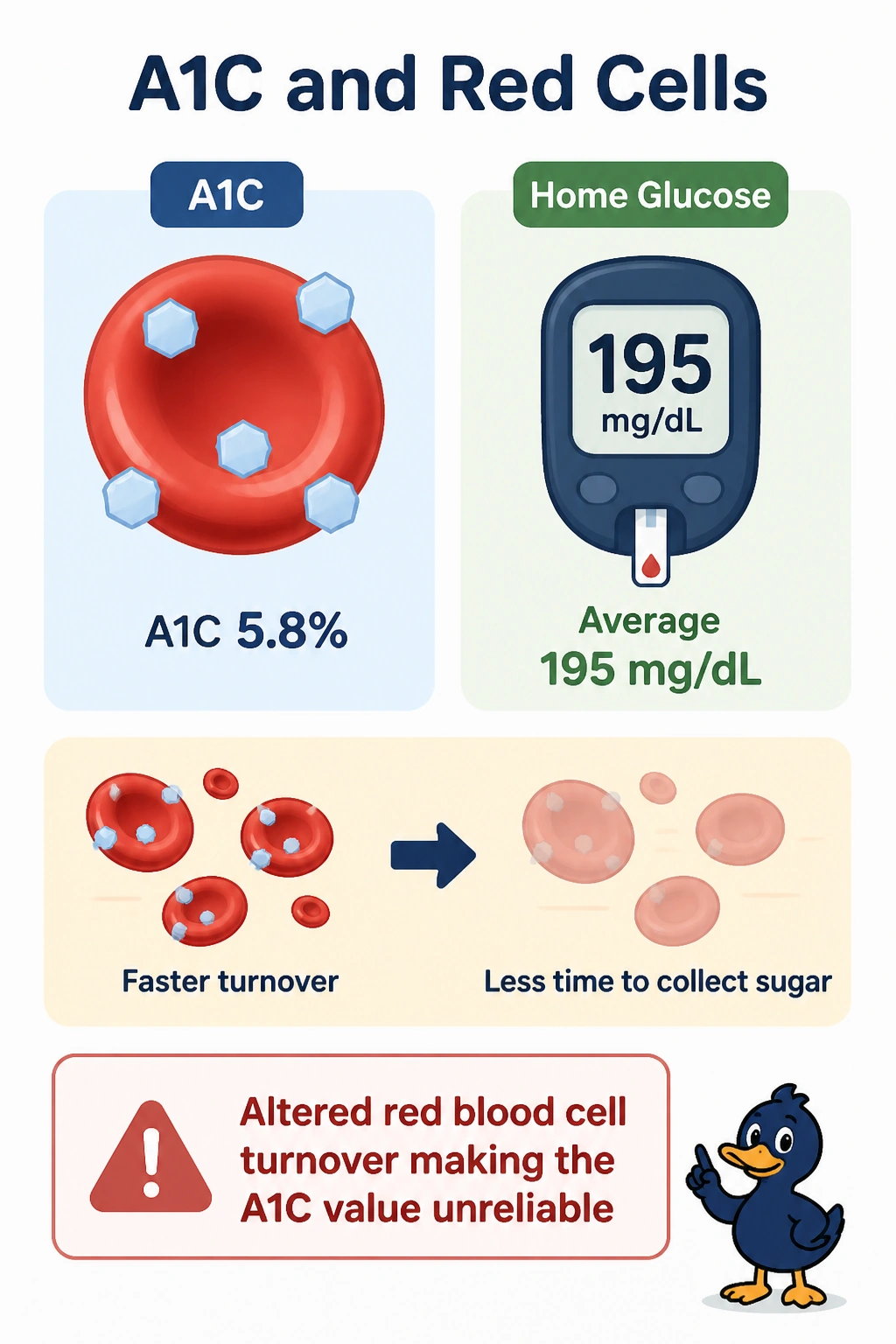
A 63-year-old woman with type 2 diabetes and chronic kidney disease recently received a blood transfusion for severe anemia, and her new A1C is 5.8% even though her home glucose meter averages 195 mg/dL. Which assessment factor explains this discrepancy?
Select an answer to reveal the explanation.
Short Explanation
A1C acts like a three-month highlight reel of your red blood cells, so when those cells are replaced early, the highlight reel gets cut short. Always check whether anemia, chronic kidney disease, or a recent transfusion is skewing the lab before trusting a surprisingly low A1C. The trap is assuming the home meter is broken when the A1C is actually the misleading number.
Full Explanation
Altered red blood cell turnover making the A1C value unreliable explains why an A1C of 5.8% conflicts with a meter average of 195 mg/dL. A1C reflects average glycemia over the lifespan of circulating red blood cells. Transfusion alters the circulating red-cell population and can raise or lower A1C; interpret this discordant result cautiously using glucose data. Hemolysis, blood loss, or erythropoietin therapy similarly shortens red cell exposure to glucose and makes A1C unreliable in chronic kidney disease and anemia. Delayed postprandial glucose absorption caused by reduced kidney clearance is incorrect because chronic kidney disease does not create a sustained mismatch between capillary glucose and A1C through gut absorption. Overestimation of fingerstick values from using capillary whole blood is inaccurate because modern glucose meters are plasma-calibrated and do not systematically inflate averages to 195 mg/dL. Recent improvement in endogenous insulin secretion as the main explanation for both measurements fails because improved secretion would lower meter glucose and A1C together, not produce a low A1C alongside persistent hyperglycemia on self-monitoring. As an exam caveat, whenever A1C and self-monitoring disagree sharply, evaluate hemoglobin, red cell lifespan, and transfusion history and rely on CGM or structured BGM metrics.
Prefer to study offline? Printable PDF study book + test engine ($7.50, unofficial). These questions stay free here.