
To enable Watson OpenScale's quality monitors to measure a model's real-world accuracy over time using labeled production outcomes, what must be configured within the model's subscription?
Select an answer to reveal the explanation.
Short Explanation and Infographic
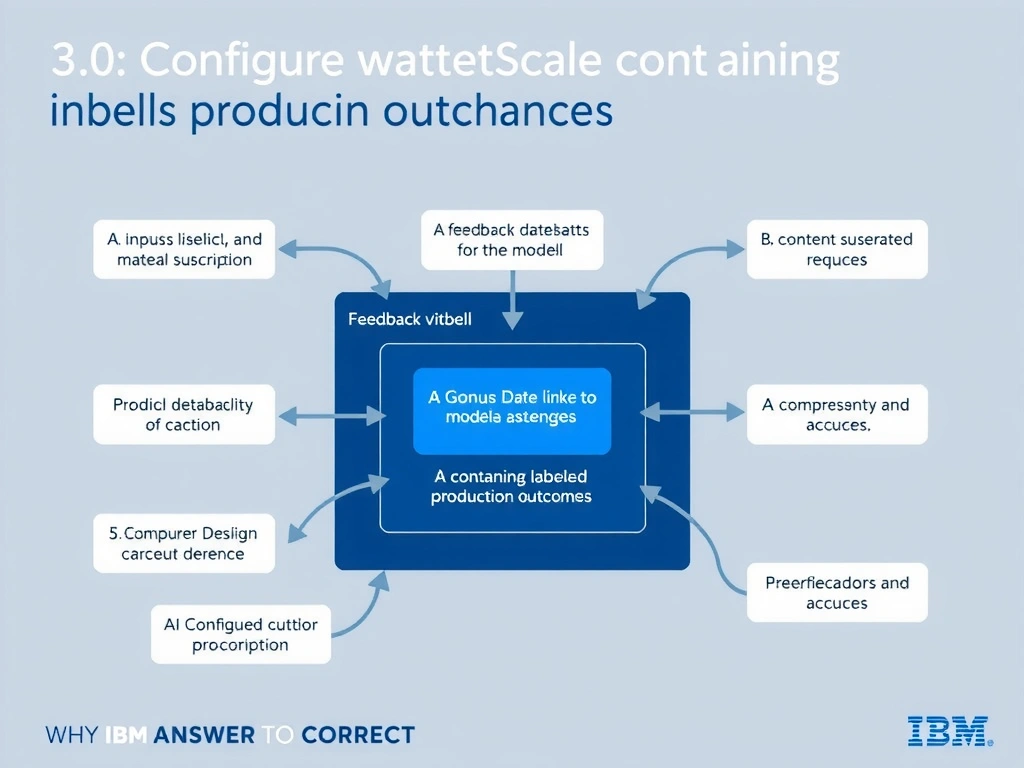
Think of it this way: in real-world AI governance, a feedback dataset linked to the model's openscale subscription containing labeled production outcomes is exactly what teams reach for when they need to handle this scenario. Watson OpenScale quality monitors compare deployed model predictions against actual ground-truth outcomes to calculate accuracy, recall, precision, and F1 metrics. On the exam, remember that this falls squarely under the 3.0 Configure watsonx.governance domain.
Full explanation below image
Full Explanation
Watson OpenScale quality monitors compare deployed model predictions against actual ground-truth outcomes to calculate accuracy, recall, precision, and F1 metrics. To enable this, a feedback dataset must be configured in the subscription and periodically populated with labeled production records that OpenScale ingests during scheduled monitoring runs. The correct answer, "A feedback dataset linked to the model's OpenScale subscription containing labeled production outcomes", directly addresses the scenario described because it aligns with the specific governance requirement in question. The incorrect options ("A drift detection baseline archive in Cloud Object Storage", "A Watson Machine Learning retraining pipeline triggered when the quality score drops below a threshold", "A questionnaire in OpenPages to collect user-reported accuracy ratings on model predictions") may seem plausible but do not satisfy the core requirement. Understanding the distinction between these concepts is critical for IBM watsonx.governance implementations and is frequently tested in the 3.0 Configure watsonx.governance section of the certification exam.